By Bill Bonner
The Occupy Wall Street movement is getting a fair amount of press. The movement, as you know, dear reader, is a loose assembly of the jobless, the homeless and the shiftless. Troublemakers, every one of them, with no coherent or sensible view of what is wrong or how to fix it. But what’s wrong with that?
The Occupy Wall Street protests started on Sept. 17 with a few dozen demonstrators who tried to pitch tents in front of the New York Stock Exchange. Since then, hundreds have set up camp in a park nearby and have become increasingly organized, lining up medical aid and legal help and printing their own newspaper, the Occupied Wall Street Journal.
About 100 demonstrators were arrested on Sept. 24 and some were pepper-sprayed. On Saturday police arrested 700 on charges of disorderly conduct and blocking a public street as they tried to march over the Brooklyn Bridge. Police said they took five more protesters into custody on Monday, though it was unclear whether they had been charged with any crime.
On Monday, the zombies stayed on the sidewalks as they wound through Manhattan’s financial district chanting, “How to fix the deficit: End the war, tax the rich!” They lurched along with their arms in front of them. Some yelled, “I smell money!”
The US is probably getting ready for a revolution. Back in the Cold War days, the CIA was asked to do a portrait of a country that might have a revolution. It decided that such a country would have three characteristics:
A big gap between rich and poor.
A middle class that was disappearing...or one that never existed in the first place.
A lot of people with a grudge.
The US fits each of these criteria. And then some others the spooks hadn’t thought about. The U6 broad measure of unemployment is going up...with 16.5% of the population without work. There are 6.2 million people who have been looking for a job for more than 6 months.
Americans are $7 trillion poorer, according to David Rosenberg, than they were 4 years ago — and property prices are still going down.
Yes, there’s also a Great Correction in progress. It, along with the policies of the US government, grind the faces of the poor.
Millions of marginally successful people think the system has failed them. Youth joblessness is at Great Depression levels. More than 45 million are on food stamps.
People come to think what they must think when they must think it. So, a person who feels he has failed must come to terms with it. He must find a reason that gets himself off the hook. It must be someone else’s fault.
It was not his fault he failed his chemistry exam. The ‘system’ should provide him with a good job anyway. It was not his fault his house got taken away; the system caused prices to fall...and his job got exported to Mumbai. It was not his fault he didn’t save any money; the banks took advantage of him mercilessly. He may even get a “deficiency notice” — telling him he has to pay the bank for its loss on his foreclosed house.
Add insult to injury, why don’t you!
The guy has a legitimate beef!
It wasn’t his fault that the Nixon administration cut the link to gold in 1971. It wasn’t his fault the Chinese produced things better and cheaper. It wasn’t his fault that the feds kept stimulating the economy...and encouraging him to go deeper and deeper into debt at artificially low interest rates. And it certainly wasn’t he who caused the housing bubble to blow up...or who caused it in the first place.
But one thing you can depend on. Not many people will do the hard work of connecting the kneebone of this disaster to the legbone that caused it. And he won’t want to make the sacrifices necessary to protect himself from it either. (Our advice: cut expenses to almost zero...save money...buy gold...become a bankruptcy lawyer.) Instead, he’ll join the revolution.
Of course, people do not join revolutions for good reasons. They join them for bad ones. They expect miracles. One wants free money. The other wants power. One wants to see his brother-in-law, who earns big money as a currency trader at JPMorgan, brought low. Another just wants to get high. One expects his mortgage to disappear. Another wants the whole neighborhood to disappear. One hopes to see his dead wife rise from the grave...the other hopes his live wife will fall into it.
One believes the bankers are rich and evil. Another believes the oil companies are rich and evil. A third thinks all rich people are evil. And a fourth believes that all people are evil, even those in the Occupy Wall Street movement.
Some want to save porpoises. Some want people to use only natural deodorant. And a third thinks the world uses too much oil...and that only people who drive Priuses should be allowed on the road on Sunday. He owns a Prius dealership.
It is fun to mock the protestors. That’s why we do it. They are such easy targets.
But here at The Daily Reckoning we always stand with the powerless, the aimless and the witless. We are champions of the underdog...the lost cause and the diehard. So, we lock arms with the protestors and pledge our solidarity.
Vive la revolution!
But the poor protestors are just victims of history. When the US embraced its empire it condemned its middle classes. Why? Because that’s how empires work. They bring in cheap goods — and sometimes money itself — from outside. Whether they are taken as booty or traded for the imperial currency, the effect is about the same; they undermine local industries and local wages.
Ancient Rome imported wheat from Egypt, by the boatload, and gave it to citizens (an early form of food stamps). Result: the price of wheat collapsed. Small farmers couldn’t compete with free wheat. They couldn’t earn a living.
The Romans also brought in slaves. Rich, politically-connected Romans took over the small farms, consolidated them into big plantations, and ran them with slave labor. Again, the local labor was out of luck.
Things got so bad for the small farmers that they sold their children into slavery...and then, themselves. Then, in alarm, an edict prohibited Roman farmers from selling themselves into slavery. They were required to remain on their farms...and at work.
Spain ran a very different, short-lived empire in the 16th century. It conquered New World civilizations and imported gold and silver on a colossal scale. It was as if they were printing money! This easy money made the Spaniards rich. They used it like America uses her dollars — to buy things from overseas. Pretty soon, the Spanish neglected their own manufactures and their own farming. Prices rose. Spain’s nascent middle class was smothered in the crib.
Are things so different now? The rich get rich. The middle classes get poorer; they have to compete with imperial plunder...riches coming from Asia, bought with dollars that were never earned...and never will be redeemed.
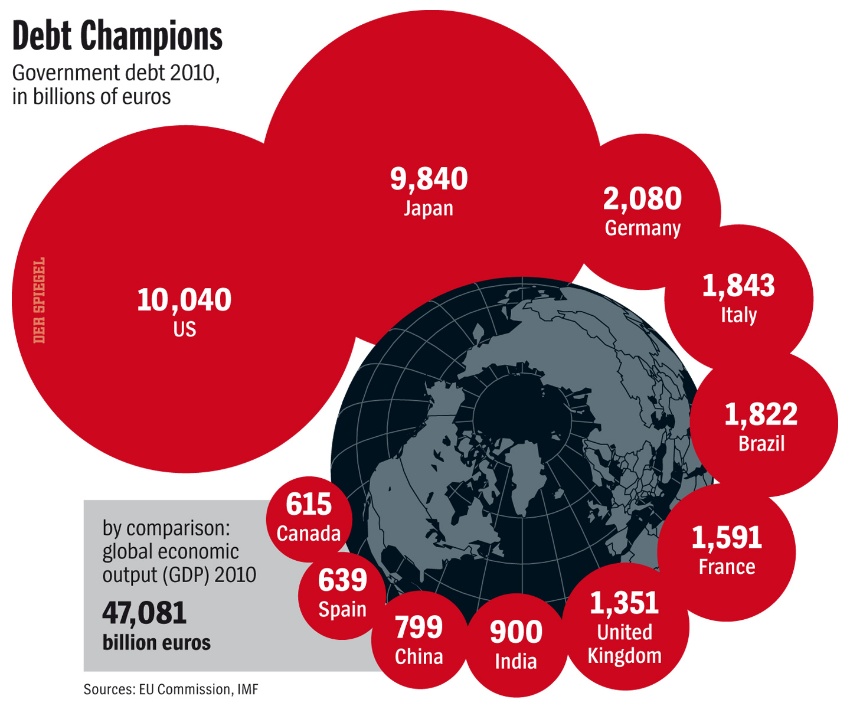
America’s middle classes were happy to sell their own children into perpetual debt servitude. The kids face obligations 5 to 15 times as great as annual output. Unless they revolt, they will have to work their entire lives to pay for their parents’ excesses.
But what will they do when future generations can take no more? They cannot sell themselves into slavery. They’ve already done so. Most face a lifetime of student debt, mortgage debt, and medical debt (aka Medicaid and Medicare), already.
What can they do? Join the revolution!