Saturday, October 17, 2015

Intolerable- then it reaches a boiling point and boom — revolution or war


Why We Are Doomed To Repeat History?


QUESTION:
Martin, Why do citizens of a country continually allow their government to destroy the nation without putting up a “real” fight? You have given many examples and no one ever seems to fight until things get really, really bad and it’s too late.
Regards,
MLO
ANSWER: This is the sad state of affairs. People who do not believe we can forecast the future never look at the past. They are delusional to assume we have “free will” that somehow implies intelligence at a collective level. Some of us see the patterns that others will never see. The truth is the truth. The old saying that “a house divided will always fall” is very true. There are always two camps throughout history and they become the driving force between the rise and the fall of all civilizations, empires, nations and city-states.
Politicians become corrupt because we do not pay attention. We get mad only when it becomes intolerable. Then it reaches a boiling point and boom — revolution or war. It is rather disgusting that we cannot seem to escape this cycle for thousands of years.

Everything is pointing to early November - With the budget issue. Major weekly resistance at 17760

Dow for the Close – Oct. 16, 2015

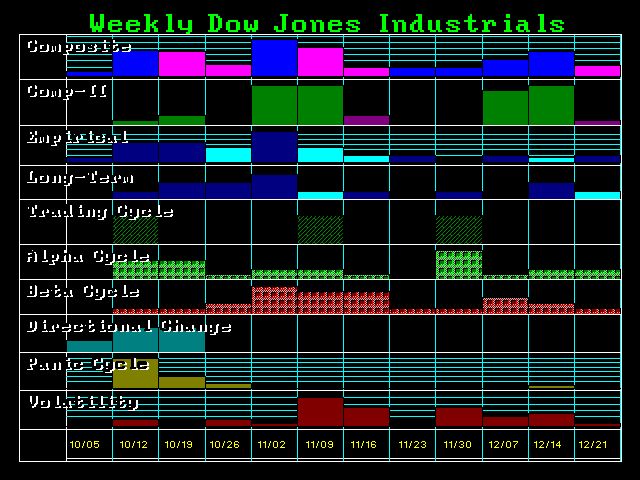
DJIND-W 10-16-2015


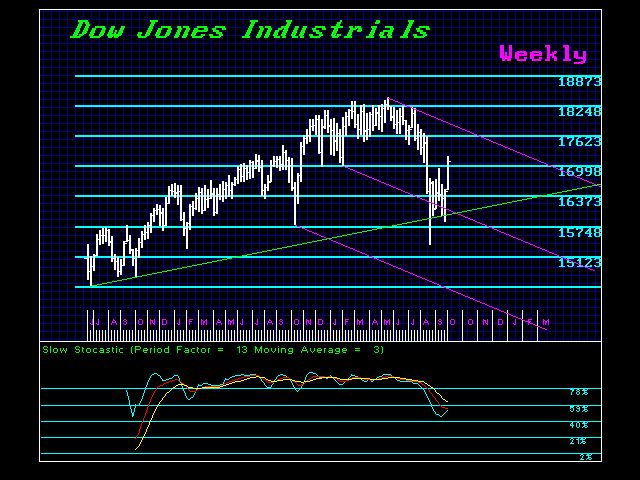
The Dow held the 15500 number on the Weekly level and then held 16280 level. Our models warn that a slingshot becomes possible taking out the August low. On the upside, we still have the major resistance at 17760 and it will take a weekly closing above that level to suggest a breakout back to the upside.


DJFOR-W 12-16-2015


Our timing models show a potential high for this week. We need to exceed this week’s high on a closing basis next week to suggest we can rise into the first week of November. However, a closing today BELOW 17068 will warn that this market is starting to run out of steam on the upside.

Everything is pointing to early November. With the budget issue hanging out there, if nobody steps up before the vote, Boehner can try to circumvent the fiscal conservatives and get 40 Democrats to vote with him to defeat the Tea Party. That will probably set in motion an all-out war inside the Republican Party. Keep in mind that the race for Speaker of the House is not really a race, and since the divisions are so deep no one wants to step into that mud.

So stay tuned. This is by no means settled in either direction. We continue to bounce off of support and resistance. If you would like to know the real LAW, even I could run for Speaker of the House. That’s right. There is no constitutional requirement to even be a Congressman or hold any elected office. Article I, section 5, of the Constitution provides the House with the authority to determine whether members-elect are qualified to be seated.
“No Person shall be a Representative who shall not have attained to the age of twenty five Years, and been seven Years a Citizen of the United States, and who shall not, when elected, be an Inhabitant of that State in which he shall be chosen.”
— U.S. Constitution, Article I, section 2, clause 2

However, Congress has latitude. For instance, William Claiborne of Tennessee became the youngest person to ever serve in the House when he was elected and seated in 1797 at the age of 22. The House also seated Claiborne at the age of 24 when he won re-election. The House, however, has not always been so lenient. Representative John Young Brown of Kentucky was first elected to the House in the 36th Congress (1859–1861) when he was 24, but the House refused to administer the oath of office to him until he was 25—after the first session of the Congress was over.
I wonder if someone will figure this out and step up to the plate as crazy as this seems

Tuesday, October 13, 2015

Recessionary trend emerge on a global scale this time

China Still Heading Lower

China-Yuan-Currency
The latest economic news from China shows that, in dollar terms, imports collapsed 20.4% in September from a year earlier to $145.2bn. This is one of the sharpest declines ever, and it is far beyond what was expected. This has had a further impact upon the raw commodity sector and metals. This latest drop in Chinese imports was down 20.4%, year-on-year, compared with a 13.8% decrease in August. Meanwhile, China’s exports were also down 3.7% during September after a 5.5% decline during August.
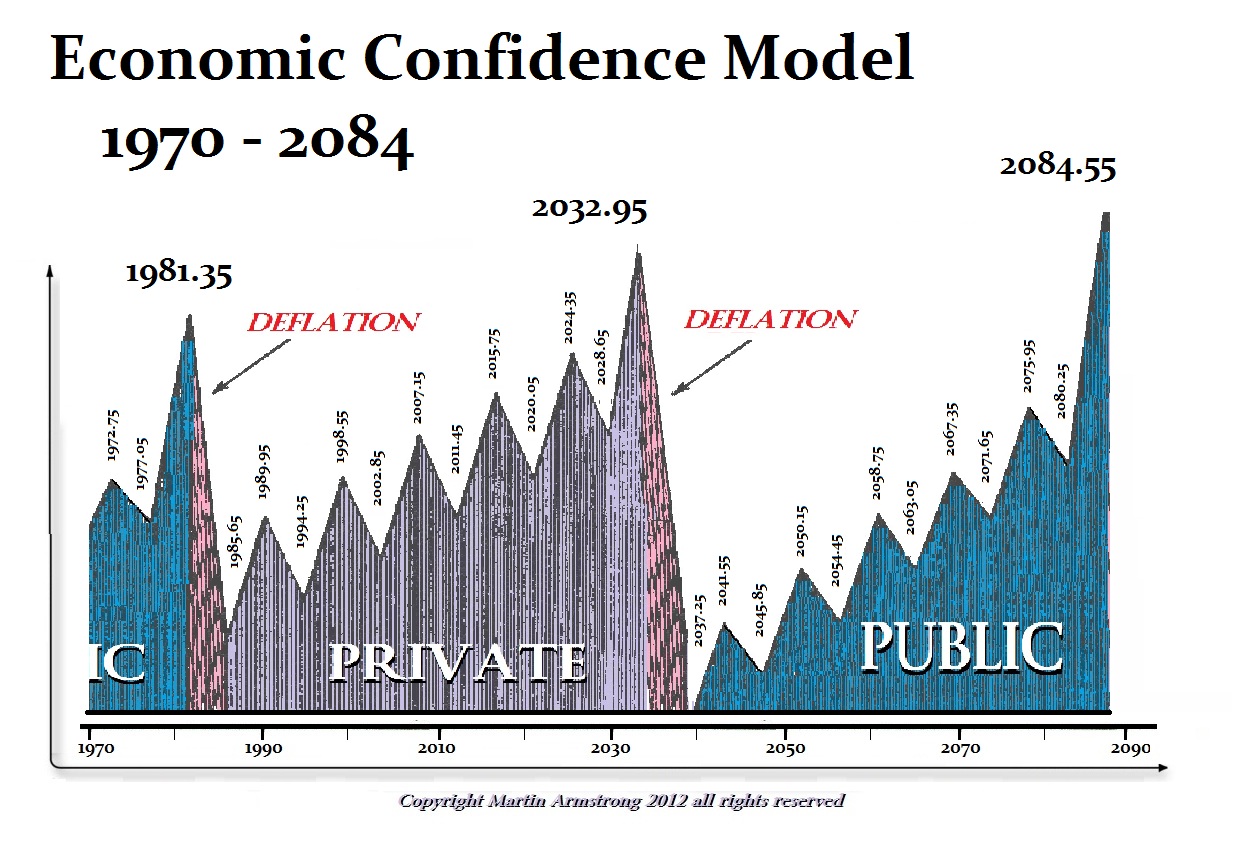
The other side of 2015.75 still looks like a sharp cliff going into next year. From an economic viewpoint, the economy turned down Wed., Sept. 30, 2015, on a global scale coinciding also with our Cycle of War on the international model. We should see the economy turn downward into a steeper recession moving into Wed., Sept. 28, 2016, which is the next turning point on the Economic Confidence Model followed thereafter by Tues., Oct. 24, 2017. Caution is advisable for it appears we should see an overall recessionary trend emerge on a global scale this time.

Monday, October 12, 2015

To negate a Slingshot we need a daily closing in the Dow above 17735


US Shares & Slingshot Move

DOWIND-D 10-12-2015
The potential for a Slingshot Move has not been negated. To negate a Slingshot we need a daily closing in the Dow above 17735. If we will get the Slingshot and trap the majority, then we should see this rally fail and new lows by the first quarter.
Can we merely do into a Phase Transition without the Slingshot? Yes. They would require key annual closing and consolidation into the first quarter before electing the Weekly Bullish Reversals.
Either way, it still appears that we will have that shift from public to private assets and the quantitative easing has shortened the duration of the debt so the slightest uptick in rates will have devastating effects. Even in Britain, Osbourne has doubled the national debt at these low levels of rates. Can you imagine what will happen when rates are forced to rise? The exist from public assets will become a huge one-way street. This is how empires fail and die. We deserve what we get by filling government with lawyers who assume the answer is more laws to dictate to society.

Problem with austerity- turning off the spigot BUT also continuing to service the debt and raise taxes


Austerity Good or Bad?


QUESTION: Martin,
The ‘Austerity’ argument seems a bit confusing.
Surely,  “Austerity” means reducing the size of Government and is an understanding that we can’t keep funding zillions of civil/public servants and on the other is a reduction of the Social Security Bill – healthcare, social benefits, the cost of the un and underemployed etc – both of which seem to be excellent objectives unless you are in one of the groups affected. Isn’t it impossible to return to or have a vibrant economy unless and until these objectives are achieved?
AB
ANSWER: The problem with austerity carried out in the fashion is they are turning off the spigot, which is ending Marxist/Socialism, but they are continuing to service the debt and to accomplish that they hunt the rich and raise taxes, then agree to exchange all info and in the process you cause capital to hoard and not invest. So you are not really ending socialism, you are moving more toward totalitarianism.
So we will get these riots for they are not just people who receive, these are the people who cannot find a job because nobody is creating them with deflation. We have to look at both sides and this is why our proposal is to eliminate taxation at the federal level to unwind this mess from both directions.
So there is more to this than just reducing social programs. Doing that raising taxes to still service debts you end you with taxation without representation for the current workforce must then pay for spending that they never received anything in return.

Sunday, October 11, 2015

Dow versus Gold Ratio - no ratio


Dow/Gold Ratio


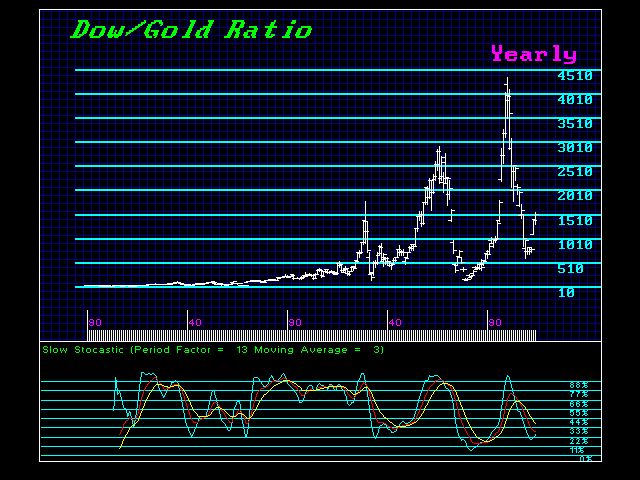
DOWGC-Y 1-1-2015


ECM-1970-2084

A number of people have written asking about the proposition that gold should rise to be equal to the Dow because that is where it had reach in 1980. Sorry – no way. When gold was $875 in 1980 and the Dow 1,000, that was the end of a Public Wave which peaked 1981.35. The difference between gold and the Dow is very important. Gold is a hedge against government for the individual; it is not an institutional investment. The reason is rather simple – gold pays no dividend.
As we can see from the above chart of this ratio back to 1790, The major support on this ratio is 3 to 3.3 and the resistance stands at 20:1. The low in the ratio took place in 2009 during the panic. Therefore, the decline was more associated with the decline in the Dow rather than gold. To reach that 20 level on a decline in the Dow again would mean if gold went all the way to the Yearly Bearish Reversal at 680 and the Dow made new lows, it would have to reach the 13,700 area.


GCSV1560


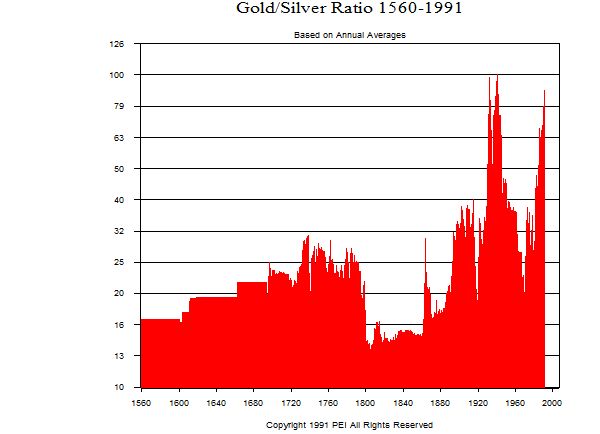
Nevertheless, the proposition that the Dow and gold should be 1:1 and therefore gold will rise to 20,000, is just pipe-dreams. As this chart illustrates, the relationship is like everything else – a cycle. Picking a 1:1 relationship and claiming that is the NORM, is the same absurdity of claiming the silver gold ration should be 16:1 because that is what Congress did during the 19th century when the open market was 30:1 by the Panic of 1893. These types of relationships are by no means realistic  just distorted delusion to sell precious metals.
 

Friday, October 9, 2015

Quantitative easing is not responsible for increasing the money supply- It is a swap of bonds for cash


Is Quantitative Easing the Same as Printing Money?

Quantitative Easing
QUESTION: Mr. Armstrong;
Thank you for coming to Athens. After the presentation, there were so many questions that the moderator did not have time for. You answered some for the crowd afterwards that I had never heard anyone ever explain. You said Quantitative Easing was not money printing nor did it really increase the money supply. You also said to the crowd that fiat is not paper money, but anything declared by government including pegs.
Could you elaborate on those statements.
Thank you for your enlightenment.
GP
ANSWER: Quantitative easing is not responsible for increasing the money supply or printing money. It is a swap of bonds for cash so they are not outright printing money. It is a swap transaction. This combined with the idea that paper money is fiat and precious metals are tangible are all seriously wrong. Fiat is the attempt by government to decree the value of money. This is no different from a peg that broke, such as the Swiss/euro peg, or the Bretton Woods attempt to fix gold in terms of dollars. ANY attempt to flat line the value of money by decree is fiat, regardless of whether the instrument is paper or seashells.
This idea that Quantitative Easing is printing money is very pre-1971 thinking and is a throwback to Bretton Woods. Such an assumption focuses on the differentiation between debt and money or cash. Pre-1971, you could not borrow against government debt so there was a clear difference between debt and money. The theory that it was less inflationary to borrow than print made sense only when there was a real difference between debt and cash or money.
Today, debt and cash are the same. If you trade futures, you deposit cash and to earn some interest you buy T-Bills, which are deposited and used as collateral. The distinction between debt and cash has vanished. This means that Quantitative Easing does NOT actually stimulate the economy. The giant assumption was that the cash would be spent within the system. But the banks complained and the Fed created the EXCESS RESERVE window which has about $2.5 trillion on which the Fed pays 0.25% interest. They only swapped bonds for the right to deposit cash at 0.25%, so where was the stimulus? Nothing was stimulated and there was no inflation since there was no actual increase in private spending.
These theories are very primitive to say the least. Nobody looks at them closely or follows the money to see if they are doing anything what the theory pretends should happen. The ECB bought 25% of the bonds and inflation still turned negative. They have stated that they will increase that to 33%. They never review their actions when something fails to work. All government ever does is move further in the same direction because government employees will NEVER admit a mistake.
This is akin to physicians in medieval times who assumed that bleeding a person would heal them because an illness was seen as if it were a poison in the bloodstream. If the patient died, they never assumed the death to be the result of taking too much blood. Instead, they would state that they did not bleed the patient soon enough and that caused their death.
Welcome to the plague of thinking among humankind. Why learn new ways as long as you can just accelerate the current failed process? It’s safer because you do not have to admit mistakes that way. This is why we must crash and burn. They will never look at their actions and are incapable of admitting an era. Anyone who challenges the status quo becomes the “fringe” element that should be ignored.