Showing posts with label 1873. Show all posts

Tuesday, December 8, 2020

The Energy Crisis During the Panic of 1873


Humans are not the only species to get viruses. A real energy crisis hit the United States that began in 1872 and expanded into 1873, which contributed to the Panic of 1873.  This was a flu virus they called distemper that shut down the US economy by infecting horses. It was in 1872 that the US economy was hit by influenza during the autumn which paralyzed the economy and social life. It was the 19th-century version of an energy crisis even before fossil fuels which these global warming fanatics want to return to. Instead of this influenza infecting people, it was a virus that spread among horses and mules. It began in Canada, and with free trade, it spread into the United States and then down into Central America.

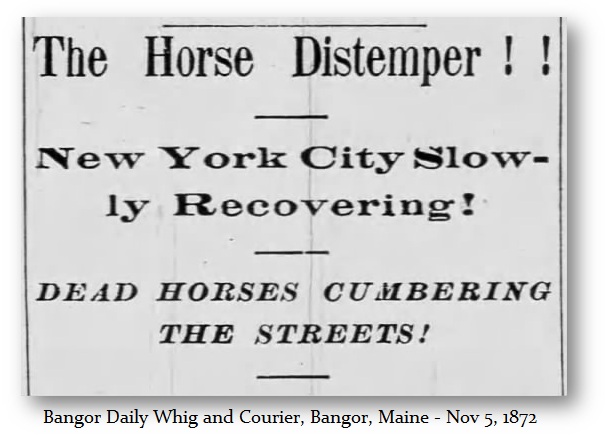
 

Before fossil fuels, horses provided essential energy to build and operate cities. The steam engine led to the development of trains, but they were limited to long distances. Horses were the backbone of how cities operated just as cars today once filled the streets of major cities. But the equine flu made exposes just how important horses were to modern civilization. When horses became infected, they stopped working and it revealed just how dependent the entire economy was upon horsepower. The distemper, as they called it, spread infecting virtually every horse, and owners did not understand diseases back then and forced their horses to still work and they were dropping dead in the streets.
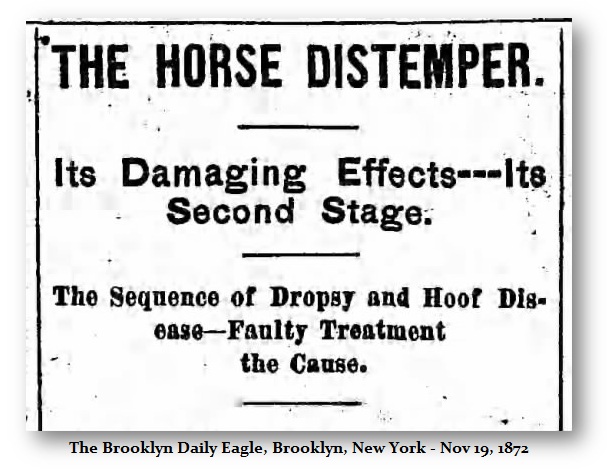
The influenza first appeared in Canada during late September in horses pastured outside of Toronto. The flu’s symptoms were cough and fever; ears drooping, they staggered and often dropped in the streets from exhaustion. Within a matter of just days, this virus spread rapidly and most horses in the city caught the virus in stables. By the time the US government became aware and attempted to prohibit Canadian horses from crossing the border, it was too late.
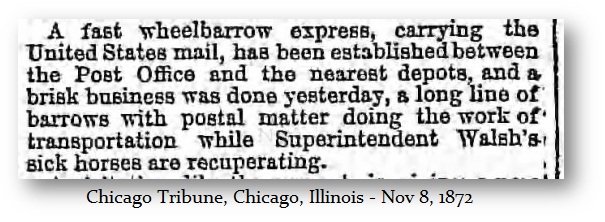
The virus spread very rapidly within a month crossing into the United States. By November, horses were dropping dead in New York City and hurting even those that did not seem to have had their immune systems compromised for this even hoof & mouth disease was impacting the survivors. Even the mail delivery was disrupted without horses.  It became known as the “wheelbarrow express” to carry the mail. They had to transport mail in wheelbarrows lacking horses.
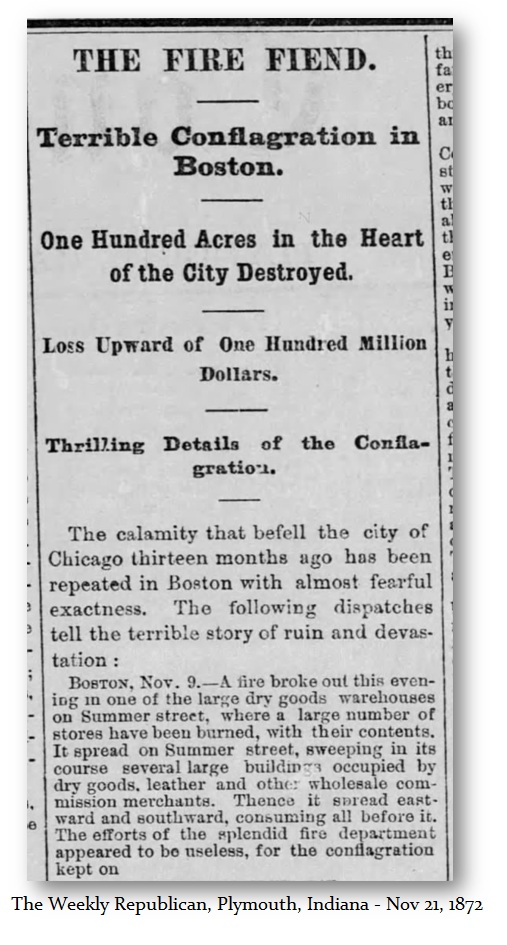
The lack of horses also impacted the ability to fight fires. The pump wagons carrying water were drawn by horses. On November 9th, 1872, there was a major catastrophic fire that gutted much of downtown Boston. They reported: “The efforts of the splendid fire department appeared to be useless…” The firefighters could not even reach the scene of the fire on foot. Without horses, the city burned. The same would happen if the fire trucks operated on charged batteries. They would never be able to handle a major blaze.
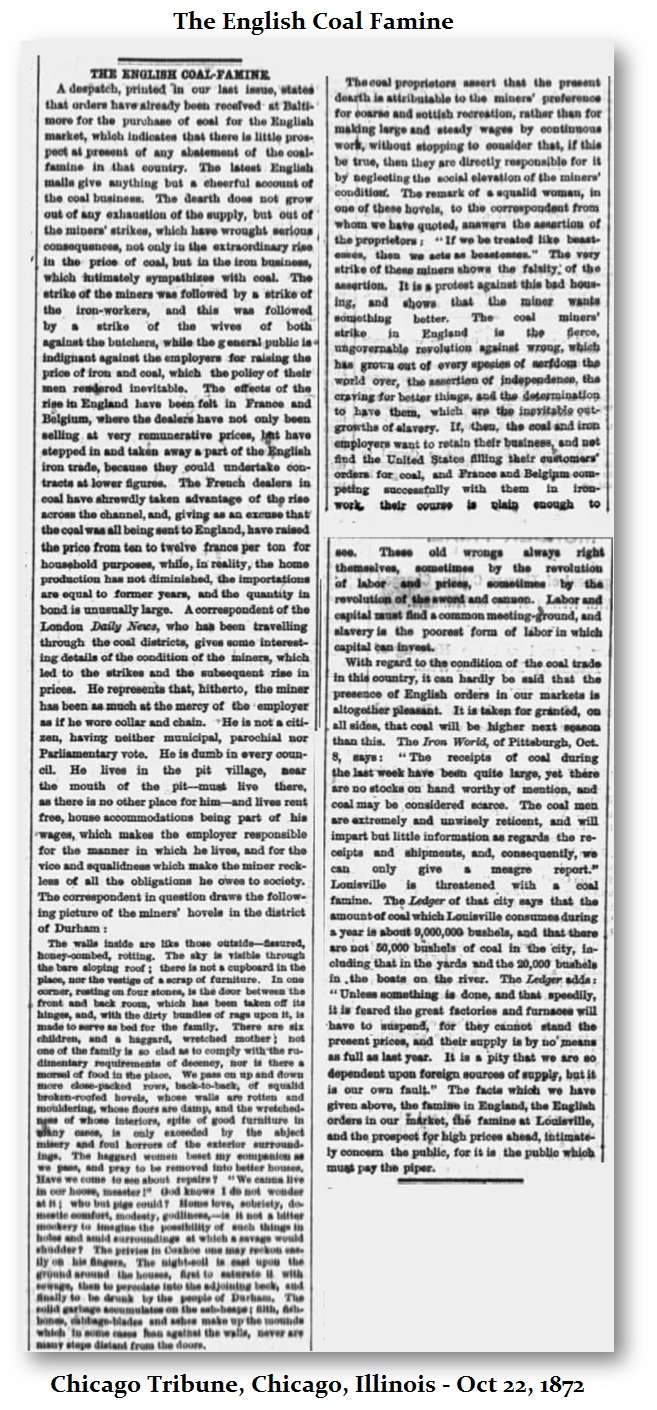
Horses were the very backbone of the economy. They brought coal out of mines, drag crops to market, and carried raw materials to industrial centers. The horse flu resulted in food shortages in the cities as we have witnessed because of these lockdowns today, but they also led to what people were calling the “coal famine,” which sent prices soaring due to shortages. In England, there were coal miner strikes which resulted in driving up prices in the United States as well. Then this horse influenza in North America reduced both coal and iron production. On top of that, produce and crops simply rotted at the docks due to the lack of horses for transportation. Producers could not pay the railroads so they, in turn, refused to stop at some cities where depots overflowed with undelivered goods. The combination of these events created the perfect storm compelling the economy to plunge. Then the introduction of only the gold standard as Germany abandoned silver, the Panic of 1873 took shape.

By December 1872, the “Canadian Virus” as it was becoming know,  reached the Gulf Coast, and in early 1873 it was hitting the West Coast. It is believed that perhaps 200,000 horses died and most were sick. The economy simply came to a significant decline. The doomsday fear was this horse flu would jump to humans. Thank God Anthony Fauci was not around back then working for Bill Gates on the side. He probably would have ensured that it made the jump. Lacking people like Fauci, it never impacted humans.
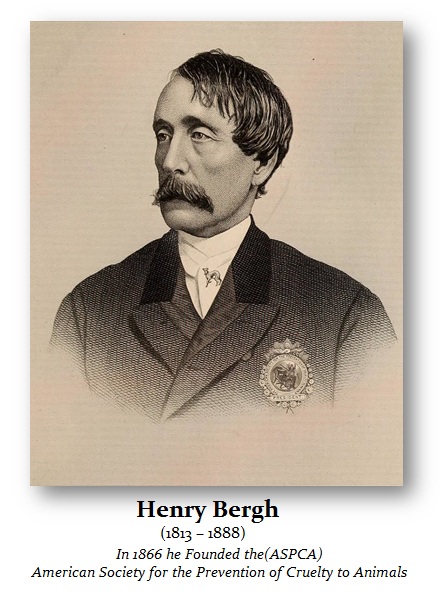
In the midst of all of this, Henry Bergh (1813-1888) had been making this argument since 1866, when he founded the American Society for the Prevention of Cruelty to Animals (ASPCA). Bergh was supported by a large inheritance. He thus had the time to devote to what he saw was cruelty to animals which at the time was largely focused on horses.
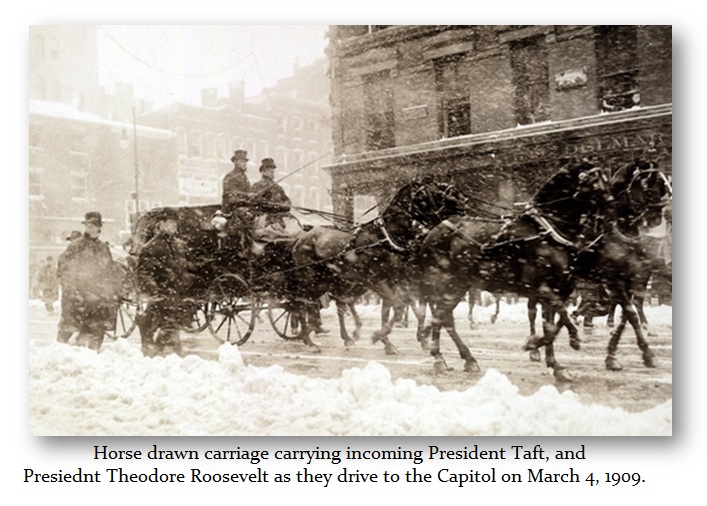
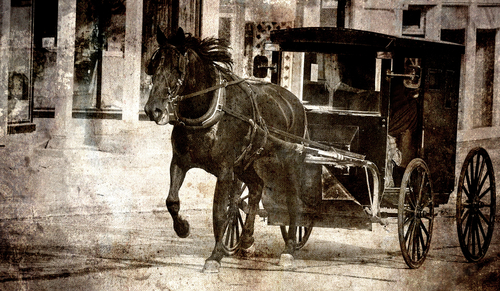
Here is a photo from 1909 showing the horse-drawn carriage taking the president-elect Taft to the inauguration with President Roosevelt both in the same carriage. That sort of civility no longer exists. Nevertheless, this influenza that infected the horses created a massive “energy crisis” which we would call it today. It certainly undermined the economy which contributed to the Panic of 1873 which became the Long Depression which lasted for 26 years.
The horse influenza became a  pandemic spreading across the country triggering a social upheaval and an economic paralysis just as if the power grid was shut off and would be comparable to what would happen today if these people were successful in ending fossil fuels. It was this problem which even led to the idea of creating the “horseless carriage” based upon economics. Horses enabled the very development of our civilization for transportation which enabled the economy to even develop as well as advancing the food production which allowed the human race to expand.

It was this influenza that provided support for Bergh’s ASPCA movement drawing the attention of Americans to the reality that horses were important but also were subject to nature. They could not be forced to work when sick. They too would simply die.

In today’s atmosphere, we should remember that ending fossil fuels will have a very profound impact just as the great horse influenza of 1872/1873.

Thursday, July 16, 2015

The Long Depression – the First Great Depression


Posted on July 16, 2015 by 
BCYC-70MA
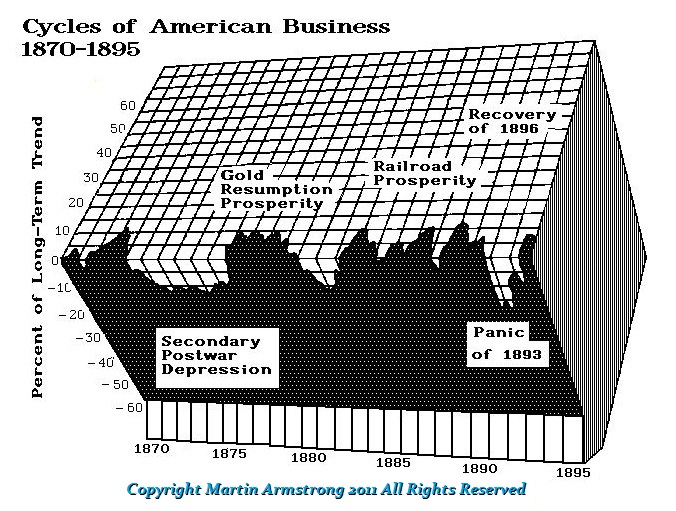
What actually constitutes the Long Depression has been debatable, for at first it was called the Great Depression, and then that title was transferred to the 1930s. Consequently, some limit the term Long Depression to the worldwide price recession beginning in 1873 and running through the spring of 1879. Six years is not exactly a “long” depression, that in our analysis is 26 years – the typical maximum period which Japan entered following 1989.95. Europe appears to be completing a 13 year depression from 2007 into 2020 thanks to austerity – deliberate deflation to support bondholders.
CALLMONY-MA
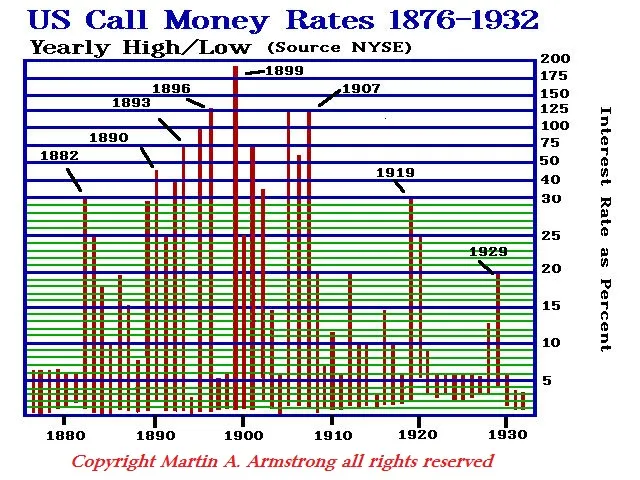
Domestic analysis of the  Long Depression event of the 19th century USA centered on the Panic of 1873, which the inflationists/Silver Democrats dubbed this financial crisis the Crime of 1873. Of course, this view ignored the global economy and this set the tone for a 26-year economic depression plagued by numerous financial panics that finally culminated in the Panic of 1893, which were devastating to say the least and the Panic of 1899 with the peak in US interest rates reaching nearly 200% in a situation similar to Greece today.
1869-Golden_Spike
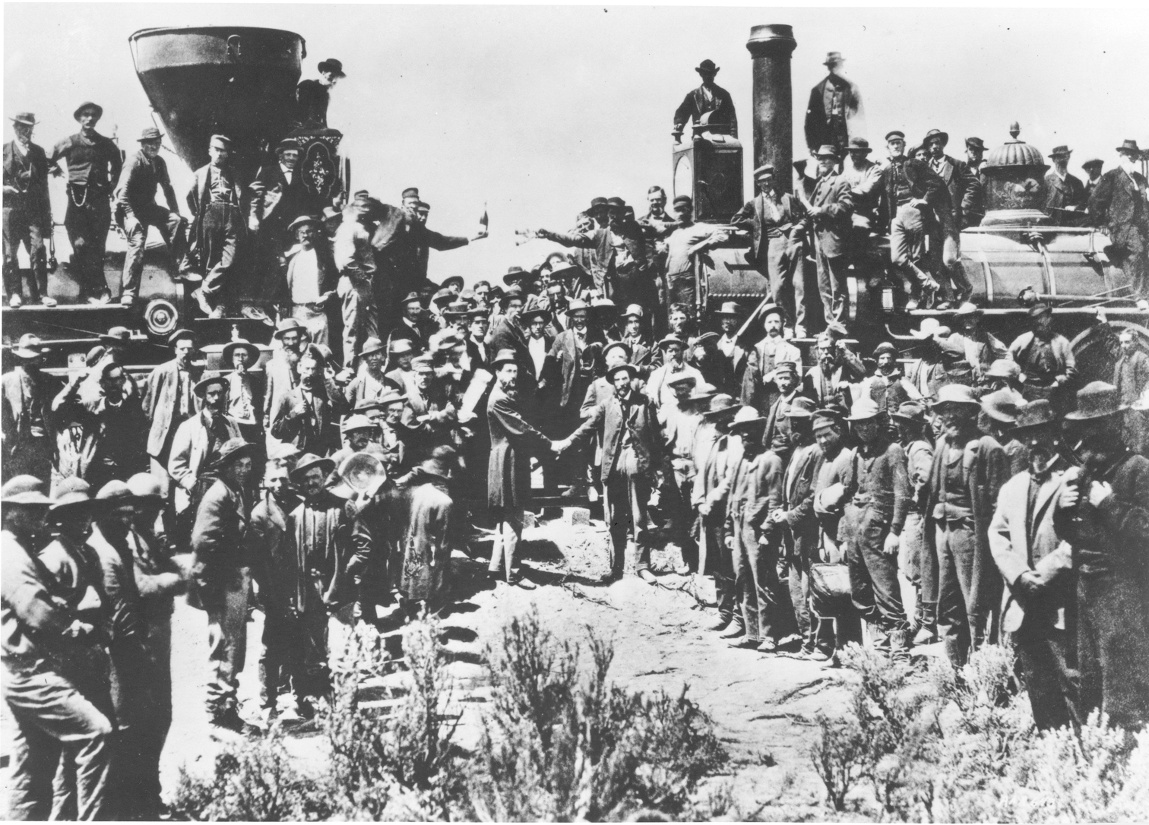
Toast-of-NYUnfortunately, as always, analysts try to reduce everything to a single cause and effect plus they wear blinders like a horse only looking at this six-year period 1873-1879 with exclusive domestic analysis. Much of this contraction of this period was traditionally attributed to a monetary contraction leading to the resumption of specie payments in 1879. This was an extremely narrow view for this had the impact of introducing austerity, but that was at the end of the period. The bubble going into the event peaked with the Panic of 1869 and the birth of the Transcontinental Railroad on May 10, 1869, and of course the Gold Panic where Jim Fisk attempted to corner the market forcing gold up in price. The scheme was that when the USA would return to a gold standard they would have to accept the market price. You can watch the old black & white film Toast of New York on this event which inspired me as a kid to explore financial history.
The Transcontinental Railroad spawned a wave of innovation that unfolded as creative destruction. Mail order companies began to develop. Previously in 1845, Tiffany’s Blue Book (the jeweller) was the first mail order catalogue in the United States.  However, after the development of the Transcontinental Railroad, what emerged was the internet of the 19th century whereas trains now opened the continent as a market. By 1872, Aaron Montgomery Ward of Chicago, produced a mail order catalogue for his Montgomery Ward mail order business. Like Amazon today, Montgomery Ward began selling over 20,000 items in a 540-page catalogue directly to customers reducing prices and eliminating local stores, exactly as Amazon has eliminated local bookstores.
Eatons1884catalogueIn 1986 in Toronto, Irish immigrant Timothy Eaton founded T. Eaton Co. The first Eaton’s catalogue was a 34-page booklet issued in 1884.  However, it was Richard Sears who began a business selling watches through mail order catalogs in Redwood Falls, Minnesota in 1888. By 1894, the Sears catalog had grown to 322 pages, offering sewing machines, bicycles, sporting goods, and even automobiles that produced from 1905–1915 by Lincoln Motor Car Works of Chicago.
The period of the Transcontinental Railroad lead to creative destruction event similar to the internet today whereas on one level the economic numbers looked good, yet unemployment was gradually rising. The price deflation was caused by innovation, as well as a decline in demand, laid the seeds for Marxism that people supported for they did not understand what was happening. They blamed industry and this fueled the development of unions as well in addition to working conditions. Hence, it was this period of a Long Depression that ignited social change insofar as it was a shift in employment to from agriculture to industrialization. Employment within agriculture was 70% in 1850, which declined to 40% by 1900, and would ultimately crash to 3% by 1980 all because of innovation from fertilizers to the combustion engine.
coxey-his-army
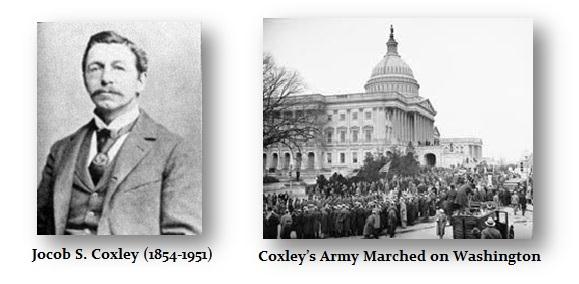
This economic evolution of the real Long Depression (1873-1899) created a “depression” for many as unemployment rose yet monopolies grew as did corporate profits for many in the right field. It wiped out Philadelphia as the financial capitol of the United States and J.P. Morgan would move that to New York City with his innovation. From this highly volatile period, as we are entering today, what emerged of socialism/Marxism that burst to the surface producing Coxley’s Army which marched upon Washington following the  Panic of 1893. It was this march that led to the idea of socialism for FDR took most of the demands first argued by Coxley that government should create jobs for the unemployed. This led to the Antitrust Legislation and the Progressive Movement of Teddy Roosevelt.
Wizard-Oz
YellowBrickRoad
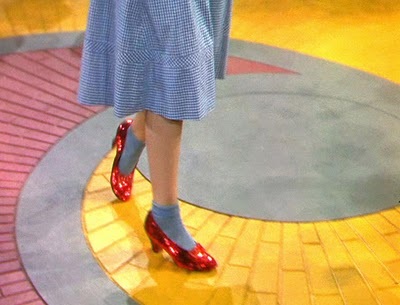
Coxley’s March became the subject of Lyman Baum’s Wizard of Oz –We’re off to see the wizard the wonderful wizard of Oz (Congress) following the Yellow Brick Road (gold standard & austerity). This economic event created serious change.
So those who argue that there was great expansion, yet ignore the social and global impact of the Long Depression, became commonplace. Today, the drive once again for austerity risks tearing Europe apart at the seams. This is what Brussels is dangerously doing and the surrender of Greece exactly opposite of their election and referendum mandate threatens to create civil war for this policy of austerity will once again destroy the social fabric of Europe.
Yes, there was an extraordinarily large expansion of industry, railroads, and physical output during the Long Depression fueled at the same time as a wave of creative destruction, but at the price of shifting trends within employment as we are seeing today with the internet. People lacking new skills to make the transition will be left behind and will blame something other than the trend which is typically corporations. So we once again have people looking at corporate profits and excess cash levels, yet there is rising unemployment, not to mention politicians demanding to raise minimum wages, and the introduction of Obamacare that provide the incentive to replace such workers with robots or client automation – “Press 3 to speak to…” etc.
Cleveland
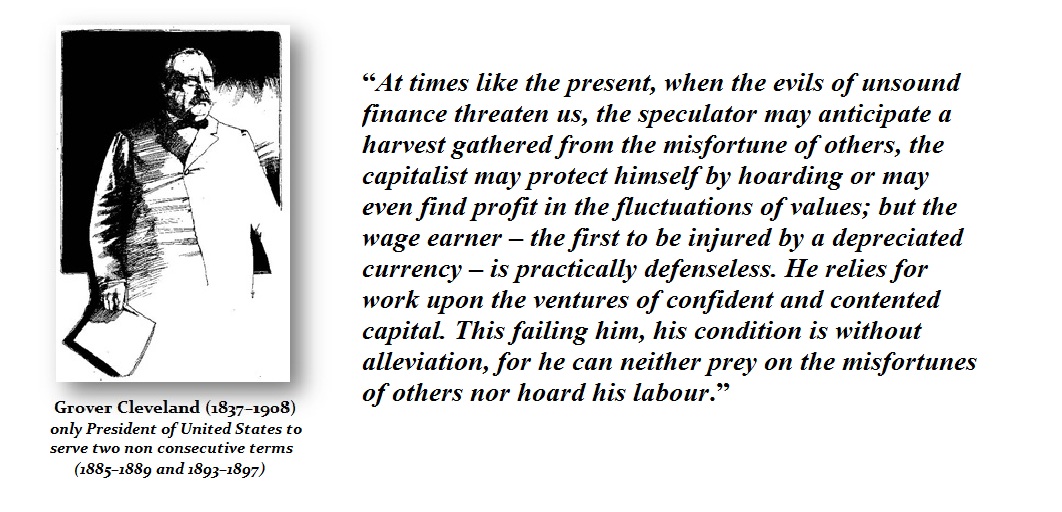
The Long Depression was a conflict between innovation and the clash between Silver Democrats funded by silver miners to inflate for their benefit that caused silver to be overvalued leading to silver imports and gold exports. The Silver Democrats thought they could force the price of silver higher to 16:1 to gold and Europe would have to accept the higher prices but the reverse unfolded. They sent silver to the USA and exchanged it for gold which to them was undervalued. By 1896, J.P. Morgan had to organize a gold loan to prevent the USA from going bankrupt. This led to the famous speech of President Grover Cleveland who could see the world in a connected manner. He observed that capital could flee the nation or hoard and refuse to invest as we are witnessing today. But labor, he warned, could neither flee nor hoard itself. Therein lies the danger we face today for social change.
Cleveland-Taxes
Grover Cleveland also said of taxes that it was unjust for a government to tax the people beyond what was necessary for it becomes “ruthless extortion and a violation of the fundamental principles of a free government.” Hillary Clinton’s economic plan, force corporations to raise wages – not reform government and reduce payroll taxes which is in the hands of politicians. Wages are not. We are plagued by people who want to rule the world yet are clueless about how it functions.

Monday, December 8, 2014

26 year cycle.

Big Bang 2015.75

 Numerous emails have been coming in about what is “Big Bang” that we originally forecast at the 1985 Conference. To put this in plain cyclical terms, there has not been a trend that lasts for more than 26 years without serious change.
BCYC-70MA
Originally, the depression that followed 1873 lasted for 26 years with reactions of course until the major bottom in 1899 when interest rates reached nearly 200% in the USA. This depression was originally called the “Great Depression”. That total was switch to the “Long Depression” after the collapse from 1929 into 1932. This decline was protracted because of the Silver Democrats trying to support the silver miners. They overvalues silver fixing the ratio at 16:1. The hope was to force silver to rise, but in fact the opposite took place.
BP-1900-1995
We warned that Japan would enter a Great Depression that would also last for 26 years from 1989.95. The final low for Japan economically should materialize in 2016. This is where Japan may see a dramatic political shift akin to Britain abandoning the gold standard on Monday, September 21st, 1931. Britain leaving the gold standard even demonstrated to the world that austerity supports bonds holders at the expense of the people.  September 21st, 1931 was an historic date; the suspension of the gold standard in Great Britain came only after the six years of painful effort of austerity followed the country’s return to gold in 1925 out of pride rather than practical economics.
1900$X-Y-31-Year-Target

We warned that 26 years from 1985 and the birth of the G5 at the Plaza Accord would mark the start of the economic decline. This gave us the target of 2011 – the breakout for the Dow. However, the target for Big Bang would be 31.4 years from the Plaza Accord. That brought us to 2016.
BigBang-2015-75

After the first of the year we will be issuing a Special Report in Big Bang and what we face the other side of 2015.75. The traditional analysis will preach that the stock market will crash. However, that may have been the events in 1929, but what happens when the crisis is in government? Will the stock market crash and then you run to government and pay them 5% to hold your money with negative interest rates?
It takes a major historical database to track HOW capital responds under different set-ups. It is not a one dimensional world with just 1929 as the outcome. Nor is it a hyperinflationary world of Revolutionary Germany and the collapse of the Dmark. If the future were truly that simplistic to figure out, then everyone can do that so why bother with any analysis?
We will let clients know when this report is ready for delivery. It will be an eye-opener to say the least. Once we have the year-end closings, the report will be set to roll.