Showing posts with label 1937. Show all posts

Friday, September 25, 2015

Recent history of gold


Did Gold Survive the Depression?
Money-Assets
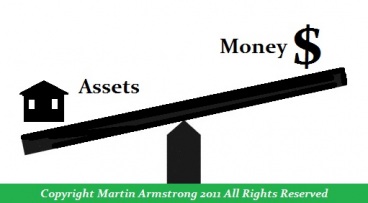
Some people totally confuse gold and money. During the Great Depression, we were on a gold standard. During a decline, ALL assets will decline against whatever is money, just as money declines during a boom. You need to separate MONEY from gold or you will never understand how the economy functions and you will buy gold when you should be selling. If you do not get this one right, forget it. You are not ready to invest.
If bronze or cattle were money, they would have risen against gold. It is MONEY vs. ASSETS — not gold. Today, gold is a commodity and it is tracking the commodity group as it is tracking silver. Gold moved opposite of silver between 1929 and 1932 only because it was then MONEY. So if you think a crash means that gold will rise, you are in for a very rude awakening.
You are doomed if you cling to the idea that gold will rise simply because stocks decline. Gold was DEVALUED in 1934 since gold was MONEY. What it could purchase for $20.67 then cost $35. The government confiscated gold and moved to a TWO-TIER monetary system with gold used exclusively for international settlements, not domestic.
1937Crash-M
Gold rose in purchasing power between 1929 and 1932 simply because it was MONEY at that time. The gold promoters do not understand that gold is no longer money, and therefore it will not rise in purchasing power in the event of a crash. The promoters do not talk about the event where government confiscated gold. They focus on the fact that gold rose in value from $20.67 to $35 without explaining that everything rose between 1934 and 1937, and then fell with the crash of 1937 when MONEY rose in value. Devalue whatever is MONEY and all assets rise, be it real estate, stocks, or commodities. This is what took place even during the German hyperinflation. It is ASSETS against MONEY, regardless of what it might be at that moment in time.
Gold 1970-1990 -M
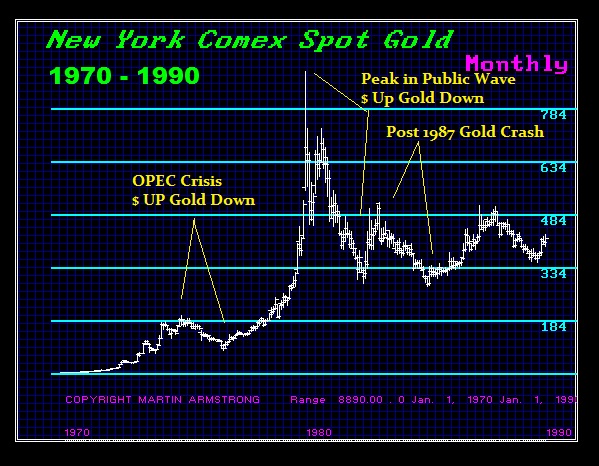
Today, gold will decline with commodities against MONEY, and then it will rise when people lose confidence in government after realizing that there is a Sovereign Debt Crisis. You better get this one right. Inflation soared during the OPEC crisis, but we ended up with cost-push inflation rather than demand; gold declined from 1974 into 1976 by about 50% and MONEY rose in purchasing power. All the classic nonsense from fiat to the end of the dollar was banter as gold fell 50%. If we look at how gold has performed when it is not MONEY, we can start to sort out the bullshit from reality.
Gold declined with each economic downturn from the OPEC crisis, the 1980 high, and the post 1987 crash. The Dow also rallied into 1980, as did silver, real estate, and just about every other commodity. The correlation between gold and all other assets was opposite of the Great Depression.
Gold 1999-2015-M
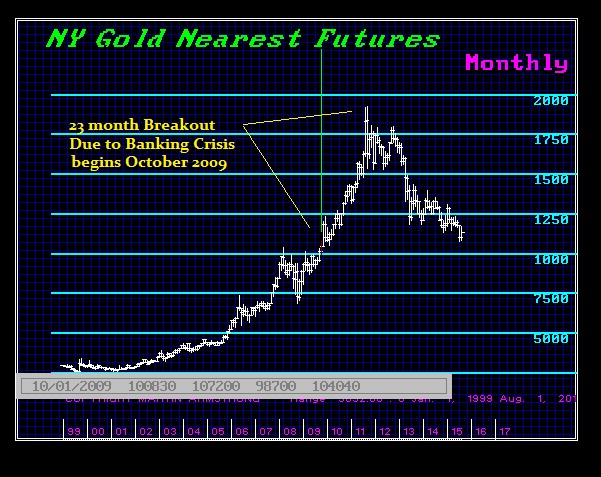
Gold broke out and rallied from our 2007 peak in the Economic Confidence Model, and stormed higher into the bottom of that wave in 2011. Here we saw gold perform as the “safe haven” but the gold promoters brainwashed everyone with their fiat nonsense. Here is one comment from a seriously brainwashed victim who can only see the world through the eyes of gold and fascism: “And BTW, 50 years from now, this will be seen as a dollar bubble. This can be detected only in relationship to metals and commodities, but this has been masked by paper to the degree that you simply refuse to look at it.” He does not understand the role of money and pines for Marxism where money is always the same value and the business cycle does not exist. People like this dream of perfect utopia where we are all mindless drones walking around in a perfect fog. They refuse to understand that MONEY is just a unit or account and a medium of exchange that everyone must agree on. You can tell the world that metals are money, but when you are starving and trying to convince someone who does not believe in your religion to give you food in exchange for metals — good luck.
MONEY is solely what another will accept because they know someone else will accept it from them. You cannot dictate to the world what you think should be money. This is not a bubble where metals will replace the dollar. This is a bubble in government. Regardless of what becomes MONEY after this event, the dollar will not be the reserve currency and has nothing to do with paper. It has to do with politics. As Milton Friedman said, “If you put government in charge of the desert, within a few years there would be a shortage of sand.” It really does not matter for you are focusing on the wrong piece in the puzzle.
Did gold rally because of fiat? No. Gold rallied because the banking system was collapsing. These people kept buying gold, swearing QE1-3 was inflationary, and lost all the way down because they failed to comprehend that this is not a battle against fiat.
Gold declined with every dollar rally when it was NOT MONEY and just a commodity, yet it rallied when there was a risk of banks failing — not QE1-3. This clearly illustrates what the “safe haven” really is.
BrettonWoods-8
Those who preach of a return to the gold standard are one mark short of being declared insane. They live in the past and are incapable of understanding economic evolution. Bretton Woods failed because they fixed gold at $35 but increased the amount of issued dollars. A two-year-old could have figured out that such a system would collapse. ALL attempts at fixing money have failed, right down to the Swiss/euro peg. So what collapsed was the GOLD STANDARD, yet people WRONGLY think that returning to some gold standard will stop the volatility and create the perfect world of Marxism by eliminating the business cycle. The problem was not the gold standard: it was the politicians. Returning to a gold standard today will not solve anything without political reform.
Latin Monetary Union
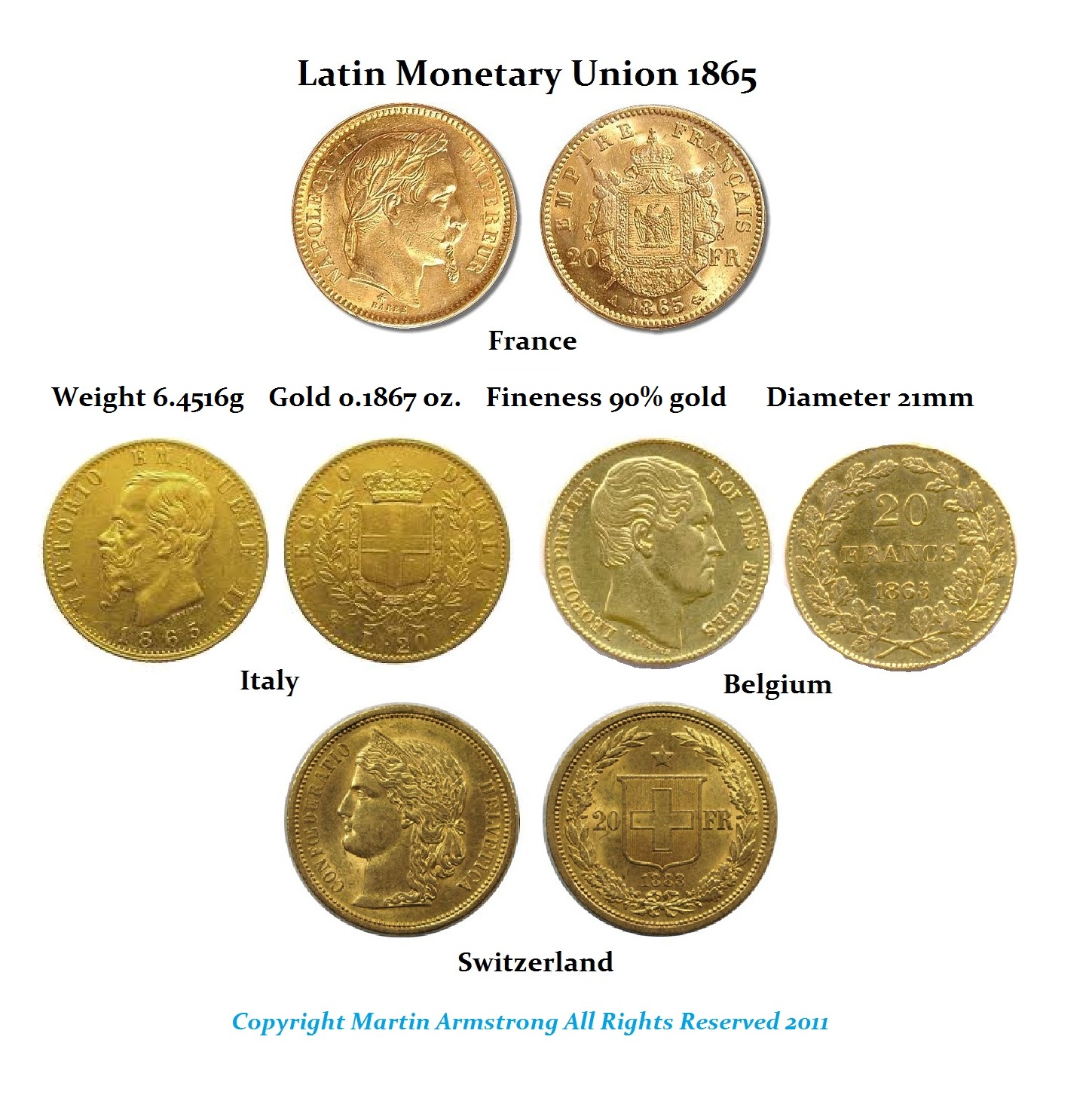
Gold cannot and has not prevented any financial crisis by creating a fixed standard. Bretton Woods was not the only gold standard to collapse. Historically, any attempt to create a “standard” is the same as creating a peg. We live in a free market and that means everything rises and falls with the business cycle. Absolutely NOTHINGon a fixed standard can survive as everything fluctuates. Governments rise and fall because of the very same stupid mistakes.
Florence
During the 14th century, Florence had the very same type of two-tier system that was the foundation of Bretton Woods. Gold served for international settlement and silver was used domestically. Companies even had to keep two sets of books, and wages were paid in silver. The price of silver rose sharply against gold, leading to deflation and rising unemployment. The people rioted, stormed the palaces of the bankers, and set fire to them.
Gold WILL RISE along with stocks and commodities against whatever is money. The “safe have” will return ONLY when the public questions the survivability of banks and government — not fiat and inflation. If you disagree, then keep buying for the wrong reason just as the Japanese did for more than 20 years. This is the outcome we face, so stop the nonsense. Gold cannot possibly react as it did between 1929 and 1932 against everything else because it is not MONEY, nor the unit of account or the medium of exchange. So get over it. It will be time to buy gold for the right reason — not for fiat or this hatred of the dollar. That is like blaming your wife because you got into an accident driving to work. Get on point if you want to survive this game. This is the real world, not fiction. If you create a theory, it better work every time or it is just propaganda.
If you insist on unrealistic outcomes, as they say, a fool and his money are quickly parted. We are in the middle of a major crisis. ALL assets will rise against MONEY, provided we do not go all the way to a Mad Max event for then only food will have value.
Far too many people assume capital will only move to gold. That is not true for BIGMONEY cannot move to gold and never will. They cannot store it and it produces no income flow. Gold is for individuals, not BIG MONEY. The second misconception that one person wrote in is that “wealth cannot simply vanish; it would go somewhere, hoarding or otherwise.” This is simply not true. Money is the unit of account that measures wealth and that rises in falls in value. Even gold is being measured in dollars (the unit of account). Wealth is simply a valuation at an instant in time. When the stock market or any asset crashes, the valuation evaporates. It is NOT a zero sum game, as in futures, for there is no contract with only one side; there must always be two sides – long v short. Wealth in every other form is simply a valuation that evaporates — it does not transfer to someone else.
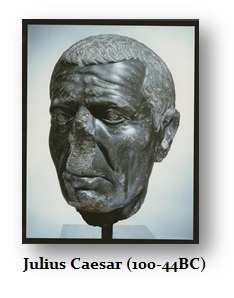
Caesar-5
Gold rises ONLY when there is uncertainty about government or the banking industry. It will not keep pace with inflation and its fate is tied to the commodity sector. Some people will send hate mail over that simply because they WANTto believe something else.
Julius Caesar understood that and said that people believe only want they want to believe. He was correct. There is no convincing a Democrat he should be a Republican or vice versa. You will believe gold is money and shut out everything to the contrary, or you will have an open mind and comprehend that money is whatever the majority accept at that point in time.
Poste

Monday, April 20, 2015

Understanding Jackson’s Bank War


Posted on April 18, 2015 by 
Understanding Jackson’s Bank War is critical to our future. He was absolutely correct insofar as following the Jeffersonian view that a National Debt would not be a Blessing as Hamilton proclaimed, but the servitude of the people that would ultimately consume all liberty. In this vain of thinking, Andrew Jackson was correct and in his annual message to Congress in December 1834, President Andrew Jackson reported that the United States would be debt-free as of January 1, 1835. This marked the first and only time that the United States or any other major nation in history had ever been free from debt. Jackson declared:
Jackson-Andrew“Let us commemorate the payment of the public debt as an event that gives us increased power as a nation and reflects luster on our Federal Union.”
Jackson had adhered to the prevailing view of Thomas Jefferson in his battle against Hamilton to create a national debt. Jefferson’s view was that incurring a national debt and passing it on to future generations condemned those generations to involuntary servitude.
There are people who have made up quotes attributed to Jefferson that are totally false. The only real quote of Jefferson regarding banks come from a letter Jefferson wrote to John Taylor in 1816: “And I sincerely believe, with you, that banking establishments are more dangerous than standing armies; and that the principle of spending money to be paid by posterity, under the name of funding, is but swindling futurity on a large scale.”
Continental$60-1779
Jefferson was concerned with debt, not private banks. The quote commonly circulated to justify the destruction of the Federal Reserve attributed to Jefferson is completely fake: “If the American people ever allow private banks to control the issue of their currency, first by inflation, then by deflation, the banks and corporations that will grow up around them will deprive the people of all property until their children wake up homeless on the continent their Fathers conquered..” Even the terms deflation and inflation did not exist at that point in time and paper currency of the colonial period was issued by the states and the Continental Congress, not private banks.
Jefferson’s views on debt was the critical point that Jackson followed. Debts passed on to children that neither voted for nor approved of them, are a blatant example of taxation without representation in the Jeffersonian view of life. When Jackson first ran for president in 1824, he denounced the debt as a “national curse.” He vowed to “pay the national debt, to prevent a monied aristocracy from growing up around our administration that must bend to its views, and ultimately destroy the liberty of our country.”
Thomas Jefferson considered excessive debt immoral, and he advocated paying off debts within a generation (i.e., 20 to 40 years at the time). This was the taxation without representation that children must pay for debts they did not create nor benefit from. Andrew Jackson was following in Jefferson’s footsteps as he sought to pay off the national debt during his presidency (1829-1837).
JacksonBankWar
Jackson created countless enemies and became one of the most polarizing presidents in American history. His war on the banks took a two-fold approach. He first needed to eliminate the national debt that he saw as beholding to the bankers. Paying down the debt required cutting government spending and you can imagine the chaos and bad feelings that would set off today. In the course of this objective, Jackson generally opposed bills that allocated taxpayer money for “internal improvements” what we call “pork barrel spending” today. In the 1863 popular story “The Children of the Public”, Edward Everett Hale used the term pork barrel as a homely metaphor for any form of public spending to the citizenry. However, after the American Civil War, the term came to be used in a derogatory sense.
Clay HenryJackson’s feud with Henry Clay was famous. Both had run for president in 1824 along with John Quincy Adams. Clay has the least votes so he lost. Jackson had really won but Clay was the Speaker of the House and he steered the election to Adams anyway. Jackson and Clay were both lawyers, and each hated the other passionately. When Jackson won the elect for president in 1829, he would personally punish Kentucky vetoing any “pork: spending since that was the home state of his hated rival Henry Clay. Still, Jackson did much to cut government spending and make it possible to pay off the national debt by January 1st, 1835.
An increase in government revenue was also required to pay down the national debt. To this end, Jackson enforced the tariff laws that many southern states viewed as excessive and even confiscatory.
In 1828, a new tariff law took effect that raised taxes on foreign imports to unprecedented levels. The law’s supporters were mostly northerners who believed higher taxes on imports would protect northern industrial goods from European competition. There was clearly a divergence between the north and south with respect to international trade. The South saw this as a law which disproportionately harmed their economy because that region relied more on foreign imports than the North. Furthermore, the Jackson high tariffs led to retaliation by foreign trading partners who in turn imposed high tariffs of their own against American exports. Since the South exported more things such as cotton and tobacco compared to the more industrialized North, the Jackson tariffs were also disproportionately harmed the Southern economy more so than the North.
South Carolina’s response to perceived onerous federal taxation led to one of the first major sectional conflicts in U.S. history and helped sow the seeds of civil war.  in 1832 outraged Jackson. He proposed to mobilize a federal army and lead it himself into South Carolina to collect the revenue. Ultimately, cooler heads prevailed when South Carolina agreed to abide by a modified tariff law. It was this tariff collection was vital in paying down the national debt.
2nd-bank of USA C
BiddleJackson’s Bank War was phase-two. Andrew Jackson despised the Second Bank of the United States, ostensibly because it held too much power over the economy, but actually because it was controlled by his political enemies. So Jackson set out to destroy the Bank for it had even provided loans to his political rivals. The Bank’s President Nicholas Biddle (1786-1844) routinely used lending practices for political gain, including using Bank funds to publish newspaper attacks on opponents as some money center trading NY banks engage in to this day. Biddle openly favored the National Republicans (later to become the Whig Party), many of whom benefited financially from Biddle’s favor. Prominent National Republicans were Congressmen Daniel Webster (who was on the Bank’s payroll as a legal counsel) and of course Jackson’s arch enemy Henry Clay who was again his opponent in the 1832 presidential election but lost.
CornExchangeBank
Jackson withdrew federal assets from the Second Bank of the United States more because of his bitter rivalry with political opponents. He then distributed federal funds to state banks setting in motion the entire wave of Wildcat Banking. State banks all issued their own money and there was no longer and central clearing house or control. Jackson essentially killed central banking in the USA for political reasons rather than true principle among Jackson’s supporters. Many of Jackson’s supporters were the first to take banking charters among the various states and thus this was in their personal interest since they lined up with their hands out to receive federal deposits,
Louisiana 1842Jackson became aware of the excess in state banking was unfolding. To combat this new trend, Jackson persuaded Congress to pass the Specie Circular Act of 1836, which required land purchases to be made in gold or silver specie – not state bank paper. This had the effect of stopping the speculative bubble in land. However, the Specie Circular ultimately led to a financial panic when loans were called and borrowers did not have enough specie to cover them. This sparked the Panic of 1837, which occurred almost immediately after Jackson left office. The result was a six-year depression. States then issued debt to try to bailout their banks. Many states then defaulted on their bonds permanently setting in motion the first Sovereign Debt Crisis among the States.
1844 Phila Nativism Riot Againt Irish
The Panic of 1837 set off a Depression that lasted for 6 years thanks to the Sovereign Debt Defaults, which included Pennsylvania. This set off riots against the Irish Immigrants that turned into a violent bloodbath in Philadelphia during 1844 as jobs became scarce and native citizens blamed the immigrants.
The political rivalry was unbelievable. Andrew Jackson’s policies naturally generated many enemies all based upon self-interests. Jackson was also the first presidential victim of an assassination attempt. In January 1835, a disgruntled house painter fired on Jackson with two dueling pistols in the Capitol Rotunda. The pistols misfired, and Jackson attacked the man with his cane until aides restrained him. Blaming Jackson for his inability to find a job, the assailant later claimed that if Jackson was dead, “money would be more plenty.” The man was institutionalized as insane and never tried for attempting to assassinate the president.
Nevertheless, when Jackson refused to renew the charter of the Second Bank of the United States, congressional Whigs who supported the Bank and controlled the Senate censured Jackson for assuming power not conferred upon him by the Constitution. This was the first and only time that a president was ever censured by Congress; a more sympathetic Congress removed the censure in 1837.
Some saw Jackson as merely attempting to pursue the founders’ vision of creating a nation free from debt and extended that to the Bank War. His attack upon the Bank of the United States was really politically motivated against his rivals rather than following a principle espoused by Jefferson. However Jackson’s conversion to hard money and decentralized banking ended in one of the worse financial catastrophes in American history. The Specie Circular Act of 1836 set in motion the major contraction in the money supply and amounted to a move what we would call today austerity, but without contemplating the extent of the leverage he set in motion unleashing the era of Wildcat Banking.
Jackson was succeeded by one of his supporters and Vice President Martin Van Buren (1782 – 1862). He became the eighth President of the United States (1837–1841), but his inability as president to deal with the economic chaos of the Panic of 1837 led to his defeat in 1840. This was the split of the Democratic-Republican Party of Jefferson which at first was known as the Whig Party which surged in popularity due to the economic depression. The Whig Party won the election in 1840. William Henry Harrison (1773–1841) was the ninth President of the United States (1841), an American military officer who was the last President born as a British subject. Harrison died in office on the 32nd day in office of complications from pneumonia,
Tyler JohnJohn Tyler (1790-1862) was Harrison’s Vice President who now became President. Despite efforts of Whigs and anti-Jacksonians, they could not override Jackson’s veto during his presidency to shut down the Bank of the United States, which became private, surviving only five years also collapsing during that aftermath of the Panic of 1837. Nevertheless. Henry Clay and his Whig allies attempted a new charter, but it became obvious that Tyler would be against for he too was a State’s right man and anti-Federalist and since he had already vetoed much of the Whigs’ agenda.
Swallowing his pride, Henry Clay sat down with the president and the two talked for more than seven hours, finally working out a plan for a new kind of bank – the Third Bank of the United States. Rather than a single national bank against the many state banks that stood around the country, this bank would serve as a link between the state and federal level, operating to moderate speculation but also supply good loans to growing areas. There was no precedent for it in the Constitution for such a bank, yet it could be enacted as a bill from Congress. Tyler agreed to this structure on August 16th, 1841. The Third Bank of the United States was given a twenty-year charter like the former two and served with success.