Showing posts with label Turkey. Show all posts

Tuesday, January 11, 2022

January 6th – Greece v Turkey


Another January 6th, 2022 important geopolitical event was the rising tension between Turkey and Greece. There has been an arms race between the two which escalated going into the end of 2021. Turkey intensified the arms race when it asked Biden to buy 40 F-16 fighter jets to upgrade its Air Force. The move coincides with the recent deal struck by Greece to acquire France Rafale jets and frigates. These two nations hate each other since when Xerces invaded Greece and was defeated and then Alexander the Great conquered Babylon. The tensions go back thousands of years but then Turkey became Muslim and now the clash remains also between Christianity and Islam.

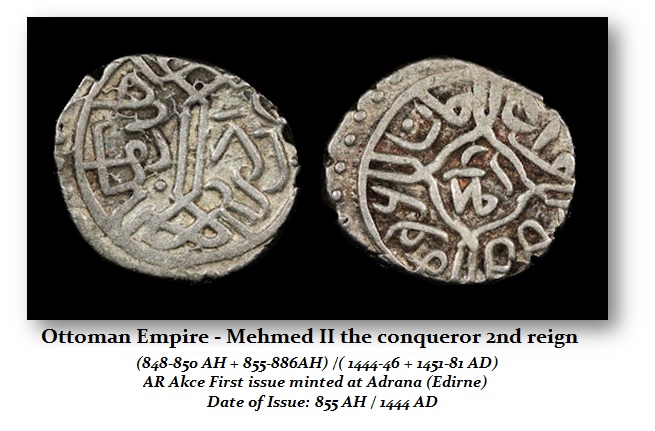
In 1453, the Ottoman Turks captured the Byzantine capital of Constantinople ending the Roman Empire for good. That completed their conquest of this once mighty empire and today we call what was Anatolia Turkey. That established the Ottoman Empire. For the next 400 years, Greece was ruled by the Turks, but Greece always resented their occupation given the history back to Xerxes and Alexander the Great. There were many failed uprisings against Turkish rule over the centuries.

In fact, it took just 28 years for the Greeks to stage their first revolt in 1481. The first uprising took place on the Mani peninsula in 1481, when Korkodeilos Kladas and the fierce Mani fighters rose up against the Ottomans. In 1711, the all-powerful Tsar of Russia, Peter the Great, issued a proclamation calling upon the Greek people to revolt. In truth, the Greeks took up arms against the Ottomans 123 separate times before 1821 and the great war.
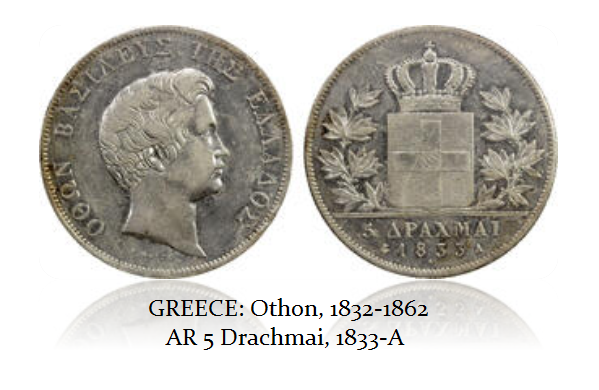
It was 1821 when the Greeks launched a rebellion that would develop into the Greek War of Independence. With the help of Britain, France, and Russia, the Greeks gained their independence from the Turks in 1832. However, the new Greek nation only included a relatively small part of European Greek lands. There remained a large Greek population in mainland Turkey, former Anatolia from ancient times. This fact led Greece to constantly seek to re-take more land from the Ottoman Turks. Multiple wars between Greece and Turkey unfolded, and local Greek rebellions with the support of the Greek government were becoming the norm.

Greek Epirus Revolt of 1854, in which Greek military officers aided the rebels in the Ottoman province of Epirus. This was also part of the larger Crimean War, and the Turks defeated these rebels. The Greek population of the large island of Crete launched many revolts against Turkish rule. There were the Greek Cretan Revolts of 1841, 1858, 1866-1868, 1875-1878, and 1889. All were defeated by the Turks.

A new revolt on Crete broke out in 1896 which led to the Second Greco-Turkish War which is also called the “Thirty Days’ War” of 1897. The Ottoman army re-organized with the help of German advisors. That enabled them to easily defeat the unprepared Greek military. Greece had to surrender some border areas in the peace treaty and were forced to pay heavy reparations to the Turks.

Nevertheless, there was the Cretan revolt, which continued until 1898. That at least forced the Turks to remove their military from the island and set up an autonomous Cretan State, which, while still under Ottoman rule, but was nominally self-governing.

Next came the First Balkan War (October, 1912-May 30, 1913), in which Greece, Serbia, Bulgaria, and Montenegro all combined forces to defeat the Turks. They almost conquered all of the Ottoman Empire’s remaining lands in Europe. This is when Crete became officially part of Greece ending the Third Greco-Turkish War.

This was followed by the Fourth Greco-Turkish War (1921-1922) which defeated the Ottoman Empire in World War One. Greek troops participated in the Allied occupation of large parts of Ottoman Turkey. This is when with the collapse of the Ottoman Empire, Greece launched a full invasion of Turkey. The goal was to re-establish all the former Greek-speaking lands into the modern Green nation.

51.6 years later, the tension rose again this time forming the Greek-Turkish Conflict Over Cyprus in 1974. This became a full-scale war between Greece and Turkey. In 1974, the island-nation of Cyprus was engulfed in conflict when a coup overthrew the government with the goal of joining Cyprus with its Greek majority population with Greece. Turkey invaded northern Cyprus and set up a separate Turkish Republic of Northern Cyprus, a “nation” that only Turkey recognizes.
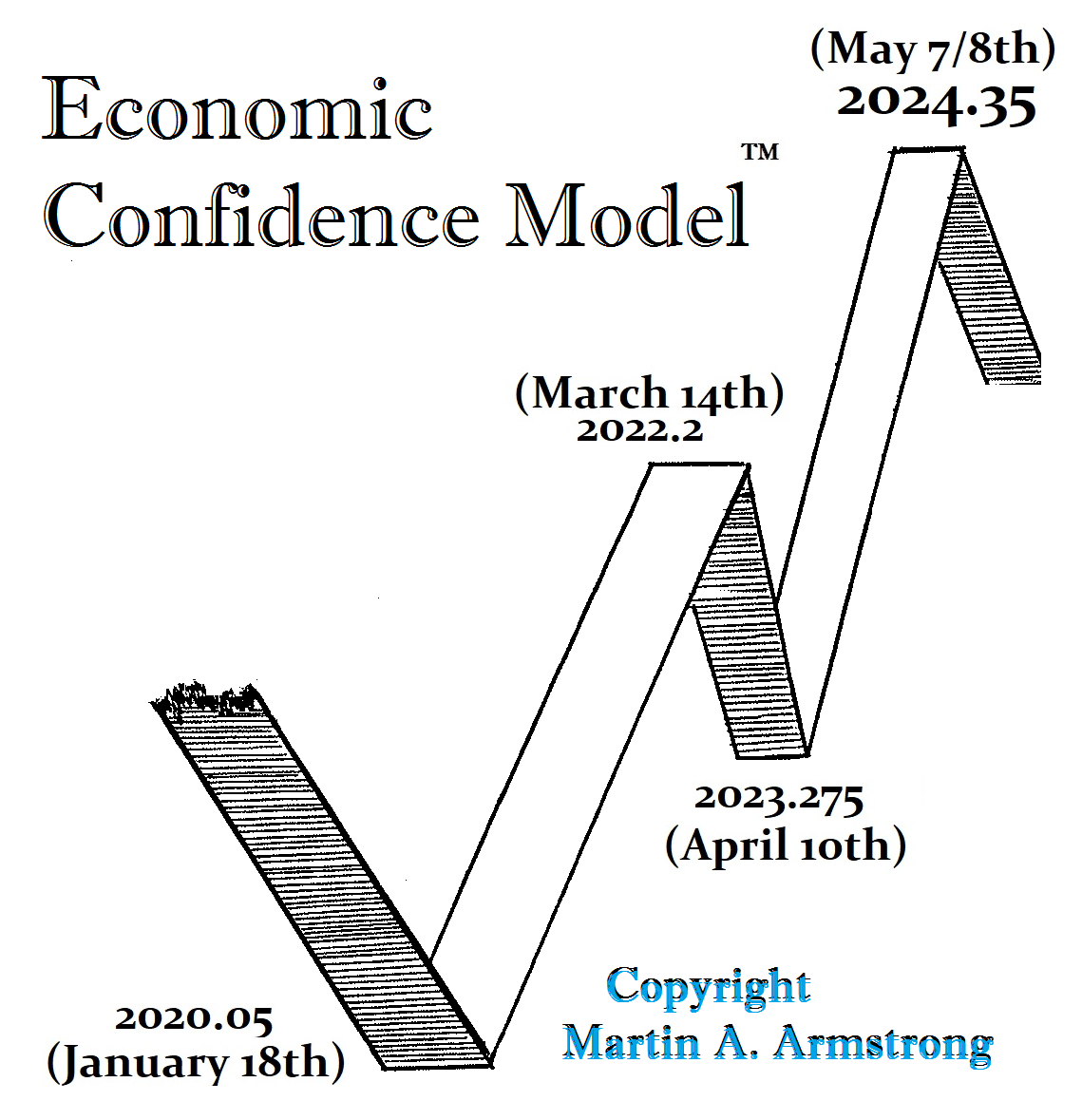
Tensions began to rise with the 2020.05 turning point on the Economic Confidence Model. These tensions are at their highest since 1974 and it looks like war is inevitable once again. Turkish President Erdogan’s re-conversion of the Hagia Sophia to a place of Muslim worship enraged many Greeks, which only exacerbated the economic competition for the oil and gas in the seabed near Cyprus. As the Greek and Turkish militaries face off at sea and in the air on a routine basis.

Here we also have a convergence of many cycles. The next 51.6-year cycle from 1974 events brings us directly to the period of rising risk of international war starting in 2025-2027 time period. This insane climate change policy that is deliberately driving up fuel prices around the world is crushing the third world and there people have far less risk in the face of war compared to the developed industrial nations.

The problem we have is as the economy turns down because of this absurd COVID nonsense that has wiped out tourism, a major income source for Greece and Turkey, hotels are closing and people are unemployed. This increases the tensions for war.

Wednesday, August 15, 2018

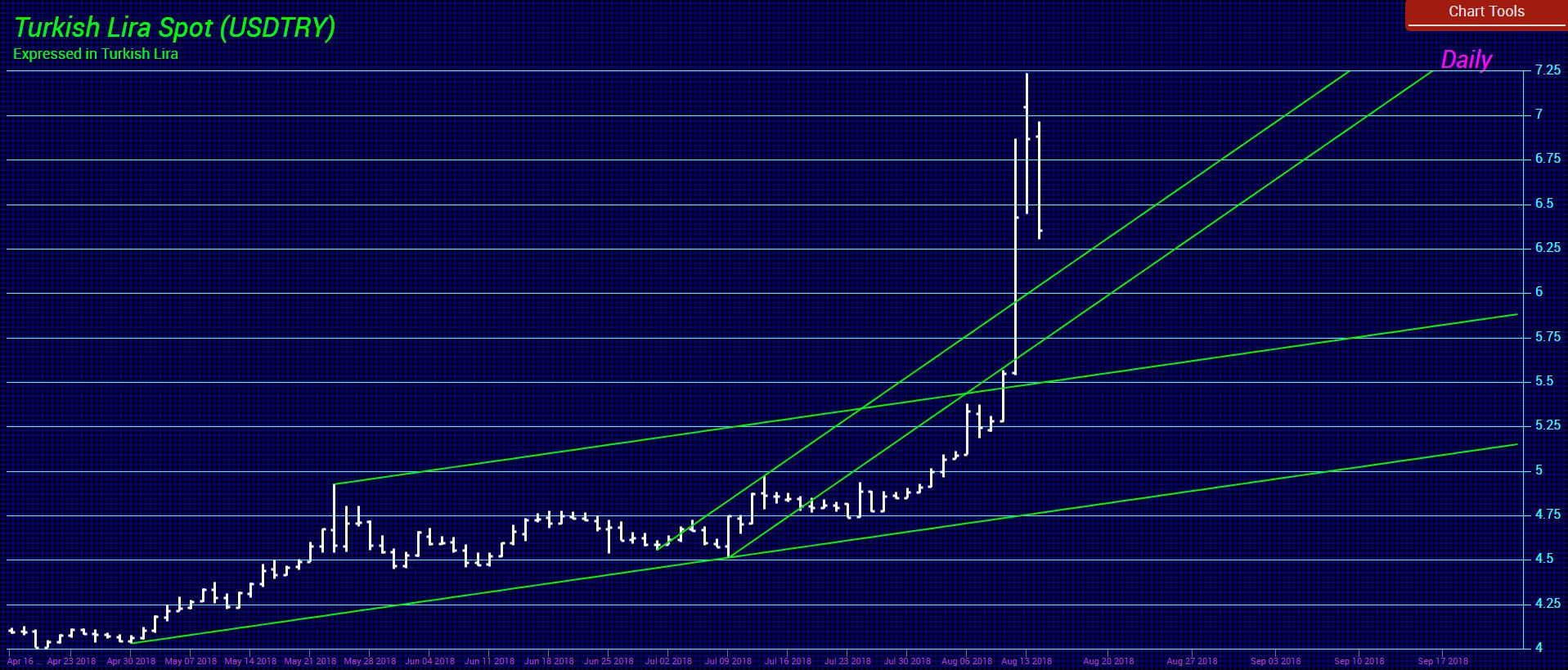
The Crisis is Turkey


President Recep Tayyip Erdogan of Turkey is finding his dreams of an all-powerful resurrection of the Ottoman Empire are falling apart. Qatar has come to the aid of Turkey offering $15 billion in a loan, but keep in mind that the entire issue with Syria began with Qatar proposing a pipeline through Syria to compete with natural gas with Russia. Therefore, it is in Qatar’s best interest to keep Turkey trying to invade Syria. The price will be the pipeline, which we seriously doubt will ever take place.
Erdogan has sent the Turkish economy into a downward spiral for some time. Its soaring inflation has exceeded 100% and rising debt-to-GDP of about 70% under President Recep Erdogan’s regime has been a growing problem. As central banks pumped money into the system over the past decade, nations like Turkey and other emerging market economies used the opportunity to raise more and more “cheap” debt to boost their productivity. Turkey has attracted capital from Europe seeking higher yields because of the negative interest rates policy of the ECB. Now we have a crisis in Turkey that is also the result of Draghi’s Quantitative Easing that drove capital to Turkey and FAILED to revived the European economy.
Erdogan’s dream of restoring the Ottoman Empire is no joke. It has been European money seeking higher yield that kept him in power. It is curious how those who seek dictatorial power are the ones who dream of restoring the power of empires long since dead. Erdogan has wanted to recreate the Ottoman Empire just as the dream of the reestablishment of the old Roman Empire as was the desire behind Napoleon and Hitler. The days of Empire Building are long gone and Erdogan has been living in the past. His goal was to expand his country’s military operations in Syria and this, he hoped, would be the first step as with Hitler’s invasion of Poland. However, the lira collapse and the expensive dollar are conspiring against him. On the one hand, Erdogan is attracted to dealing with Russia who is on the opposite side of the game board with Qatar. Erdogan has the free markets moving against him and he is more likely to turn to Russia than the West to retain personal power. Nevertheless, he turned to Qatar because he was desperate for money to retain personal power. If he loses the support of his military, then they will side with the people and Erdogan’s head may end up on a spike. Yet, the financial markets are working against Erdogan and as the crisis continues, Turkey can hardly afford military adventures.
Many rushed into Turkey and bought their bonds at 20%. Many Spanish banks had capital was invested in Turkish bonds to get the higher yield to the tune of on average 20%+. Based upon the phone calls, there are way too many institutions who invested into Turkey. They simply assumed that NO government defaults because the powers that be will always bail out the bondholders. This time the IMF is really powerless. They can make some noise and others will say the crisis is subsiding. However, this is just talking. There is nobody who can save Turkey at this point as long as Erdogan remains in power. Qatar will discover that Turkey is a bottomless pit. They will try to now ease the crisis with words because of the extensive foolishness of banks and pension funds who bought Turkey bonds to try to get yield.
The fall in the Turkish lira has also benefited the Syrian Army, which launched an offensive on the last large mercenary fortress in Idlib. Turkey was actually against the offensive because it feared that it would fall to Syria and that is against Erdogan’s dreams of taking more territory. What is not really looked at internationally is the plain fact that Turkey does not have its own arms industry. Erdogan needs arms to be imported and as the lira crisis materialized, his Turkish operation Olive branch and shield of the Euphrates in Syria become rapidly too expensive. Back in January 2018, the Siyasi Haber newspaper reported that an estimated $400 million was being spent on Operation Olive Branch alone. Erdogan has spent over $1 billion so far in his attempt to conquer that region of Syria.
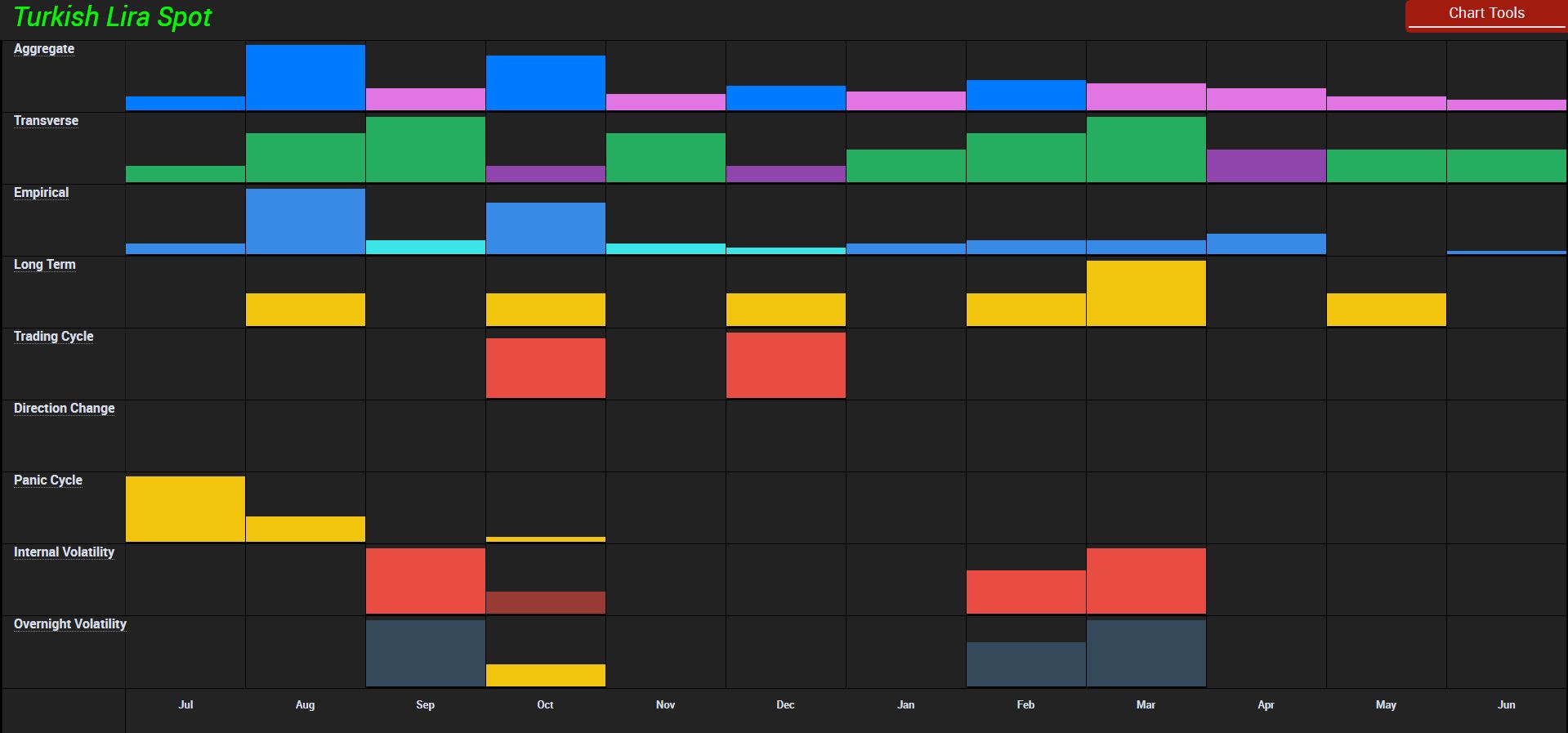
Instead of building his economy and benefiting the people of Turkey, Erdogan has been more interested in resurrecting the Ottoman Empire. It has been his mismanagement of the economy and his hostile attitude even to Greece that is behind the Turkish Lira Crisis. August has been our target for the crisis and so far the computer has been correct on that score. However, volatility will remain high going into October and then we see it will return as the new year begins. Qatar coming to the rescue should help support the lira for now. Those who are wise had better sell their Turkish bonds and step off of this trade. August should prove to be only a temporary low for the lira.

First to crack would be emerging markets and Turkey, 2nd Europe, 3rd Japan, last US


This is No Joke – Monetary Reform Will Be Forced Upon the World


QUESTION: Mr. Armstrong; I really understand why the government wanted your model so bad. You have been the only one to correctly forecast the entire world. The emerging markets are cracking and the euro is falling apart. What is next in your timetable?
ANSWER: We have been warning that the first to crack would be emerging markets and Turkey was the focal point. We are also beginning to witness the debt crisis in China due to loans in dollars as well. Many of these companies simply lacked the sophistication to understand currency risk or hedging strategies. The second in line would be Europe and the Euro is really in danger of bringing the entire world economy down. The third in line will be Japan, and then finally the crisis will hit the USA. We are just living in an era where people have believed the nonsense for far too long. Adam Smith’s Invisible Hand cannot be defeated.
This is SERIOUS. People have to understand that this is NOT my personal belief, opinion, or anything else based upon some predetermined conclusion. People attack me personally because they cannot defend a system that NOBODY in their right mind would have created from scratch. Our system is a patchwork of band-aids that are applied to each crisis and then never removed. Collectively, that have combined to create a complete nightmare. This has become such a mess, there is NOT a single person I know in government capable to even correcting this mess. The truth ALWAYS is exposed.
I am only one person. I do not have the support to manage a global crisis or step in to help every country. This will take a lot more than just me. The countries who want help are generally the peripheral not the majors for this is too political.

Monday, February 26, 2018

Our models tend to reflect that Turkey will see a complete monetary collapse during the 2021/2022 period.

Turkey – Default or War?


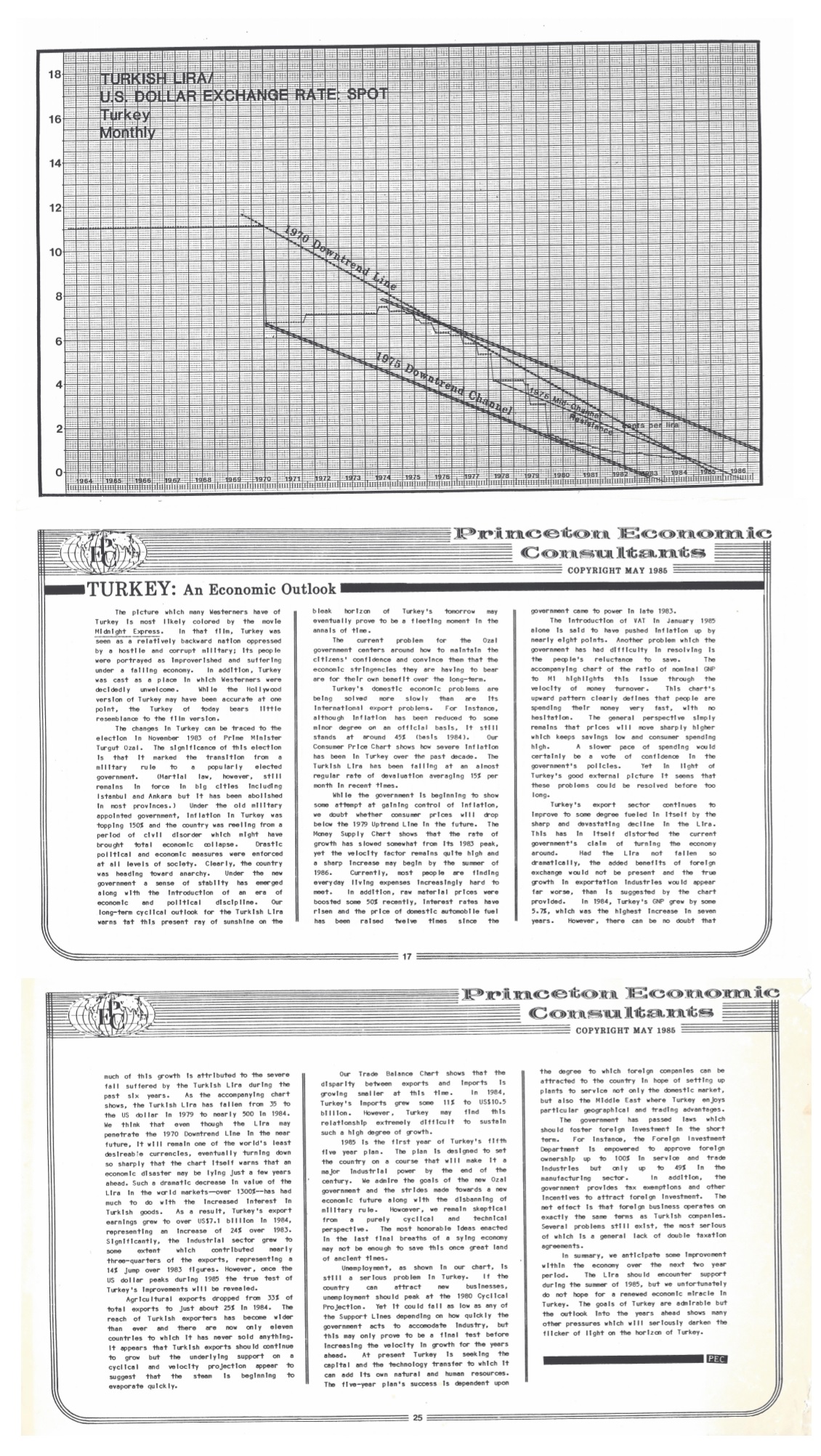
QUESTION: Mr. Armstrong, My father was ______ the banker who commissioned you to do the Turkish lira hedging project in 1983. He passed away as you know. I found this material in his files on Turkey that you apparently published back in 1985. Some articles are saying that Turkey is the epic center of debt. I do not get that sense here and I figured you were really the authority my father always quoted. Can you shed some light on this subject?
Thank you
__
ANSWER: Yes, I remember your father well. You have my sincere condolences. I remember that project for it was very challenging. I had to create a hedging model for the Turkish lira when nobody would make a market. That was one of my earliest synthetic creations.
The Turkish lira continues to move into hyperinflation and it has nothing to do with the fiscal policies of the government. Plain and simple – even its own people do not trust the government nor the currency. Hyperinflation takes place not because of the quantity of money, but because of the collapse in public confidence.
Turkey is BY NO MEANS the epic center of the debt crisis. That is really an absurd statement. Turkey has sold Dollar-denominated foreign debt like all other questionable emerging market countries. That is how they all have sold debt by taking the currency risk on to themselves.
I have been warning that as the US rates rise, this puts pressure on the $9 trillion of emerging market debt issued in dollars. The risk of a major debt crisis starting in Turkey is a very myopic view as we are facing a contagion of a Sovereign Debt Crisis among all emerging markets.
Turkish President Recep Tayyip ErdoÄŸan is an autocratic strongman. The far greater risk is his rising threats against Greece and others to start a war. He has threatened the Kurds with war as well asGreece. He has threatened to extend the Afrin military operation to Manbij.
Yes, it is true that Turkey owes foreign creditors $ 450 billion, of which $ 276 billion is denominated in dollars and euros. The Turkish private sector has about 36% foreign-currency based debt. Because of the decline in the lira, interest rates on domestic loans has risen from 6% to 12%.
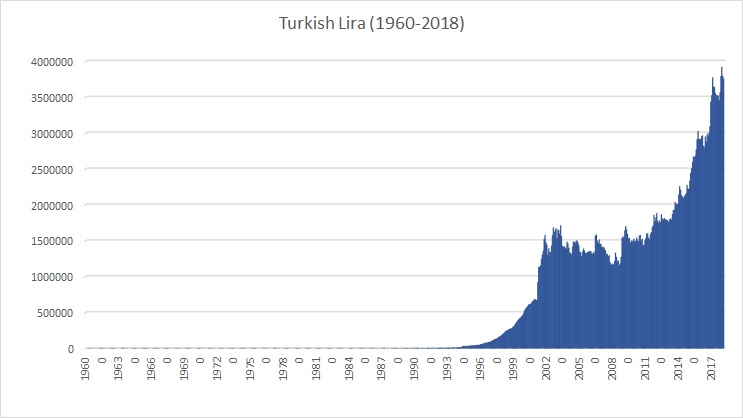
The lira has depreciated against the dollar dramatically since August 1970. It was trading at 9 to the dollar back in 1960 according to our database.
1960 — 1 U.S. dollar = 9 lira (TL)
1980 — 1 U.S. dollar = 0.0001 lira (YTL)
1988 — 1 U.S. dollar = 0.0018 lira (YTL)
1995 — 1 U.S. dollar = 0.0611 lira (YTL)
1996 — 1 U.S. dollar = 0.1075 lira (YTL)
2001 — 1 U.S. dollar = 1.4396 lira (YTL)
2004 — 1 U.S. dollar = 1.3421 lira (YTL)
2008 — 1 U.S. dollar = 1.21 lira (YTL)
2009 — 1 U.S. dollar = 1.6 lira (YTL)
2012 — 1 U.S. dollar = 1.81 lira (YTL)
2016 — 1 U.S. dollar = 2.94 lira (YTL)
2017 — 1 U.S. dollar = 3.77 lira (YTL)
2018 — 1 U.S. dollar = 3.75 lira (YTL)
As interest rates rise, Turkey will certainly find itself in trouble. However, to say that Turkey will just default is one thing. The real risk is that Turkey will start a war to maintain its dignity and suspend all debt payments overseas both public and private.
Our models tend to reflect that Turkey will see a complete monetary collapse during the 2021/2022 period.
The people do not trust the Turkish lira. They are hoarding currency of just about any other country but their own.

Wednesday, September 20, 2017

After Rome fell, the financial capitol of the world moved to Constantinople in Turkey, Byzantine Empire then to India.

Cycle of Knowledge

QUESTION: Hello,
I am a French Astrophysicist and I end up watching with great interest a TV story about Martin Armstrong. As a scientist I am really curious and keen to build new connection between our way of describing the Universe and the bias introduced by our own vision and history. Hence I was wondering if the algorithm that Martin has developed was ever tested on human knowledge discovery or if this is something that could be interesting to do.
Kind Regards,
IA
ANSWER: Absolutely. There is cycle to knowledge that I have also encountered and found fascinating. We reach period of knowledge and then we seem to lose it all and reboot. Society before the Dark Age knew the Earth was round and not flat.  For example, if we look at the ancient Greeks, the knew the Earth was round and not flat. They burned people like Giordano Bruno (1548–1600) alive at the stake for claiming the world was round and it revolved around the sun instead of the other way around. The Greek philosopher Aristotle (384-322 BC) argued in his writings that the Earth was spherical, because of the circular shadow it cast on the Moon, during a lunar eclipse. Another reason was that some stars visible from Egypt are not seen further north. Aristotle wrote:
 The evidence of the senses further corroborates this. How else would eclipses of the moon show segments shaped as we see them? As it is, the shapes which the moon itself each month shows are of every kind — straight, gibbous, and concave — but in eclipses the outline is always curved: and, since it is the interposition of the earth that makes the eclipse, the form of this line will be caused by the form of the earth’s surface, which is therefore spherical.
    Again, our observations of the stars make it evident, not only that the earth is circular, but that it is a circle of no great size. For quite a small change of position to south or north causes a manifest alteration of the horizon. There is much change, I mean, in the stars which are overhead, and the stars seen are different, as one moves northward or southward. Indeed there are some stars seen in Egypt and in the neighborhood of Cyprus which are not seen in the northerly regions; and stars, which in the north are never beyond range of observation, in those regions rise and set.
    All of which goes to show not only that the earth is circular in shape, but also that it is a sphere of no great size: for otherwise the effect of so slight a change of place would not be so quickly apparent. Hence one should not be too sure of the incredibility of the view of those who conceive that there is continuity between the parts about the pillars of Hercules and the parts about India, and that in this way the ocean is one.
(Aristotle, “On the Heavens,” Book II, Chapter 14, The Works of Aristotle, Oxford University Press; pp. 297-298.)
Aristotle, on the other hand, disagreed with the Atomic theory developed by Democritus (460—370 BC) in 465BC. He believed that instead of being matter being made of tiny particles (atoms) that they were all fundamentally air, fire, water, and earth. The Atomic theory was actually first proposed by Leucippus (c 5th cent. BC), and was then adopted by Democritus. The Atomic theory stated that “The universe is composed of two elements: the atoms and the void in which they exist and move.” According to Democritus atoms were miniscule quantities of matter, which he believed could not be destroyed, differ in size, shape and temperature. They were also in constant movement yet could not be seen with the naked eye. He believed that there are an infinite number of atoms.
Then there was the Alexandrian philosopher Eratosthenes (c. 276BC–195/194BC) who actually estimated how large the Earth was. Eratosthenes learned that on midsummer day (June 21) in the town of Syene in southern Egypt, the noontime Sun was reflected in a deep well for it was directly overhead on that one day. Eratosthenes in Alexandria which was about 5000 stadia north of Syene. In Alexandria the Sun on the corresponding date did not quite reach zenith (perfectly overhead), and vertical objects would cast a short shadow. Hence, Eratosthenes calculated that the direction of the noon Sun differed from the zenith by an angle that was 1/50 of the circle, that is, 7. 2 degrees. With this realization, ,Eratosthenes estimated the circumference of the Earth to be 250,000 stadia.
 I have stated before that after Rome fell, the financial capitol of the world moved to Constantinople in Turkey. After the Byzantine Empire fell, that financial capitol moved to India. It was because of the importance of India that Columbus set sail on a mission to India based upon a wrong calculation of the size of the earth. Columbus relied upon the calculations of the earth from Ptolemy. Ptolemy influenced Strabo who in turn reduced the 250,000 Stadia of Eratosthenes to 180,000, and then stated that half of that distance came to just 70,000 stadia, making India reachable by sailing West. So India has played a very important role for Europe bumped into the Americas by trying to sail to India.
This is only one example of how there has been a cycle to knowledge. It is by no means linear. Knowledge is built from experience. Thus, we have to go through the business cycle to advance. This was in part included in Schumpter’s explanation of the business cycle that there are waves of innovation. He did not see what I see studying history that there is also a peak and then a decline to the level of knowledge as well and it is not linear as Schumpter imagined from a small data set.

Thursday, May 4, 2017

Govt cannot borrow internationally, so it now wants to confiscate people’s gold using a bond scheme

Turkey to Confiscate Gold in New Clever Way – To Help Citizens Earn Money


Gold 400 oz Bars

emogin smile haloThe dwindling credit of Turkey and significant decline in its currency, has led to the new clever idea of confiscating gold with a smile. The Turkish Central Bank has set up two new investment opportunities for physical gold on behalf of the government. Their objective is to make the private gold stocks of the citizens available to the financial system for themselves, but how to sell that to the people?.
The Turkish central bank is launching two new investment opportunities for physical gold, according to reports in the Daily Sabah . They are issuing a gold bond on one hand and on the other an instrument for the loan of gold and gold jewelry.
The scheme is that the Turkish government is really seeking to use the precious metal in the private sector making it available to the financial industry. This is being marketed as broadening the financial system allowing citizens to earn additional income with their gold reserves under their mattresses by turning it in to the government. The are pitching that this will stimulate the economy according to Deputy Prime Minister Mehmet Simsek .
What the government is really doing with issuing a gold bond is they are issuing a bond in return for your gold. They are promising to pay a certain interest rate during the term of the paper in Turkish lira. This interest rate will be oriented towards the development of the gold price. The gold-covered loan certificate also entitles the holder to receive interest after physical gold or gold jewelry has been deposited with the intermediary bank.
This clever scheme means that the government cannot borrow internationally, so it now wants to confiscate people’s gold using a bond scheme that in the end they will be forced to default. This will be a major test of the saying: You can fool all the people some of the time and some of the people all the time, but you cannot fool all the people all the time.

Wednesday, April 19, 2017

Turkey - war cycle seems to be working on time as this is lining up with that model pinpointing 2020

Erdogan Seizes Total Control of Turkey


Erdogan-3
Turkish President Recep Tayyip Erdogan has achieved his dictator status which was his long-held ambition to expand his powers after the referendum handed him the reins of supreme power. However, the integrity of the vote is seriously questioned and the slim victory of just 51.4% approving a series of constitutional changes converting Turkey’s political system from a parliamentary to a presidential one, means there is going to be tension in Turkey looking forward. There will be no real checks and balances in place.
The opposition parties naturally called for the vote to be annulled because of a series of irregularities, The electoral board decision to accept ballots that did not bear official stamps has really called into question did the people really vote for this dramatic change.
The press in Turkey, like in Europe and America, seems to be just political propaganda always supporting whatever the government wants. Erdogan used his full powers of the state and government to dominate the airwaves and billboards while the opponents complained of intimidation, detentions and beatings. His response to the critics tyook the position that Turkey’s referendum was “the most democratic election … ever seen in any Western country.”
In Istanbul, there were protests chanting “thief, murderer, Erdogan” while banging pots and pans. The opposition, which is nearly 50% of the country, do not believe the votes were even real. Of course, Erdogan rejected all criticism as he spoke to flag-waving supporters in the Turkish capital, Ankara that were arranged and staged giving the airs of North Korea.
You can see Erdogan ‘s vision of resurrecting the Ottoman Empire hidden in his words. “The crusader mentality attacked us abroad. … We did not succumb. As a nation, we stood strong.”
Fall of Constantinople
ConstantineXI(1453)QuaterHyperThe  Ottoman Empire lasted for two cycle intervals of 309.6 years beginning about 1302 and its fall was 1922/1923. This attempt to resurrect it has come right on target – two intervals of Pi 31.4 years or 2016/2017. The next target is 2018/2019, which will be 18 intervals of Pi from the fall of Constantinople in 1453 with the last Emperor – Constantine XI (1448-1453). The war cycle seems to be working on time as this is lining up with that model pinpointing 2020.
The problem with Erdogan is he still lives in the past and believes in the battle of Conquest for power to him is defined by territory possessed. This was his objective to removing Parliament and seeking full dictatorial power