Monday, October 9, 2017

Why would anyone buy European bank stocks?


The European banking crisis is still brewing. The biggest problem rises from the rules that if a bank is in trouble, they just seize the bank and sell it for $1 and all the shareholders lose everything. This is having serious impacts on the European Banking System as a whole as I previously warned. The Italian bank Carige has had difficulty in trying to raise capital to meet requirements. If any bank cannot raise enough capital to meet the requirements, the European supervisory authorities can seize the bank in accordance with the new rules. Once again, the government solution is to make up rules that totally disregard the private reality. 
Why would anyone buy bank stocks in Europe today if the government can seize everything and shareholder get zero? Spain’s Banco Santander bought rival Banco Popular for €1. This is Brussels’s new system to rescue failing banks without burdening taxpayers or stressing markets. This was cheered around the world because the shareholders lost absolutely everything. The bank which was valued in the collapse at €1.6 billion was bought for €1. Why would anyone buy European bank stocks?

Sunday, October 8, 2017

Democracy - buying the votes of groups to maintain the lifetime jobs.

Why is Congress at 31% & Trump at 41% Approval in the Polls?


A root cause for Congressional ineffectiveness will be found in the simple fact that the exercise of good governmental judgment cannot possibly compete with re-election pressures. This is why term limits are ABSOLUTELY  MANDATORY if we ever hope to have a reasonable government. There is a substantial conflict between good government and corrupt ineffective government. Congress has merely been transformed into a school how to be corrupt and get away with it.
Congress has only at best a 31% approval rating against Trump at 41%. Democrats in Congress are at 29^ with Republicans at 36%. Nancy Pelosi is at 35% and Chuck Summer is at 23%. Yet CNN and the New York Times bash Trump as being so unpopular while they ignore Congress’ approval rating.
What is amazing is that people criticized Trump for lacking experience in government. Yet, politicians lack any skill set whatsoever to understand the real world. There is no advantage to the nation from lengthy political office holding for there is no empirical evidence that it has increased the knowledge or skill to run the nation. Unfortunately, the only skill or increased knowledge is confined to re-election techniques and how to raise money. This is always counter-trend to the public interest of running the nation. So much governmental expenditure is pressured by the re-election fervor that the real Federal deficit cannot be closed and the Federal debt will continue to skyrocket without end. These debt ceiling increases are a joke because they all just want to spend money so they get re-elected. That is using public funds for personal gain at the expense of our future.
From 1789 to 1855, members of Congress received only a per diem (daily payment) of $6.00 while in session, except for a period from December 1815 to March 1817, when they received $1,500 a year. Members began receiving an annual salary in 1855, when they were paid $3,000 per year.
1780s–1820s was the formative era when the good of the nation tended to be at least on the agenda when they earned just $6 per day when they showed up. The 1830s–1900s was known as the partisan era. This was followed by the 1910s–1960s known as the committee era which was a system of seniority that handed long-time Members of Congress more and more power and encouraged politicians of both parties to serve for long terms which has continued into the present time. This was augmented by the 1970s–present, known as the contemporary era, which is all about spending money to create socialism and buying the votes of groups to maintain the lifetime jobs in Congress.
All of this should be changed to one-term and out. Then we can get back to the formative age where country returns to the to of the list of important consideration

Friday, October 6, 2017

The EU is retroactively changing taxes.

EU is becoming a No-Go-Zone for Business


The European Union has ordered AMAZON to pay about 250 million euros ($294 million) in taxes to Luxembourg, saying it was given an unfair tax advantage from 2003 because it paid less than they would have paid in France or Germany. The EU is retroactively changing taxes. This is a sure fire way of telling companies to get out of Europe. If no matter where you build your plant, if you would have been paying a higher tax in France or Germany, the EU says that is not fair and you have to pay more in BACK TAXES.
In restructuring companies, taxes were always NUMBER ONE after Country Risk. The EU has just made Country Risk paramount. Honestly, I would have to advise companies NOT to set up shop inside the EU. Best to go to the UK and pay any tariff than to be retroactively taxes because the EU is broke. This is introducing a whole new risk into the mix. The EU is becoming a no-go-zone for business

Gold – Dollar -Trade Deficits All Mixed Up


COMMENT: Marty; I get these emails about gold and have to wonder how people can keep preaching the same thing for decades and never be correct once. Not they say in a very simplistic manner that  Politicians argued that endless trade deficits were immaterial because U.S. exceptionalism allowed America to do what it wanted. If foreign leaders refused to accept dollars for commerce as Saddam and Gaddafi did, the U.S. used its military might and CIA for regime changes. Even the strongest adversaries like China and Russia cannot compete against U.S. weapons of mass destruction, so they are increasingly engaging in currency wars of their own to protect their national sovereignty. Is the dollar in trouble as a result?
They seem to advocate the collapse of the USA is necessary so they can make money on gold. Like you said on Global Warming, they want to reduce the population so a good thing would be to stop having children without thinking the birth rate is down so pension are collapsing.
What you have shown is none of this nonsense is necessary for gold to rise and that trade is a tiny fraction of capital flows. Are these people just mindless? The dollar is the lynch pin holding everything together. Here in Europe we have a lot more problems than the USA. BitCoin crashed because the Chinese were fleeing to dollars trying to get their money out of China.
REPLY: This is the classic problem in analysis. You fit the fact to your predetermined conclusion. They keep praying for the collapse of the dollar to make gold go up. The problem is then, if everything collapses, what good is gold if you cannot spend it because nothing has survived?
Very strange theory. BTW, Saddam and Gaddafi did not reject dollars. I even managed money for Muammar Gaddafi TWICE. He had no problem pouring millions of dollars into accounts to trade. I also knew Milton Friedman who advised that a floating exchange rate would provide a check and balance on the system where fixed exchange rates . The trade deficit is offset by the capital account reflecting investment. In fact, if a foreign entity BUYS American debt, that inflow goes into the capital account – not trade account. However, the interest payments go out in the Current Account commonly called the Trade Account. There do not even understand the accounting.
The more foreign investors come into America and the repatriate their profits, the “trade deficit” will appear to get worse and it has NOTHING to do with trade.

Thursday, October 5, 2017

ECB v the Federal Reserve – Different Animals Altogether


QUESTION: Do you you really think Trump would let the Central Banks Default? He said we would write off Puerto Rico's debt maybe he plans to write everything off can he do that? If this really did happen wouldn’t the dollar be worthless?
S
ANSWER: It seems as though far too many people ASSUME that all central banks were createdEQUAL. Sorry – that is just not the case. These people who do not really know what they are talking about assume that just because the Fed has the power to create elastic money, that therefore the ECB can do the same thing. SORRY – WRONG!!!!
There is a substantial difference between the Federal Reserve and the European Central Bank (ECB).
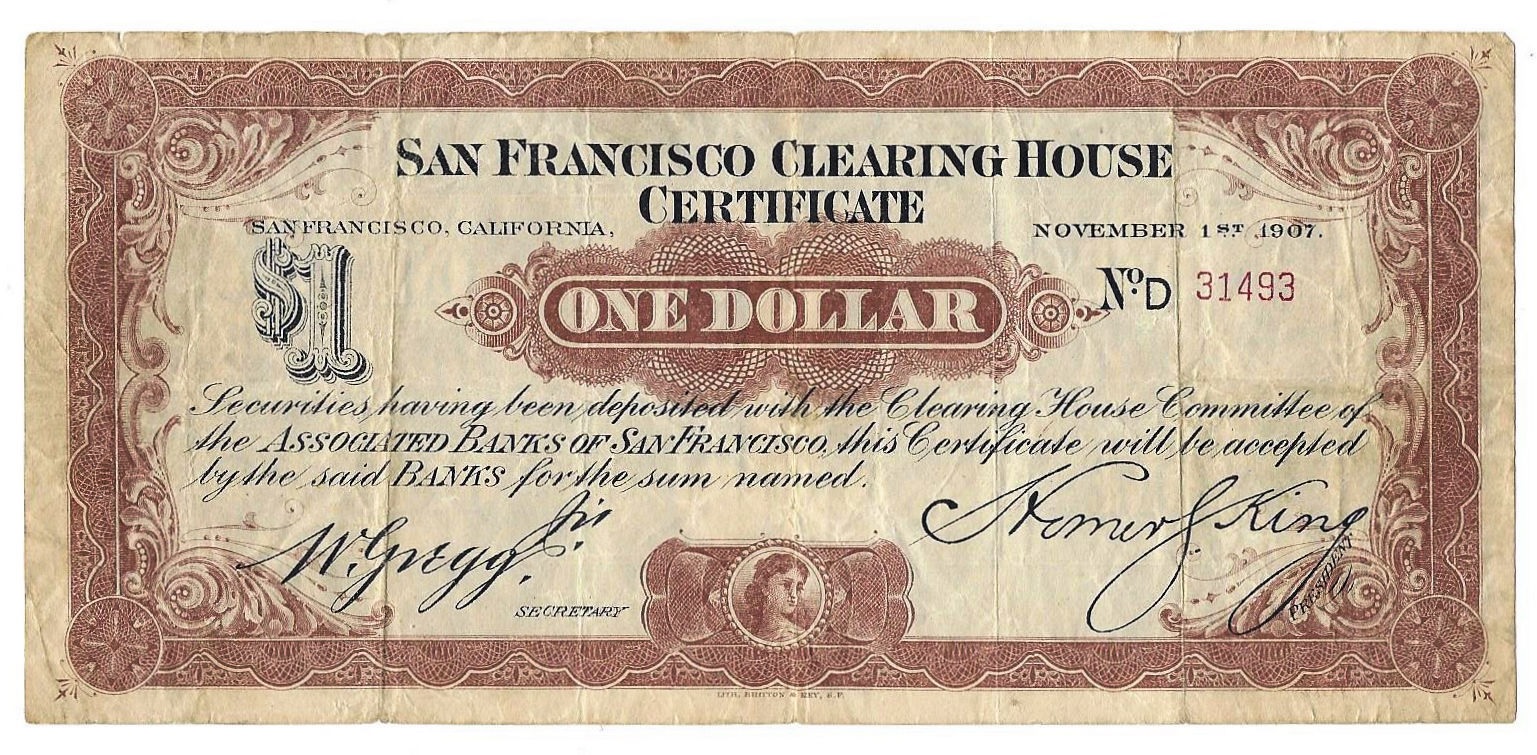
The accounting at the Fed allows for it to CREATE money as needed. Now the fiat crowd will argue that the Fed can just create money in a very ELASTIC money supply. This is true and it was intended from the very outset that when economic declines appeared, the leverage within the system would implode and thus to ease that contraction in the supply of money. Hence, the shortage of money resulted in defaults and assets decline in value relative to the contraction in money supply. Therefore, the Fed was created with the power to create ELASTIC money based upon the system of Clearing House Certificates that had pre-existed during the 19th century. The Clearing House  would issue its own money and then after the crisis, that money was retired – hence the term ELASTIC.
So how does this contrast with the ECB? Here in lies the problem. The ECB is NOT authorized to create
an ELASTIC MONEY SUPPLY. Germany would never allow that. Consequently, the ECB cannot continue to just buy-in sovereign debt of member states as the market forces come down upon them. The ECB, unlike the Fed, will run out of money and then there will be a very public crisis whereby the ECB will have to be recapitalized. I wrote about this before in Federal Reserve v ECB.
I warned back then that “Something will have to give in Europe.” The ECB was granted a ceiling to buy in government bonds. It cannot just print money with no end in sight. It must get approval, which the Fed does not require from Congress. The two are completely different animals.
On top of this, each member state retained its own central bank. Each member bank issues euros in their domestic economies. You can collect euro coins from each central bank – the ECB does not issue them.
Then the reserves of the European banking system had to be politically correct and the reserves were composed of all member bonds. Why? Germany opposed a single European debt issue.

Now, the Fed bought in $4 trillion against $20 trillion and the debt was only federal. The ECB bought the worst debt and now owns 40% of the total debt of the Eurozone members. Why is the ECB in danger of a default?
If there is a disagreement in Brussels, then the ECB runs out of cash. As interest rates rise, the value of its balance sheet will collapse. The ECB cannot sell the debt back to the market for there is no bid. To try to support the debt market, Brussels made it illegal to short government debt. Hence, there is no free market in European sovereign debt. If the ECB bought 40% of all debt, who is going to buy it when they stop?
This is a completely different perspective v the Federal Reserve which will just let its US federal debt holdings mature and expire. They too cannot sell the debt or interest rates would explode.
Welcome to the reality of the crisis. NOT all central banks were created equal. Those who paint them all with the same brush know nothing about what they are talking about. The ECB claims it cannot go bankrupt because it will just issue more money. The fact that they have even stated that demonstrates there is a huge problem. That depends upon one thing – approval from the politicians to issue more money.
I meet with central banks directly! This is comments about a field I only read about in the newspapers. I am not even sure the newspapers ever reported the actual differences between the central banks.
Governments are NOT a single entity. Central Banks are far too often on the opposite side of the table with the Political side of government. It is far more complicated than most people would ever guess.

Monday, October 2, 2017

The Theory of Non-Linear Intervention


Economics is well known for rather unrealistic theories based upon fundamentally unsound principles, such as the assumption that all things remain equal. Reality parts with academics whenever such assumptions are drawn to a foregone conclusion. However, greater false assumptions, which go unnoticed, lie at the foundation of so many theories in economics – primarily the assumption of linearity.
In our thinking process, we all are trapped by the Aristotelian sequence of logic – if X takes place then Y must follow. Unfortunately, we think in a linear fashion and, as such, most theories seek to embellish this very basic assumption. The financial world honestly wants to believe in simplistic notions. Raise interest rates and demand will subside along with inflation is but one false linear assumption. Man prefers to believe in linear relationships and systems, because anything beyond two variables becomes far too complex for rational thought processes.
Man’s natural tendency toward linear thinking has indeed created many heated battles. The arguments between supply and demand-side economics is one such example. Given the assumption of a linear economy, demand-side economists argue that the economy can be controlled through the manipulation of government spending and interest rates. In effect, demand-side economics seeks to use the consumer (demand) as a club to beat capital over the head. Yet these same demand-side economists claim that supply-side economics benefits the rich at the expense of the poor. Strangely enough, throwing the consumer out of work and causing higher unemployment to affect lower demand is the core of demand-side economics. It is hard to see how demand-side benefits the poor at the expense of the rich. The supply-side economist argues that there should be less government intervention in demand. Instead, government should stimulate the economy through encouraging greater output through supply stimulation.
Both sides have identified two extremes within a non-linear system, even though, based upon a linear assumption, their arguments assume that the other is totally wrong. If we look at just the last 10 years of economic activity one can clearly see changes within the infrastructure which provide a period where each form of economic management would indeed be appropriate.
Looking at the period of 1976–1980, it would be difficult to label this period as anything other than an inflationary spiral led by demand. Raising interest rates would be appropriate under such conditions when it is demand which flourishes wildly beyond its normal capacity. Hoarding and speculation was in full bloom. Therefore, one should employ “demand-side” economics when it is, in fact, demand which is out of control.
Nevertheless, in the post-1986 era and particularly since the ’87 crash, speculation is hardly the issue. We do not find excessive demand leading to the hoarding of commodities, as was the case leading into 1980. Yet, governments around the world are still employing demand-side economics to curb inflation, which is being caused by real shortages in labour and commodities. Clearly, in this case at least, supply-side economics makes much more sense. If interest rates continue to rise, the world economy will be threatened by a sharp and severe recession. However, the shortages on the supply side in energy, agricultural and base metals will not be corrected by raising interest rates. Higher interest rates will not cause the weather to return to normal. Higher interest rates will certainly not encourage miners to open new mines. Higher interest rates will also not cause a reversal in trend within the energy sector where exploration has been cut by more than 50% in the last two years.
Supply-side economics is as valid as demand-side. There is a time and place for everything within the system because the system itself is non-linear. The chart provided illustrates our Theory of Non-Linear Intervention. This theory is essentially very simple and is based upon actual observation.

The standard economic assumption under demand-side economics is that raising interest rates will lower demand and inflation. If, in reality, this were the case, then Argentina with 300% interest rates per month would not be possible. However, continually raising interest rates does not prevent inflation. At some point in the system, confidence breaks down and higher costs in interest rates only add to costs of production and doing business. Eventually, this spurs on inflation instead of reducing it. Today we have gone to negative interest rates trying to stimulate inflation by punishing people if they fail to spend their money. What is constantly overlooked is the mere fact that if people worry about surviving the future, they will hoard money and save for the rainy day. The evidence of this are all the hoards of ancient Roman and Greek coins that reveal in times of uncertainty, people simply buried their money for a rainy day.
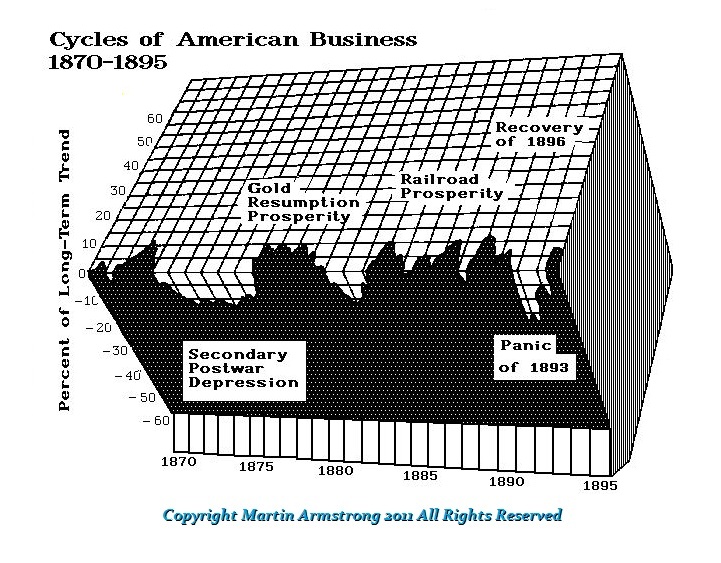
The very basic assumption that the system is linear is obviously incorrect. The business cycle exists throughout all times and portrays that the system is very much non-linear. If any effect is taken to extremes, the exact opposite effect emerges. This is the result of Non-Linear Intervention. Each economy possesses a different infrastructure. Consequently, the threshold where interest rates will cease being anti-inflationary and transform itself into the catalyst of inflation resides at different levels in each economic system. Differences in the value of labour, taxation, political systems and market mechanisms must be taken into account.

In conclusion, government intervention, which seeks to manage the economy in an efficient manner, always fails because they are conflicted with self-interest. They are the biggest debtor within society. Attempts to only manage the economy by  demand-side economics ignores the free market entirely. Intervention cannot possibly work when government remains in the dark about how the economy even functions. They fail to comprehend the direction and cause of inflation or deflation. The first step is recognizing that there is a business cycle, the second is to accept that a cycle exists, and third, we merely try to prepare for the downturns exactly as David advised the Pharaoh – 7 years of plenty v 7 years of drought.

Diversification – Smart or Dumb?


WorldIntRates-2012
QUESTION: Mr. Armstrong; Do you believe in portfolio diversification?
ANSWER: No not really. I see no point in putting money in something you know will be a loss. Diversification within a sector is one thing. But buying government bonds when rates are at a 5,000 year low and governments are in trouble around the world, I just see as really stupid.
Once you understand how our global model works, you can see the trend unfolding in a numerous instruments that therefore confirms the trading direction. For example, we warned that gold had made an important high and would crash from 2011 for at least 3 years minimum. At the same time, we warned that the Dow would breakout to new highs. Barrons reported that forecast and did not believe that we would be correct. Both the high in gold and the breakout in the Dow were connected. Each confirmed the other among a host of other relationships.
What is impossible is trying to forecast just gold or the Dow in isolation relying upon fundamentals, which always prove to be worthless. Take the Long-Term Capital Management Crisis of 1998. The problem began in Russia and investments there collapsed but you could not get out at any price. They began selling assets everywhere else in the USA to Japan. This became a liquidity crisis that spread into a contagion. You could look at all of the fundamentals that said nothing should be happening in Japan. That led to massive losses in Japan that were contrary to fundamental analysis.
Everything is interconnected. Diversification is for people who cannot forecast so they just hope to stay ahead of the game. Asset Allocation has to be done smartly. You need some cash and those who will want some bonds v equities simply need to stay short-term and away from issues that will be a problem.