Showing posts with label Hyperinflation. Show all posts

Saturday, June 15, 2019

Governments have often resorted to forced loans .

Forced Loans People Ignore Until it’s TOO LATE

QUESTION: With the private vs public debt and interest rate discussion, nobody is mentioning things like government legislation to forcing people to buy government debt. For example 401’s, IRA’s… must have or be in government debt.
Your thoughts?
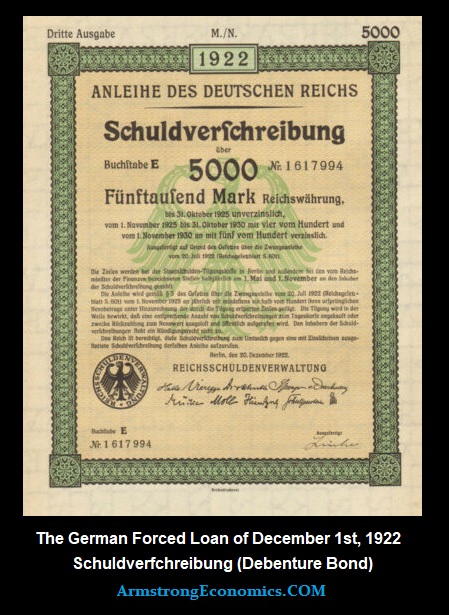
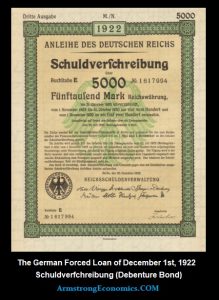
ANSWER: Governments have often resorted to forced loans. When Italy was in trouble, they took 90-day paper and converted it to 10-year paper. Most people are clueless about the German hyperinflation. They assume it was due to the government printing money. The spark was December 1922 when the government confiscated 10% of everyone’s property and handed them bonds as a forced loan. Confidence completely collapsed at that moment.
This is all part of the process of the decline in confidence in the government. This is why the system is unsustainable. We will be heading into a great monetary crisis very soon.

Tuesday, April 23, 2019

The Consequence of War that Led to the German Hyperinflation


QUESTION: Everyone has a chart of the German DAX postwar. I have never seen a chart of the German stock market before the war. Do you have any?
HVS
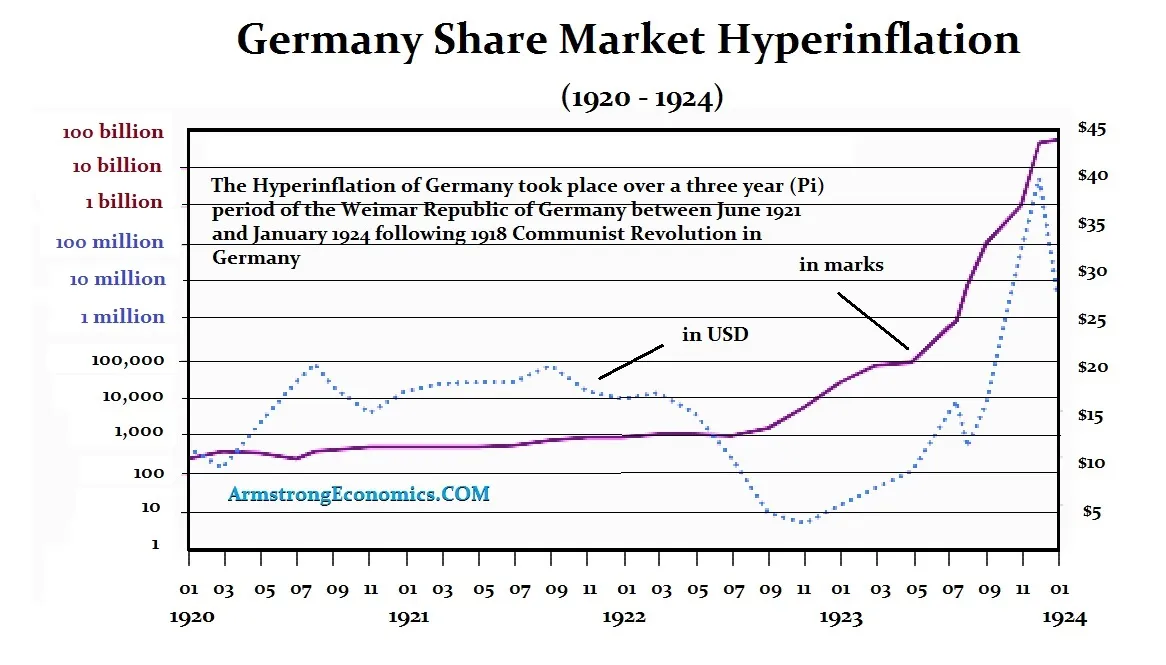
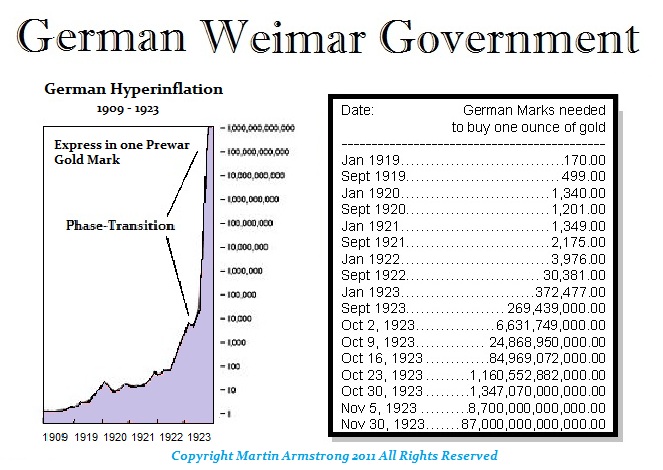
ANSWER: Yes. However, you must understand that because the world was on a gold standard, the arbitrage volatility was reflected in the bond and share markets when the currency was fixed. This is why the German share market closed in August 1914, along with just about everyone else. Here is a chart that show the performance of the German share market during the hyperinflation period. We have the DAX also extended back in time. But don’t forget, the DAX is a total return index. If we plot just price, you will see that the German share market looks very much like France.
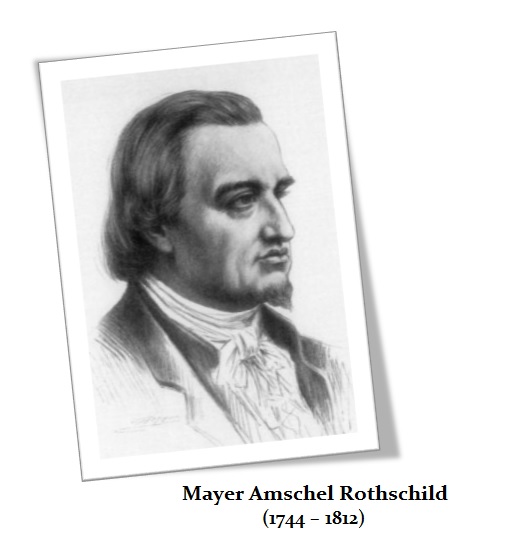
The primary stock exchange in Germany was in Berlin. However, there were 21 exchanges in total. The origins of the Frankfurt Stock Exchange date back to medieval trade fairs during the 11th century. By the 16th century, Frankfurt developed into a wealthy and busy city with an economy based on trade and financial services. Annuities in particular were the hot items back then. It was in 1585 when the bourse was established to trade in fixed currency exchange rates. Currencies actually led to exchanges rather than shares. Eventually, Frankfurt developed into an early share market, competing with London and Paris. Mayer Amschel Rothschild and Max Warburg became very influential in the financial trade of Frankfurt.
The Frankfurt Stock Exchange had been a major international center. It was completely wiped out by World War I and its consequences. Back then, foreign shares and bonds traded on cross exchanges since money was fixed. German investors at the start of World War I dumped foreign bonds and shares, fearing that their capital would be restricted or confiscated. This is also why all the exchanges simply closed in Europe. Any capital they managed to free up from the sale of foreign investments was reinvested mostly in German government bonds. They were patriotic and believed in their government. However, by the end of the war, the Frankfurt Stock Exchange lost all foreign securities listings for bonds or shares. Frankfurt lost its standing as an international stock exchange entirely, and that would only begin to resurface in 1949.
In Europe, the fear of catastrophic declines in stock prices was met with controls at first. Overall, stocks and bonds were not allowed to trade below the price they had been trading at on July 31, 1914. Restrictions were also placed on capital. Money movement was highly restricted to preventing any large outflows of capital, forcing many into black markets. One means was to buy collector stamps and coins. They would then export especially rare stamps and then sell them in America. After two world wars, most of the rare stamps happened to be in America and gradually returned to Europe during the late 1960s.
With these restrictions in place, markets reopened in Europe. The London Times began printing stock prices for London and Bordeaux on September 19th and for Paris on December 8, 1914. In January 1915, all shares were allowed to trade on the London Stock Exchange, though with price restrictions. The St. Petersburg exchange reopened in 1917, only to close two months later due to the Russian Revolution. The Berlin Stock Exchange did not reopen until December 1917.
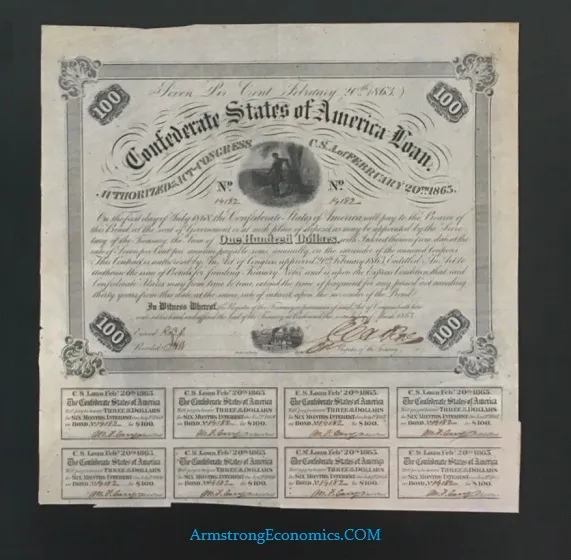
The loss of the war meant those who had invested in German bonds suffered the same fate as those Americans who invested in Confederate bonds. Indeed, to fund World War I, Germany relied more on raising money by selling bonds than imposing taxes. This had the net effect of wiping out the savings of the middle class and upper class. During the hyperinflation going into 1923, the losses in bonds were devastating, but in contrast, equities became a prized object among speculative investors. The Frankfurt stock exchange saw unprecedented losses in the bond markets and shares became the speculation objects that rose sharply going into 1923.
The German war costs covered by taxation, including state and federal combined, was only 13.9% which was lower than 18.2% taxation imposed in Great Britain for the war effort. German debt exploded after 1916. That is when the federal government’s short-term floating debt grew relentlessly, and by the end of the war it accounted for nearly one-third of the German national debt. The seriousness of the German debt crisis, which led to the postwar hyperinflation, was the fact that after 1916 German banks began to purchase more of the government’s floating debt. Government debt dominated the market and banks took on more public debt than private. When the public debt was marginalized by hyperinflation, it also wiped out the banking system.
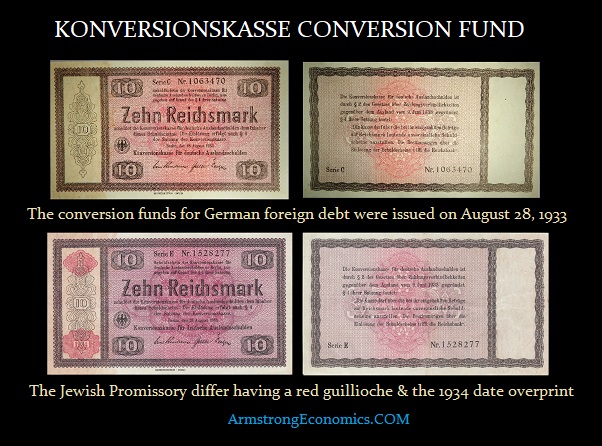
By the end of the war, the international contacts of the Frankfurt Stock Exchange had been lost. Inflation set in and reached its first peak in 1923. In October 1929, the Germany stock exchange prices crashed dramatically on the 25th. The world economic crisis ruled the following years. The economy only began to stabilize in 1932. The following year, the Nazis took over and centralized the nation’s economic policy. The Frankfurt Stock Exchange was merged with the Mannheim Stock Exchange and the number of exchanges nationwide was reduced from 21 to nine. Under the stringent Nazi economic regime, free trade was suffocated as Hitler defaulted on external debt. The majority of capital assets was directed to benefit the war economy. He even issued conversion fund certificates that were exchanged one for one with German marks if you sought to leave the country. This was part of the currency controls but they were worthless once you left the country.

Tuesday, December 25, 2018

German Hyperinflation & the Dawes Plan


The German Hyperinflation was by NO MEANS about inflation created by an increase in the money supply under the Quantity Theory of Money (QTM). Today, Angela Merkel has forcefully imposed Austerity upon the whole of Europe because she really does not understand what even caused the hyperinflation. It was at the Palace of Versailles outside Paris when Germany signed the Treaty of Versailles on June 28th, 1919 with the Allies, officially ending World War I. AT that time, the English economist John Maynard Keynes attended the peace conference. However, Keynes left in protest of the treaty becoming the first outspoken critic of what would prove to be the most punitive agreement that only set the stage for World War II and the rise of Adolf Hitler in 1933.
John Maynard Keynes wrote in his The Economic Consequences of the Peace, which he published in December 1919, that the harsh war reparation payments and other harsh terms that they were to impose on Germany by the treaty would lead to the financial collapse of the country. Keynes further warned that this Treaty would result in serious economic and political repercussions on Europe and the world as a whole. The political trend at the time refused to listen. This was all about punishing Germany.
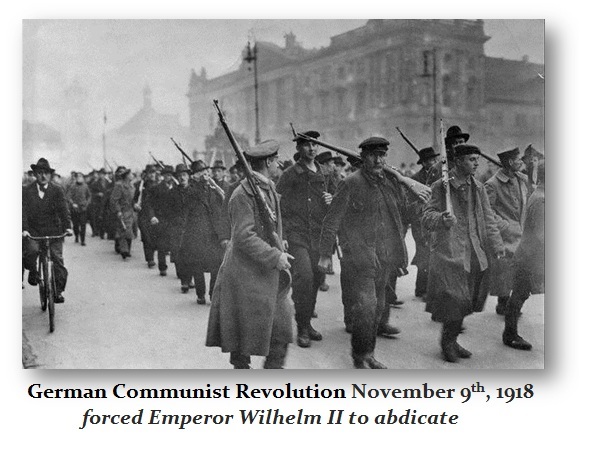
We must also understand that wars are created by politicians – not the people. Prior to the Treaty of Versailles signed in June 1919, there was the German Communist Revolution which began the Weimar Republic. It was this 1918 German Communist Revolution which was inspired by the 1917 Russian Revolution that resulted in the overthrown of the monarchy in Germany ending the Emperors and the king of Prussia. The revolutionary period lasted from November 1918 until the adoption in August 1919. But what also seems to be omitted from many accounts taught in school, is the simple fact that the German government interfered in the Russian Revolution and was instrumental in creating the Russian Revolution.
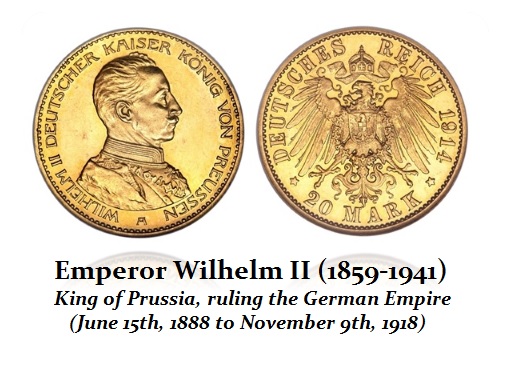
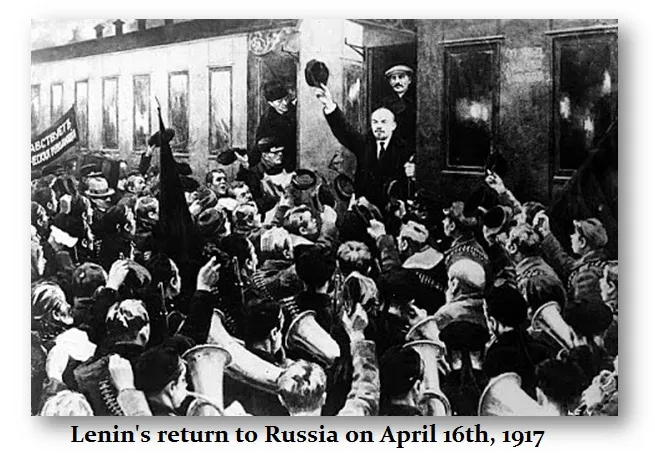
The German Emperor Wilhelm II Imperial Government actually feared that Russia would enter World War I. The rising communist movement in Russia was anti-war. Germany saw a chance for victory in Europe if it kept Russia out of the war. Hence, Germany supported the Communist anti-war sentiment of the Bolsheviks in Russia. Germany permitted Vladimir Lenin (1870-1924) to travel in a sealed train wagon from his place of exile in Switzerland through Germany, Sweden, and Finland to Petrograd. Since the start of the February Revolution in Russia, Lenin was trying to figure out a way to get back into Russia. Germany aided his return assuming he was anti-war and would thus keep Russia out of World War I. Lenin returned to Russian on April 16th, 1917. Within months of arriving, Lenin led the October Revolution in Russia and the Bolsheviks seized power and indeed Russia withdrew from the world war. According to Leon Trotsky, the October Revolution would not have succeeded without Lenin.
With the success of the October Revolution in Russia and the Dream of a new Marxist Utopia, the Germans entered into a civil war and invited Lenin to please take Germany. Clearly, the scheme of the Imperial German government had backfired. It not only was instrumental in creating the Soviet Union by turning over Russia’s socialist transformation decisively into the hands of the Bolsheviks, its plan led to the overthrow of its own hold on power. This is all recorded in contemporary newspapers (see New York Times Nov 11, 1918).
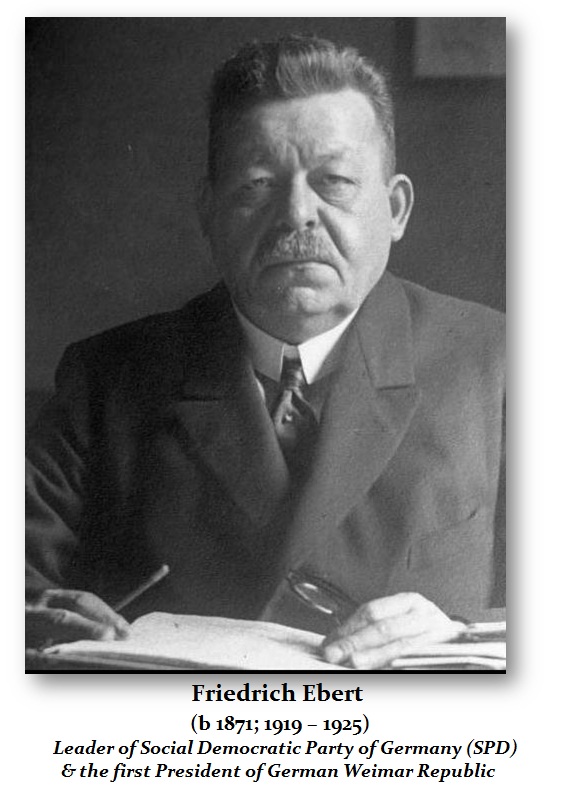
The Prussian Emperor Wilhelm II (1859-1941) found himself in the midst of troubling economic and social disorder. A series of mutinies by German sailors and soldiers undermined Wilhelm II’s government and he lost the support of his military which enabled the German people to revolt. Wilhelm II was forced to abdicate on November 9th, 1918. The very following day, a provisional government was announced composed of the Social Democratic Party (SDP) and the Independent Social Democratic Party of Germany (USDP). To this day, the SDP has remained as a major part against all opposition. Then in December 1918, German elections were held for a National Assembly with the goal of creating a new parliamentary constitution. On February 6th, 1919, the National Assembly met in the town of Weimar and formed the Weimar Coalition. They also elected SDP leader Friedrich Ebert (1871-1925) as President of the Weimar Republic who served from 1919 until 1925.
It was Friedrich Ebert who had to deal with the Treaty of Versailles. When the terms became known on May 7th, 1919, the German people rose in protest. Ebert himself did denounce the treaty as “unrealizable and unbearable” yet he understood that Germany was not allowed to negotiate nor reject the treaty. Ebert even asked Hindenburg if the army could put up a defense if the Allies renewed hostilities. Hindenburg said that the army was not capable of resuming the war even on a limited scale. Ebert then advised the National Assembly to approve the treaty, which it did by a large majority on July 9th, 1919.
The Treaty of Versailles commanded Germany to reduce its military, take responsibility for the World War I, relinquish some of its territories and pay exorbitant reparations to the Allies. It also prevented Germany from joining the League of Nations at that time. Thus, the treaty punished the German people for the sins of its government. Indeed, the military created World War I for it is generally accepted that Wilhelm II was largely just a ceremonial figurehead. During the Sarajevo crisis with the assassination of the Archduke Franz Ferdinand of Austria on June 28th, 1914, he was Wilhelm’s friend and he offered to support Austria-Hungary in crushing the opposition who assassinated the Archduke. Wilhelm went on his annual cruise of the North Sea July 6th, 1914. Wilhelm returned to Berlin on the 28th of July that year and eagerly read a copy of the Serbian reply. Wilhelm wrote his comment on it:
“A brilliant solution—and in barely 48 hours! This is more than could have been expected. A great moral victory for Vienna; but with it every pretext for war falls to the ground, and [the Ambassador] Giesl had better have stayed quietly at Belgrade. On this document, I should never have given orders for mobilization.”
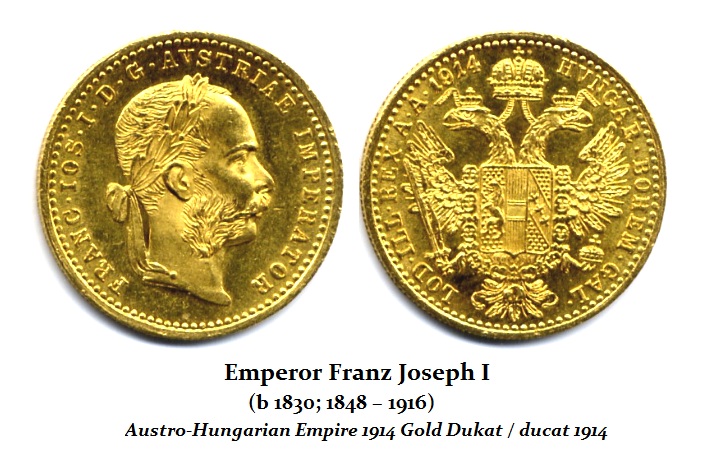
Wilhelm did not know at the time that the military had convinced the Emperor of the Austro-Hungarian Empire, Franz Joseph I (b 1830; 1848 – 1916), to sign a declaration of war against Serbia. As a direct consequence, Russia began a general mobilization to attack Austria in defense of Serbia. Wilhelm wrote a lengthy commentary containing his observations:
“… For I no longer have any doubt that England, Russia and France have agreed among themselves—knowing that our treaty obligations compel us to support Austria—to use the Austro-Serb conflict as a pretext for waging a war of annihilation against us … Our dilemma over keeping faith with the old and honourable Emperor has been exploited to create a situation which gives England the excuse she has been seeking to annihilate us with a spurious appearance of justice on the pretext that she is helping France and maintaining the well-known Balance of Power in Europe.”
In school, I remember being taught that World War I was the result of treaties among governments which then force one to come to the aid of another. Clearly, the Treaty of Versailles set the stage for World War II by its very crushing terms that nobody would be able to meet. The Treaty of Versailles set out a plan for reparations to be paid by Germany requiring to them to pay 20 billion gold marks, as an interim measure, with the final amount to be decided upon at later date. In 1921, the London Schedule of Payments set the German reparation figure at 132 billion gold marks divided into various classes, of which only 50 billion gold marks were required to be paid.
Meanwhile, the industrialists of Germany’s Ruhr Valley lost their factories in Lorraine. Germany had seized Lorraine back in 1870 and now this was to also part of the demands be returned to France. There was also an occupation of the Ruhr industrial area by France and Belgium. The Germans affected by the Treaty and the seizure of their property by France and Belgium now demanded hundreds of millions of marks as compensation from the German government and they paid the Ruhr Valley industrialists for their losses. This also contributed to the German Hyperinflation crisis and it effectively reduced the ability of the German economy to recover.
While the narrow neo-classical economic theory, hyperinflation is rooted in a deterioration of the monetary base, there is little attention paid to the collapse in public confidence that there is a store of value that the currency will be able to command later. Hence, people do not save and the velocity of money increases as people attempt to spend it as fast as they get it. There is a perceived risk of holding currency which rises dramatically at the core. Interest rates rise because they are the premiums people expect in the future when loans are repaid to make a profit. The hyperinflation that was set in motion by the Treaty of V was not limited to Germany. We also saw hyperinflations that I defined as a sharp and sudden doubling in prices (50% decline in the purchasing power of a currency) is less than three months in Austria and Hungary as well during this same period. In the case of Austria, hyperinflation began in October 1921 and continued into September 1922. In Hungary, the hyperinflation unfolded between March 1923 and February 1924. Philip Cagan’s (1956) The Monetary Dynamics of Hyperinflation widely accepted a definition which defines it as a price-level increase of at least 50% per month. However, even Cagan had to make exceptions because this cannot be defined precisely as some percent that is crossed will result definitively in hyperinflation. Therefore, the accepted definition remains rather vague and ill-defined.
In the case of Austria. here there was a separate treaty known as the Treaty of St. Germain which declared that the Austro-Hungarian Empire was to be dissolved. Under article 177 Austria, along with the other Central Powers, accepted responsibility for starting the war. The new Republic of Austria was to then consist of most of the German-speaking Danubian and Alpine provinces in former Cisleithania. Hungary was now split and Austria was commanded to recognize the independence of Hungary, Czechoslovakia, Poland, and the Kingdom of Slovenes, Croats, and Serbs. The Treaty of St. Germain also included ‘war reparations’ of vast sums of money that could also never economically be paid.
In the case of the Austrian Hyperinflation, the foreign-exchange value of the Austrian crown reflected the catastrophic depreciation of this event. In January 1919 one dollar could buy 16.1 crowns on the Vienna foreign-exchange market; by May 1923, a dollar traded for 70,800 crowns. According to the provisions of the Treaty of St. Germain, the newly created Republic of Austria had to overstamp the old paper money of the former Austro-Hungarian Empire still circulating in its territory, then had to replace the overstamped banknotes with new ones, and finally had to introduce an entirely new currency. To complete the first step, the circulating banknotes had to be overstamped with the inscription DEUTSCHÖSTERREICH, and new banknotes were also issued with this feature. Later, still under the name Oesterreichisch-ungarische Bank, banknotes were printed using the German-language clichés on both sides yet still displayed the DEUTSCHÖSTERREICH inscription. From 1920 onward, a new stamp appeared on banknotes: “Ausgegeben nach dem 4. Oktober 1920”. Next, in 1922 a new series of Krone banknotes was introduced with a completely new design to complete the second step. This series contained 1 Krone, 2, 10, 20, 100, 1000, 5000, 50 000, 100 000 and 500 000 Kronen, later 10 000 Kronen (1 000 000 Kronen was planned but not issued). Finally, in 1925, as the third step was to issue a new series of Austrian Schilling banknotes.
During this period, the printing presses worked night and day churning out the currency. At the meeting of the Verein für Sozialpolitik (Society for Social Policy) in 1925, Austrian economist Ludwig von Mises told the audience:
During the first five years after World War I, coal was scarce in Europe. France sought coal for its steelmakers from Germany. But the Germans needed coal for home heating and for their own steel industry, having lost many of their steel plants in Lorraine to the French. As a means of protecting their own growing German steel industry, the German coal producers—whose directors also sat on the boards of the German state railways and German steel companies—began to leverage high costs though shipping rates on coal exports to France.[3]
In early 1923, Germany defaulted on its war reparations payments and German coal producers refused to ship any more coal across the border. In response to this, French and Belgian troops occupied the Ruhr River valley inside the borders of Germany in order to compel the German government to continue to ship coal and coke in the quantities demanded by the Versailles Treaty, which, Germany which characterized as onerous under its post war condition (60% of what Germany had been shipping into the same area before the war began).[4]
This occupation by the French military of the Ruhr, the centre of the German coal and steel industries outraged the German people. They passively resisted the occupation, and the economy suffered, contributing further to the German hyperinflation.
Hyperinflation thus unfolded in Germany because those with money saw what Lenin had done in Russia and sent whatever wealth they had to other places, particularly the United States.  They got their wealth out through using foreign coins, but also collectibles such as stamps and coins in particular. By the end of World War II, most German rare stamps and coins were actually in the United States and were slowly making their way back to Germany during the 1960s and 1970s.
The Weimar Republic then just printed money to pay reparation payments and the entire system collapsed.
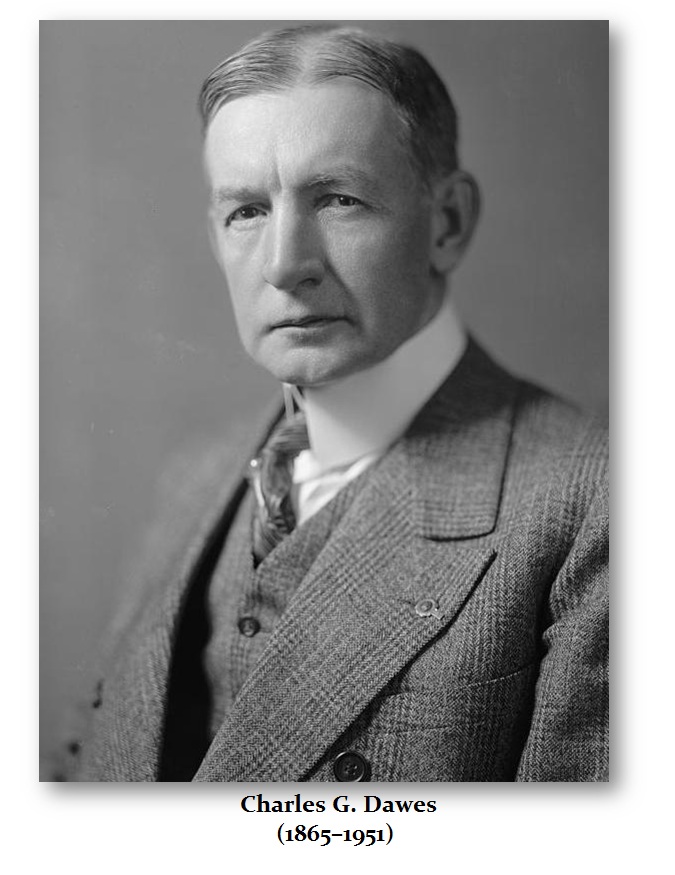
The Dawes Plan (as proposed by the Dawes Committee, chaired by Charles G. Dawes) was an initial plan in 1924 to resolve the World War I reparations that Germany had to pay, which had strained diplomacy following World War I and the Treaty of Versailles.
The Dawes plan provided for an end to the Allied occupation, and a staggered payment plan for Germany’s payment of war reparations. Because the Plan resolved a serious international crisis, Dawes shared the Nobel Peace Prize in 1925 for his work.
It was an interim measure and proved unworkable. The Young Plan was adopted in 1929 to replace it

Thursday, March 22, 2018

The Way to Survive Hyperinflation


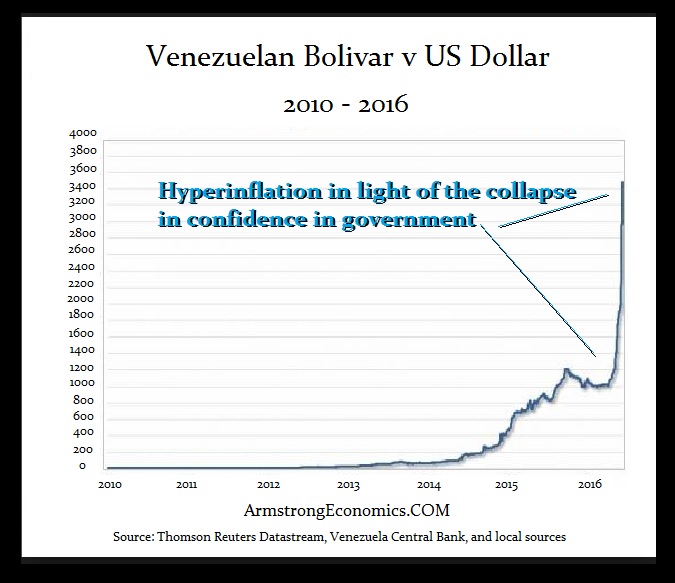
COMMENT: Mr. Armstrong; I just wanted to comment that I am from Venezuela. My father came here to visit me in Florida where I live with a Green Card. Everything he saved in life for his retirement is now worthless and it does not even pay to travel back to collect his pension. The hyperinflation is a collapse in the confidence of government as you have explained. Those who saved for their retirement and had pensions, lose everything. They will be paid the amount that they were promised, but it will not even buy a single night’s dinner and soon a beer.
Thank you for your contribution to society. I wish more people would listen to you. Experience is the root of knowledge. Opinion is the root of bias. You have proven that
JE
REPLY: To survive hyperinflation requires the holding of tangible assets and never cash or pensions. The way pensions can be devalued is through inflation over the course of time and circumstance. What I paid into Social Security will never come back to me in terms of real purchasing power and that is without hyperinflation. I have stated before, I met with the Treasury back during the Reagan Administration and said these insane levels of interest rates will triple the national debt in less than 10 years. They simply responded; Yes but we will be paying back with cheaper dollars.
All promises of government are simply eroded with inflation. That is why Southern Europe fell into such chaos. The currency doubled instead of declining when the joined the Euro. That is why Europe has been a failure under this political-economic philosophy. The Euro first crashed, and then doubled in value. Southern Europe was used to deflation always reducing their debts. Suddenly, their debts doubled. And people cannot figure out why the Euro is in such trouble?
I do like your saying though. It is spot on

Monday, March 19, 2018

The Unsound Theory of Inflation


QUESTION: You defend central banks yet the Rothschilds when clearly Mayer Amschel Bauer Rothschild said: “Give me control of a nation’s money and I care not who makes it’s laws.”  Any comment?
SL
ANSWER: No problem. He never said any such thing it was completely made up. It was attributed to him in 1838 when he was already dead for 26 years. Besides that, what is very clear is that this is based on the assumption that money is fiat. The USA began to issue paper money in 1861. During the period that Mayer lived, the money supply was primarily coined.  The only plausible reference would be implied that he debased them. He was a banker and never produced the coinage.
It would be nice just for once that you bothered to actually understand the role of central banks as originally set forth. What they do today with Quantitative Easing has proven that the entire theory of an increase in money supply will be inflationary is outright BOGUS.
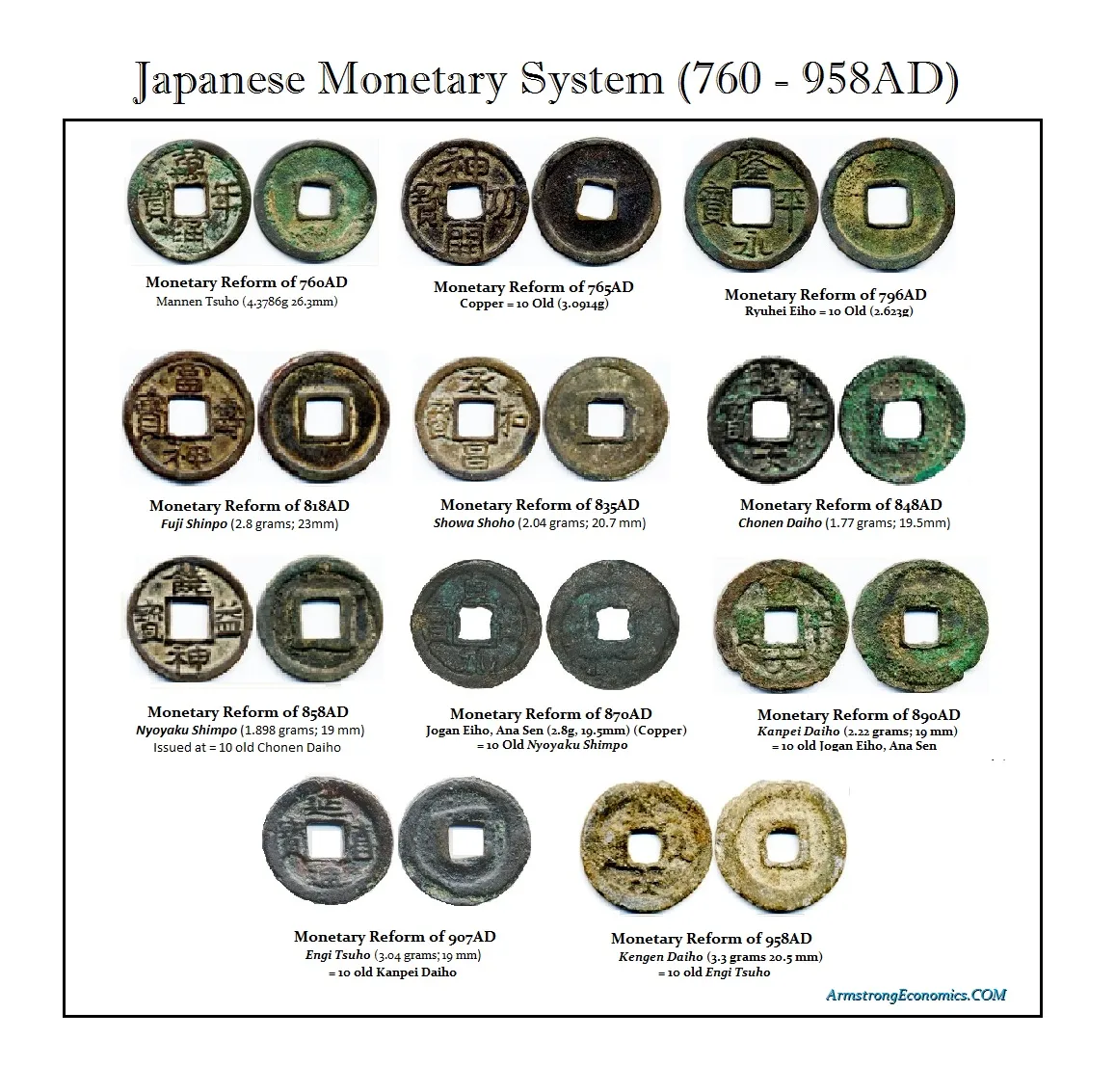
In every case of HYPERINFLATION, not even once did inflation ever begin by increasing the money supply. Inflation begins when PEOPLE lose CONFIDENCE in the government and they spend the currency as fast as they can or outright refuse to accept it. I have explained that the Japanese Emperor used a different approach. He DEVALUED all outstanding money to 10% of his new coinage. That led to the collapse in CONFIDENCE to the point that the people never trusted the government and as a result, the Japanese lost the ability to produce money for 600 years.
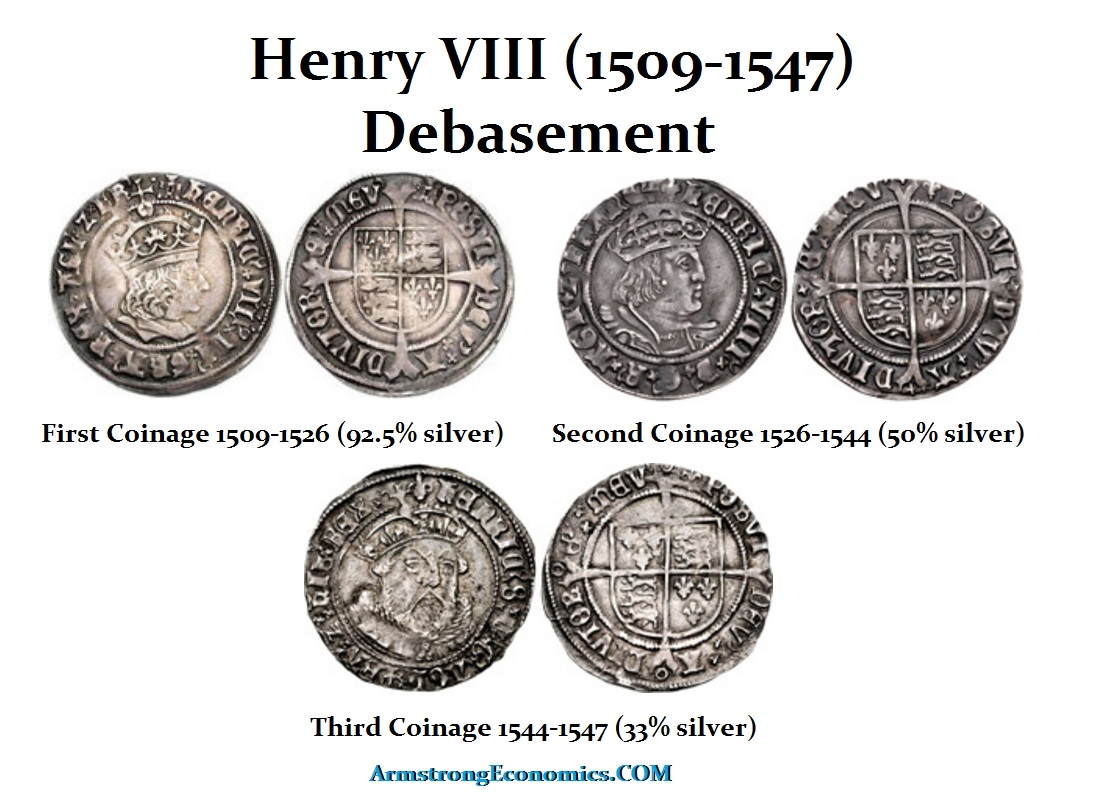
The definition of what creates inflation is entirely wrong. Even Gresham’s Law needs to be placed in context. Gresham worked in the foreign exchange markets in Amsterdam. Henry VIII debased the English coinage. But coinage traded on foreign exchange markets according to its metal content. The inflation Gresham referred to was experienced in the foreign exchange markets so what he truly observed was the decline in the British coinage value on international markets. Don’t forget, this predates the central Bank of England which was established in 1694.
The entire observation of inflation began with Gresham. However, it was extended by David Hume (1711-1776) who made observations BEFORE paper money began. This observation is not respected even today. David Hume showed why net exporting in exchange for gold currency, which then increased the domestic money supply and was hoarded by Britain, could not actually enhance wealth. Hume’s argument was essentially the monetarist quantity theory of money which would influence others over time. Prices in a country would change directly with changes in the money supply. Hume explained that as net exports increased and more gold flowed into a country to pay for them, the prices of goods in that country would rise with the economic boom. The USA saw this through the course of World War I and World War II ending up with 76% of the world’s official gold reserves. Consequently, an increased flow of gold into England would not necessarily increase England’s wealth substantially was Hume’s argument because the increase in domestic prices due to the gold inflow would discourage exports and encourage imports. Hence, this trend then counter-reacts with trade and automatically this will start limiting the amount by which exports would exceed imports. The more money that flowed into a country, like the USA, the higher the prices and this would then reduce exports. Adam Smith’s attack on mercantilism and argument for free trade, strangely ignored Hume’s argument. Hume’s view of capital flows can be verified throughout history and is really the underlying foundation of the balance-of-payments issues that Trump fails to understand. Hume also advanced the idea of “creeping inflation” that takes placed with a gradual increase in the money supply that would lead to economic growth. This is largely correct, but money supply growth must also keep place with population growth or you will produce deflation – more people and less money to go around.
With the introduction of paper money during the mid to late 18th century, the relationship between the over-supply of banknotes and a resulting depreciation in their value was noted by earlier classical economists such as David Ricardo (1772-1823). However, the issue of paper money during the American Colonial period must also take into consideration two factors: (1) England starved America and extracted money assuming they were using Spanish coinage, and (2) the American Revolution which was funded by creating paper money. There was again a lack of CONFIDENCE to the extent that when the American Revolution ended, the Constitution prohibited States from issuing money again and federally no paper money was issued again until the American Civil War in 1861.
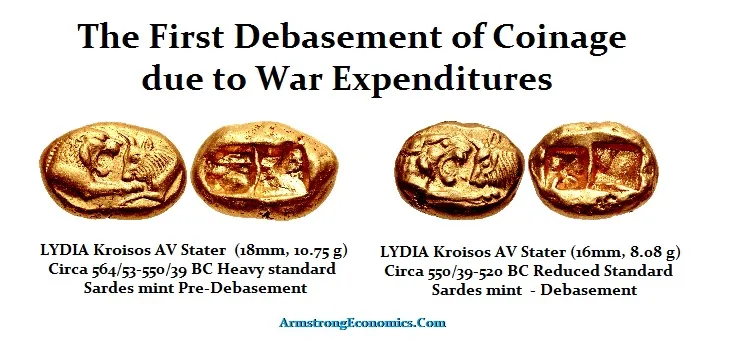
Therefore, most HYPERINFLATION periods are associated with war like the American and French experiences. However, in Lydia, the very first government to issue coins, we see the debasement unfold as a direct result of war. Therefore, there is no evidence of hyperinflation unfolding absent a collapse in the CONFIDENCE of the people in that government.
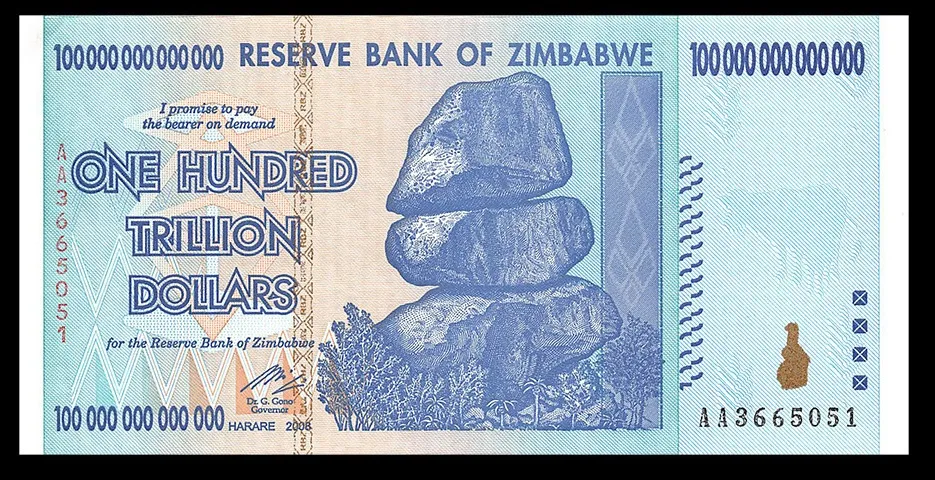
In the case of Venezuela, obviously there has been a collapse in CONFIDENCE. The same was true in Zimbabwe after it seized all the property of white farmers. Foreign investors refused to ever participate again.
The German HYPERINFLATION came with the Communist Revolution in 1918. That sent capital into hiding and fled overseas, primarily to the United States

Friday, March 2, 2018

Hyperinflation Unfolds Only When Public Confidence Collapses


COMMENT: Mr. Armstrong, I read your piece on South Africa and you are the only person to explain that the hyperinflation in Zimbabwe took place after they stole all the land from the white farmers. You really turn over every stone in your research.
My hat is off to you sir.
MH
ANSWER: Well I was not aware of that, but it does not surprise me. Everyone attributes hyperinflation to the simple increase in the supply of money. I have stressed countless times that hyperinflation unfolds ONLY when people NO LONGER TRUST THE GOVERNMENT! The Zimbabwe hyperinflation ended the same way as Germany. Once Zimbabwe expropriated white farmers without compensation, public confidence collapsed. Nobody would invest in Zimbabwe after that. This is what South Africa now risks. Nobody will invest in a country that does not respect property rights. This is what we call COUNTRY or POLITICAL RISK! 
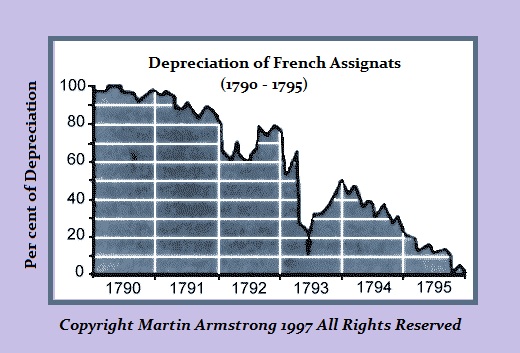
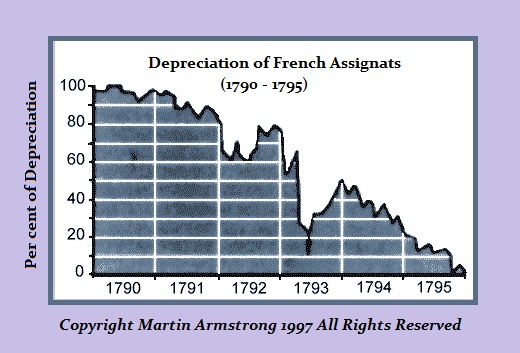
The French hyperinflation took place with the assignats, which were issued in conjunction with the revolution. They were so interested in robbing the rich and even the Catholic Church, that the confidence in banks and the government collapsed.
I have also shown numerous times that the famous German hyperinflation followed the Communist Revolution in 1918, which established the Weimar Republic. Once again, if you had any wealth, you hoarded it. People held foreign coins as the alternative to German currency.
In Venezuela, once more it is the collapse in the confidence of government that compels it to produce more and more money to pay its troops. This is the net effect once again when people no longer trust the government and wealth is hoarded using foreign currency – in this case, American dollars.
I have also make it abundantly clear that Japan LOST its ability to even issue coins for 600 yearsbecause, with each new emperor, he devalued the outstanding money supply to worth just 10% of his new coins. Once again, people lost faith in Japanese coins and began to use Chinese and bags of rice. It is ALWAYS the CONFIDENCE in government that is the primary component of hyperinflation.
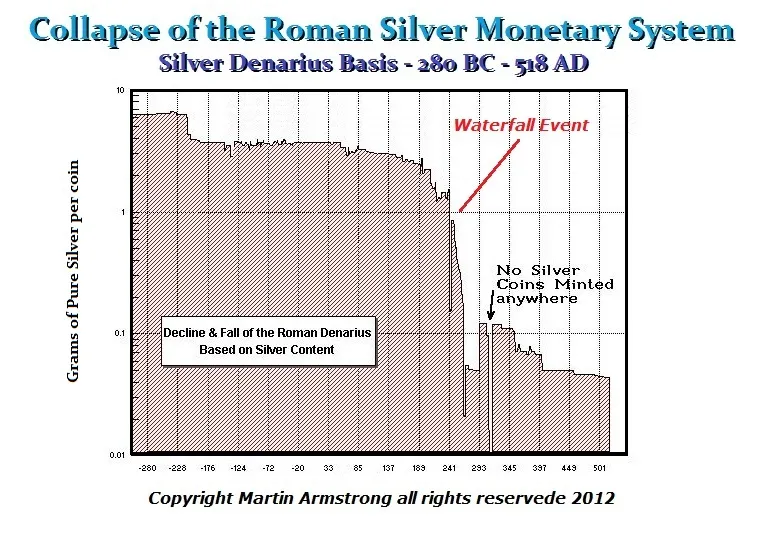
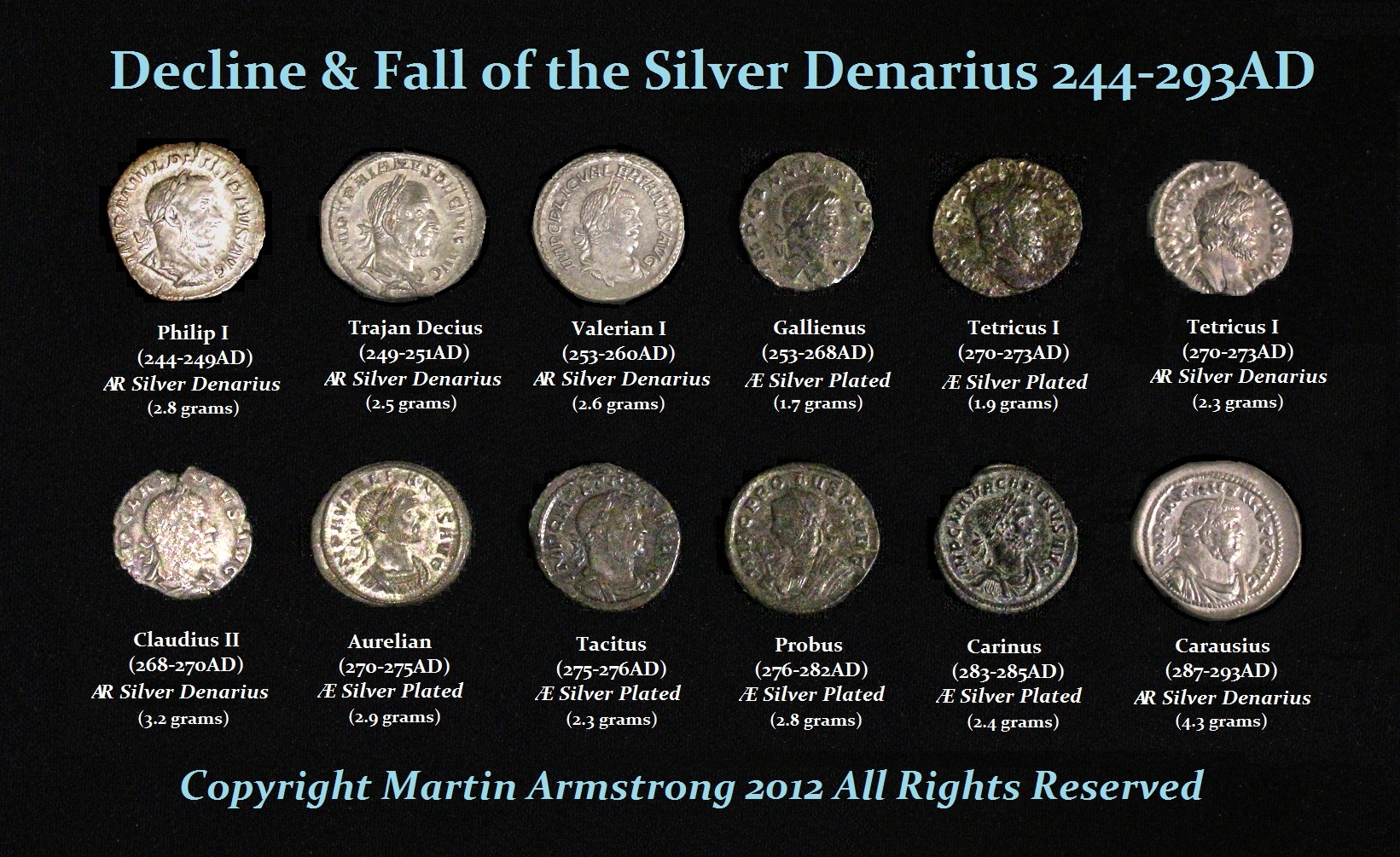
I have also shown that the hyperinflation that took place in the Roman Empire during the 3rd century followed the capture of Emperor Valerian I in 260AD by the Persians. Once that took place, the barbarians from every angle began to invade the Roman Empire. Money was hoarded and the government had no choice but to debased the coinage to try to cover its bills.
There is a wealth of examples that demonstrate it is the collapse in CONFIDENCE that takes place and then the hyperinflation unfolds as a RESULT of that. It is NEVER as the goldbugs pitch to sell people gold that an increase in money supply is the cause of hyperinflation. It is ALWAYS, and without exception, the collapse in public confidence that precedes the hyperinflation