Showing posts with label Volatility. Show all posts

Friday, March 9, 2018

Interbank Market Collapsing - liquidity is extremely vulnerable, liquidity will simply vanish entirely, volatility will rise sharply


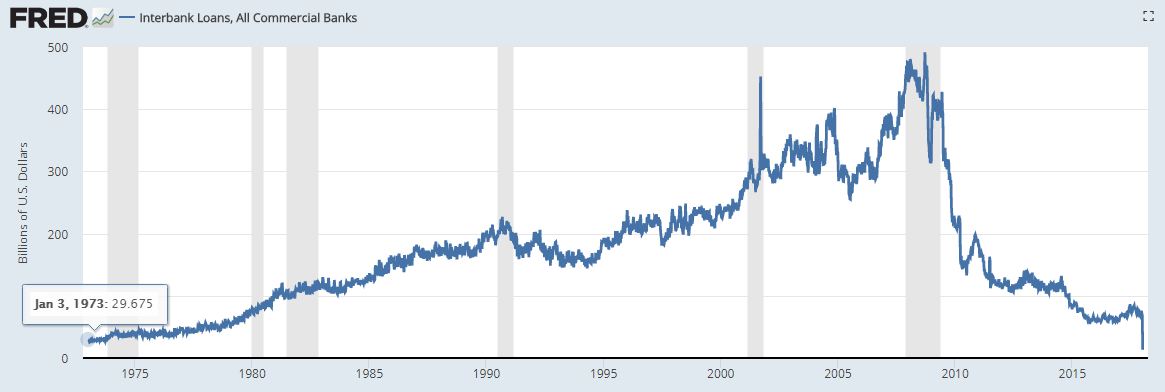
QUESTION: Mr. Armstrong; Has inter-bank lending collapse due to a lack of confidence concerning counter-party risk?
Thank you for being a rare source with experience
ER
ANSWER: Yes that is a correct statement. The failure of Lehman and Bear Sterns was the result of inter-bank lending when they could not make good on the collateral they posted the day before in the REPO market. Then we had the collapse of MF Global, which was also a loss linked to the overnight markets. Now mix in the LIBOR scandal and banks were scrutinized for manipulating LIBOR rates in the inter-bank market.
The interbank lending market is a market in which banks extend loans to one another for a specified term, typically 24 hrs. Most interbank loans are for maturities of one week or less, the majority being overnight. Such loans are made at the interbank rate (also called the overnight rate if the term of the loan is overnight).
The collapse of this market is a clear warning that liquidity is extremely vulnerable. When crisis strikes, liquidity will simply vanish entirely. This warns that volatility will rise sharply and it appears to be predominantly focused in on the debt market.

Monday, February 19, 2018

Volatility – What is It ?


QUESTION: Dear Martin,
In the private blog you mentioned a few times that the volatility will rise again in the week of the 12th. When you mention volatility, do you mean volatility as measured by the VIX index?

So far the VIX has lost around 1/3 this week so I suppose you mean something else?
Thanks!
JWD

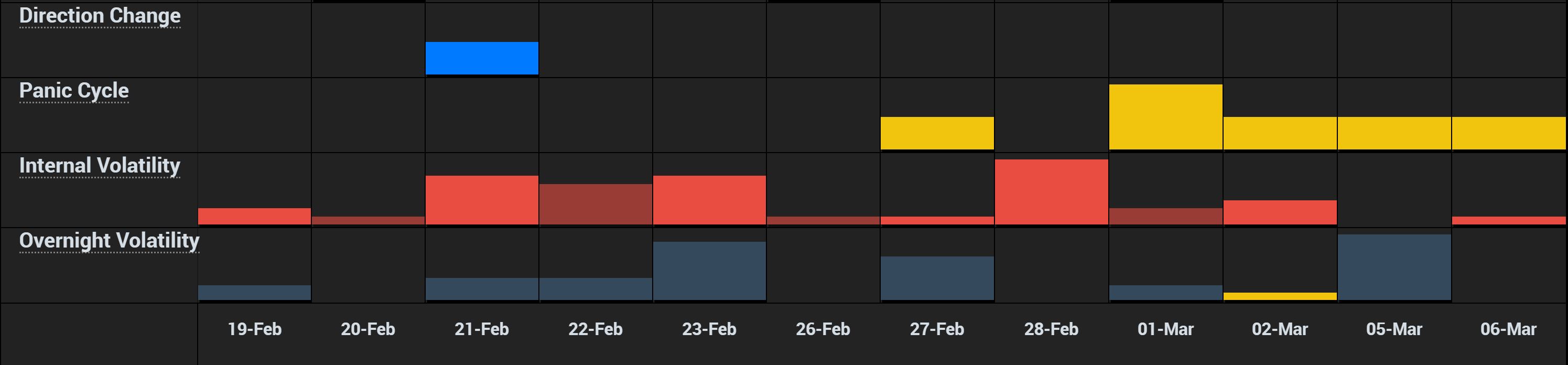
ANSWER: The VIX is not a true indicator of volatility. We have three main volatility measurements and each is different.
(1) you have the traditional measurement of close to close. That is interesting, but it does not truly capture the concept of volatility.
(2) Then there is intraday volatility which we measure and simply the percentage movement between the high and low of that session. You can have a 1,000 point swing in the Dow intraday yet close nearly unchanged. The first volatility measurement would never even show a blip.
(3) The third measurement is overnight volatility. This is measured from the previous close to the open of the current day session. For example, Monday, February 5th the Dow opened at 25337.87 compared to Friday’s closing of 25520.96 gapping down.
Our indicators are intended for trading, unlike the VIX. In our Arrays, you will see Overnight Volatility, Intraday Volatility, and Panic Cycles, which are extreme moves in one direction or an outside reversal which exceeds the previous session high and penetrates the previous secession low.

The VIX is a convoluted formula that does not reflect trading but more of a trend lending itself to manipulations. Hence, the VIX is not very reliable. The VIX is a measure of expected volatilitycalculated as 100 times the square root of the expected 30-day variance (var) of the S&P 500 rate of return. The variance is annualized and VIX expresses volatility in percentage points.
Volatility Index VIX Futures
where var = (365/30) x Expected 30-day variance.
The 30-day variance is the sum of squared standard deviations st (“volatilities”) of the S&P 500 rate of return at every point in time t during the 30 days:
Volatility Index VIX Futures

Monday, September 4, 2017

The Crash & No Bid


QUESTION: Hey Marty,
Love your blog and the insight you have given all your readers. However I am wondering that when you say the markets are going to become more volatile – how does that effect the trigger that sets off the dominoes ??
what i mean is, if the economy around the world hits rough water; what is the rogue wave that sinks the ship? is it a quantity/ volume of capital money that shifts, or is it a short circuit due to political turmoil?
I read that the whole 2008 “crash” was triggered by 500 billion dollars, which is minuscule amount of the total USA GDP. But i have also read from your blog that Germany has 5X its GDP in synthetics on the book !
*IF the markets are more volatile, does that mean there is LESS threshold due to a minor tremor in the gov or markets?
your insight on how volatility increases with regards the tipping point, and WHY the tipping point may happen would be of great interest.
N From Canadaor
ANSWER: 

Markets crash when the majority are long and anything can spook them because there is a lack of new buyers coming in to carry the market higher. Some longs try to sell and they find a lack of bids. The crash comes when you hit the no bid and market-makers withdraw. That is the sharp increase in price volatility that is different from volume volatility. With price volatility, there need not be major volume – just a gap and a lack of bids. The event need not even be real – just a rumor.

The panic unfolds because of price movements rather than volume. When large gaps appear WITHOUT supporting news, even professionals sell because they cannot make a decision in a vacuum.