Thursday, November 29, 2018

Commodity cycle appears to be pointing to 2024 peak

Why Has Farmland Exploded in Price? The Accidental Trend Correlation
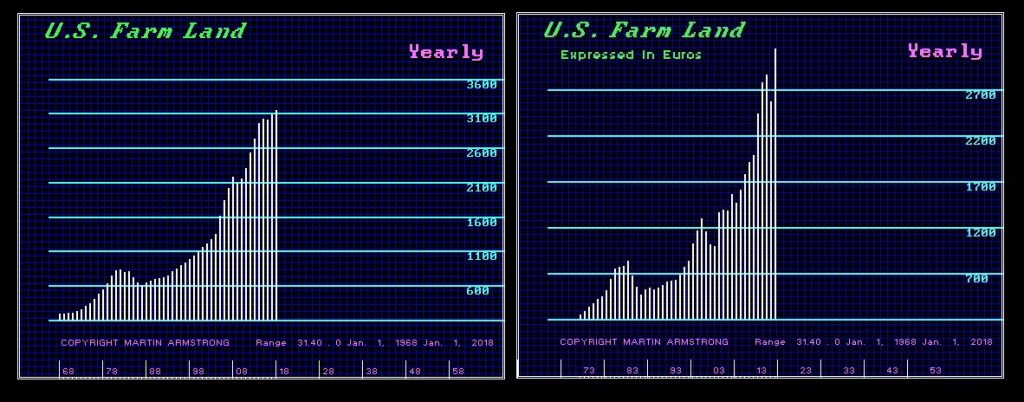
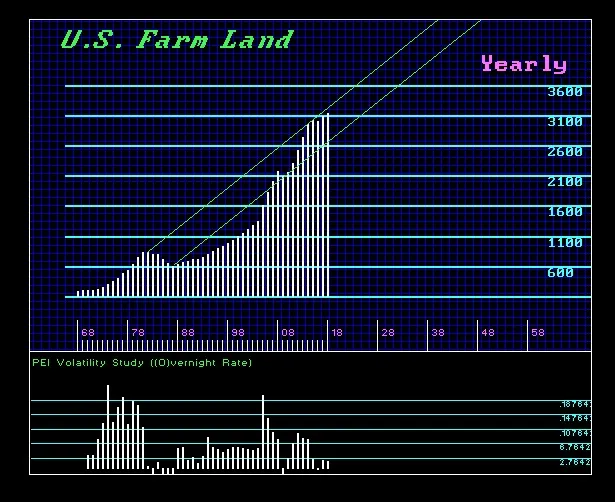
Most people have little idea WHY big money was targeting buying farmland in Canada, USA, and Australia. It was more than just Chinese investment. With interest rates down to negative, capital has been looking for returns. They were buying farmland and then renting it out generally for 5%. This created what many call the farmland bubble which has now begun to burst in some Corn Belt states, such as Iowa, as interest rates begin to rise. In 2015, the average increase of 2.4% percent on the low end and up to 8% in some states where the crop yields were best. This has not been a small investor or spec market. This was driven by the big boys seeking yield thanks to particularly the European Central Bank (ECB).

The nominal high came in 1982 and the commodity boom peaked in 1980 and interest rates peaked in 1981. The rising dollar caused the correction in nominal terms declining into its low in 1987. The market began to recover while the days of inflation and goldbugs faded forging the final low in gold during 1999. As is often the case, people just never look at assets in terms of international value. The surge in prices of latter that domestic analysts have called a “bubble” truly reveal more of a Phase Transition type rally more than doubling in price when plotted in Euros. The key to any market lies hidden within the depths of international capital flows which are driven foremost by currency values.
The lack of individual investors infiltrating this market leaving the big agricultural bets being placed not on expectations of global food demand will increase over time, but looking simply for yield, has led most analysis astray. Institutions, like the pension fund TIAA-CREF, have been the big buyers throughout 2017. They have been looking for bargains as farm real estate values have started to decline. Small farmers are finding it difficult to borrow from the banks for a crop season which can involve loans into several millions of dollars. If crops are wiped out, then they have a real problem.
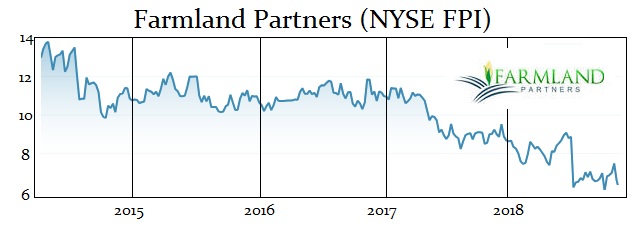
There have been stocks issued seeking to capitalize on the boom. Farmland Partners (FPI, NYSE) has been down about 20% since it was floated in 2014. It is a REIT which is a company that owns, operates or finances income-producing real estate. REITs were modeled after mutual funds to gather investors to collectively own valuable real estate and provide the opportunity to access dividend-based income and total returns. On its website, it states: “Farmland Partners Inc. is an internally managed, publicly traded (NYSE: FPI) real estate company that owns and seeks to acquire high-quality farmland throughout North America addressing the global demand for food, feed, fiber and fuel.” However, the play has NOT been the boom in commodities, but the yield from renting out the land.
Investors should be very careful with REITs because they tend to be illiquid and volatile.


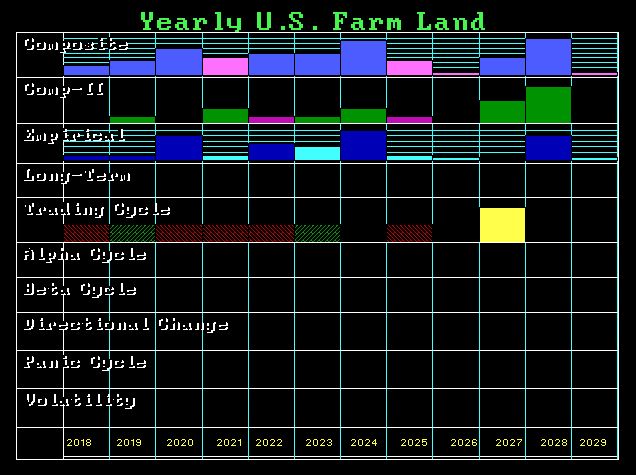
When we look at the Array, we see turning points lining up for 2020/2021 and 2024 followed by 2026 and then 2028. The commodity cycle appears to be pointing to 2024. That is when we should see farmland values peak in real terms but keep in mind that it will all depend upon the particular region. The weather is going to kick in and that will reduce crop yields. Keep in mind that most of these REITs have entered this sector of the market for the wrong reason. It was not truly a commodity boom expectation as it was simply to get a 5% yield when interest rates were below that level. As interest rates rise above that 5% threshold, we will begin to see the big players bailout and begin to dump farmland at losses. Anyone looking to borrow against their land should use FIXED RATES only. If you decide to sell your land to the big boys while rates are still below 5%, the include a right of first refusal to buy it back at a reduced price when they decide to cut and run – which they will inevitably always do at the precise wrong time.

Saturday, November 10, 2018

Kennedy – Roosevelt & Corruption?


QUESTION: Mr. Armstrong; I had always heard that Kennedy made a fortune on Scotch. My question is, where they booze runners during the Prohibition?
Thank you
GR
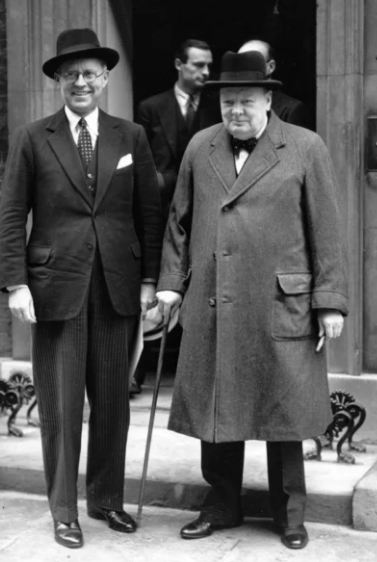
ANSWER: No. But they actually used Roosevelt to secure that lucrative import trade of Scotch – my favorite drink. Joe Kennedy traveled to London in 1934 on the steam-driven ocean liner, the SS Europa. While he brought his wife with him he also brought James Roosevelt (1907 – 1991), the American president’s oldest son. The trip was portrayed as a please vacation, but bringing the President’s son was the clear signal it was not a vacation.
Kennedy’s main prize would be to gain the British rights to send Scotch whiskey, gin, and other imported liquors. He knew based upon inside information that Prohibition would be ended. Joe brought the president’s 25-year-old son to help organize a private visit with Winston Churchill.  He used Roosevelt’s son to get that contract. The deal paid off and Joe got the private meeting with Churchill and visited him at Churchill’s Chartwell home.
So you see, political inside favors have been going on a very long time. James Roosevelt was closely linked with Joseph P. Kennedy Sr. Many of James Roosevelt’s controversial business ventures were indeed aided by Kennedy. Jame’s dealings were often clouded. In fact, Treasury Secretary Henry Morgenthau even threatened to resign unless FDR forced James to leave a questionable company which became known as the National Grain Yeast Corp. affair (1933–35), which was believed to be just a front for bootlegging. It was James Roosevelt who lobbied his father to make Kennedy the ambassador to the United Kingdom.
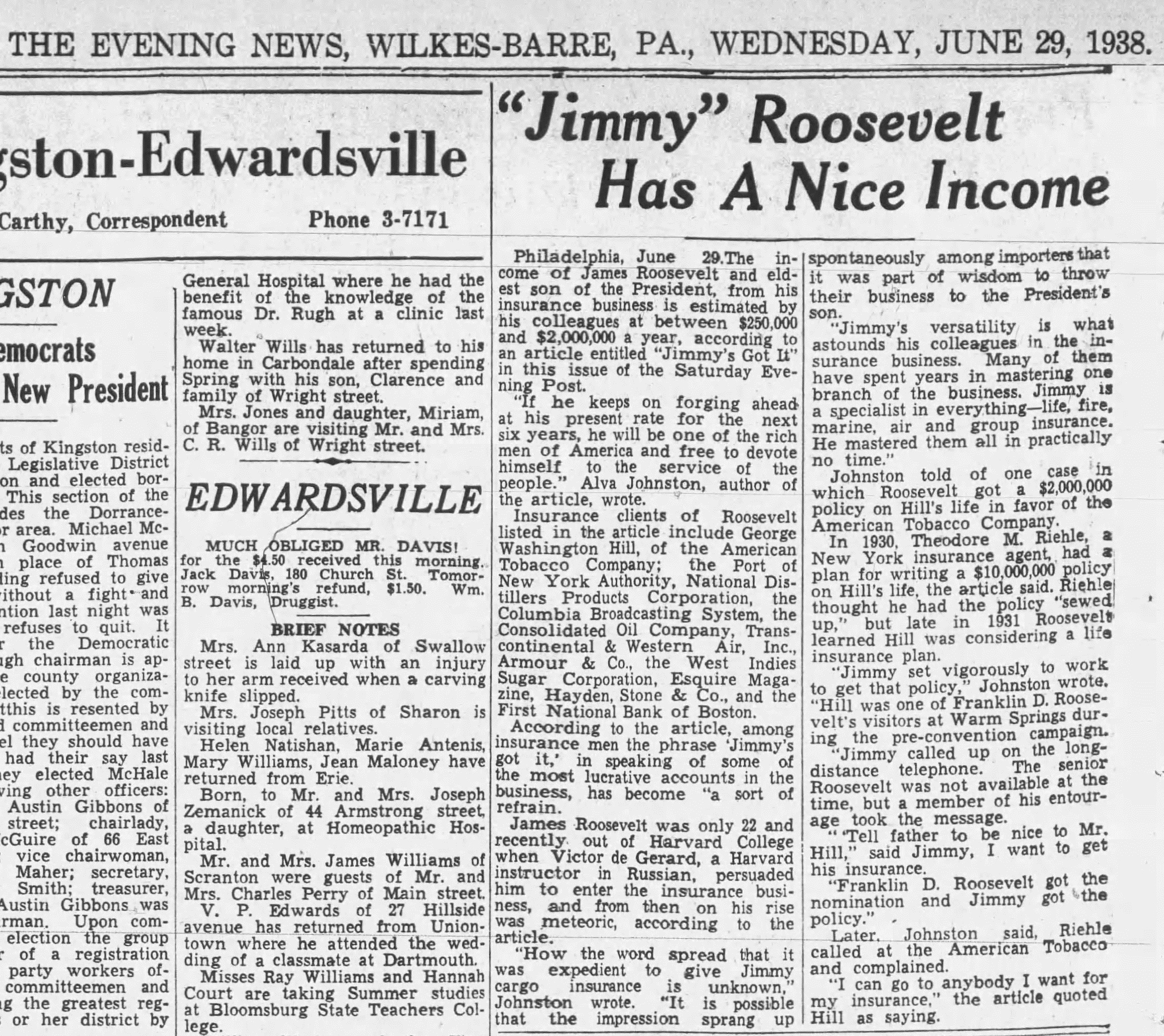
James was a shading type of character in the eyes of many. Later on, during July 1938, there were allegations that he had used his political position to steer lucrative business to his insurance firm. He was then forced to publish his income tax returns and denied these allegations in an NBC broadcast and an interview in Collier’s magazine. This became known as the Jimmy’s Got It affair after Alva Johnston’s reportage in the Saturday Evening Post. Roosevelt resigned from his White House position in November 1938. The press was often highlighting how rich Jimmy was becoming when his father was a Socialist.

Wednesday, October 24, 2018

There is little doubt that as we head into 2032, the freedom of speech will also vanish.


Egyptian Economist Arrested for Criticizing Government


The Egyptian Economist, Abdel Khalik Farouk, is the author of more than 20 books on corruption in the Egyptian economy. His latest book, Is Egypt really poor?  was confiscated by Egyptian authorities last week on the day of publication. The owner of the printing house, Ibrahim El Khatib, was also arrested. Farouk has set out that the corruption inside the Egyptian government is what keeps the nation poor. He is correct on that score for corruption in governments, in general, are always the greatest redistribution of wealth ever created.
Then there is the Greek Chief statistician Andreas Georgiou who is now under the charge of having harmed the national interest! He was the one who corrected the faked Greek deficit number of -3,9 to the real number of -15.4%.   On August 2nd, 2010, he was appointed as President of the Hellenic Statistical Authority (ELSTAT). Then on August 2nd, 2015, he surprisingly resigned from office with immediate effect. This in July 2016, the Greek Supreme Court upheld charges against Georgiou for having harmed the “national interest” for effectively telling the truth.
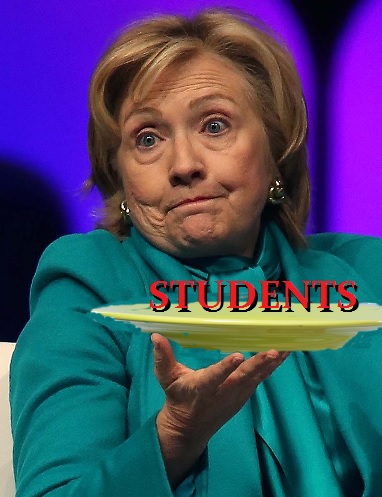
Of course, our media is part of the corruption in general. They preach the government line and spit out propaganda and they could care less what they are doing to the United States or the world. Hillary, for example, was perhaps the peak of corruption. Here we had a politician with the audacity to pretend she stands against the “rich” and then all the super rich stand in line to buy favors. Goldman Sachs went as far as to ban its staff from even donating to the Trump campaign. What did the bankers get in return for supporting the Democrats? Student loans were then non-dischargeable in bankruptcy and then the bankers cleverly told parents they had to co-sign for their children and suddenly the bankers own your home for a degree that 65% of the children cannot even find a job. Now Hillary advocates civil unrest and says it is warranted UNLESS the Democrats take back government. Hence, she no longer believes in Democracy.
What the Democrats did to American families was CRIMINAL. We now have the largest percentage of children in their 30s still living at home. The bankers have destroyed the real estate market and ensured that the next generation will not be able to buy a home because of student loans. The State of New Jersey refused to forgive a student loan co-signed by a mother after her son was murdered. This was not unique. A mother from Michigan ended up in the same position.
Formal education has become a huge scam. Degrees are worthless and schools just grab the money and run. They are NOT preparing people for careers in the least. Studies have confirmed there is something seriously wrong because this has become a giant fraud.
There is little doubt that as we head into 2032, the freedom of speech will also vanish. What I have just written will become banned. Welcome to the inherent corruption that is consuming everything. They will imprison, murder calling it suicide or an accident, whatever it takes to prevent the truth from being told. This is how Empires, Nations, and City-States die.

Monday, October 22, 2018

Roman Republic’s Debt Crisis & Led to it’s Collapse


QUESTION: You said that Imperial Rome did not have a national debt nor central banks. Did Rome ever have debts that were not private?
JY
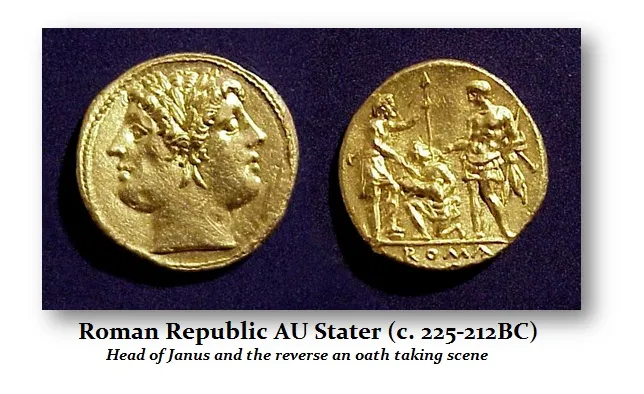
ANSWER: Yes. In all honesty, it was the Debt Crisis that ended the Roman Republic. There was a Sovereign Debt Crisis during the Roman Republic period resulted in a dictatorship and a debt default. The Roman Debt Crisis of the 1st century BC has left behind a vivid account of what took place. The volume of gold and silver in Italy had increased dramatically during the late 2nd century BC following the Punic Wars. We have the first real gold coins issued by the Roman Republic at that time.
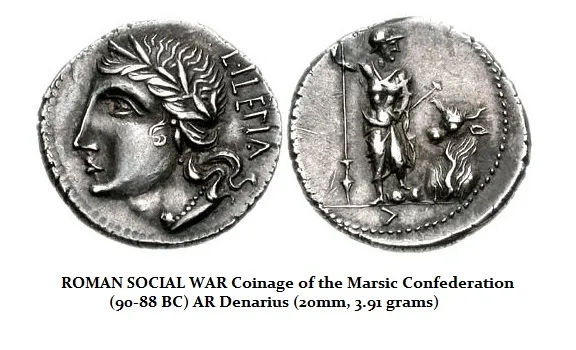
However, this concentration of wealth, which was akin to the United States after World War I and II, was absorbed by commercial expansion and investment in Gaul and Asia. A period of excessive concentration of money and large profits came to an end with the rise of the Social War of 91-88BC which was a war waged between the Roman Republic and several of the other cities in Italy (no taxation without representation), which prior to the war had been Roman allies for centuries. The war was begun by the Picentes because the Romans did not want to afford them Roman citizenship, thus leaving the Italian groups with fewer rights. The war resulted in a Roman victory and genocide against the Samnites. However, Rome granted Roman citizenship to almost all of its Italian allies, including the Samnites, to avoid another war. Therefore, we find that the debt crisis was correlated with a separatist movement – which we are beginning to see worldwide starting in Europe, but will eventually become a contagion in the United States as the conflict between left and right erupts after the November elections.
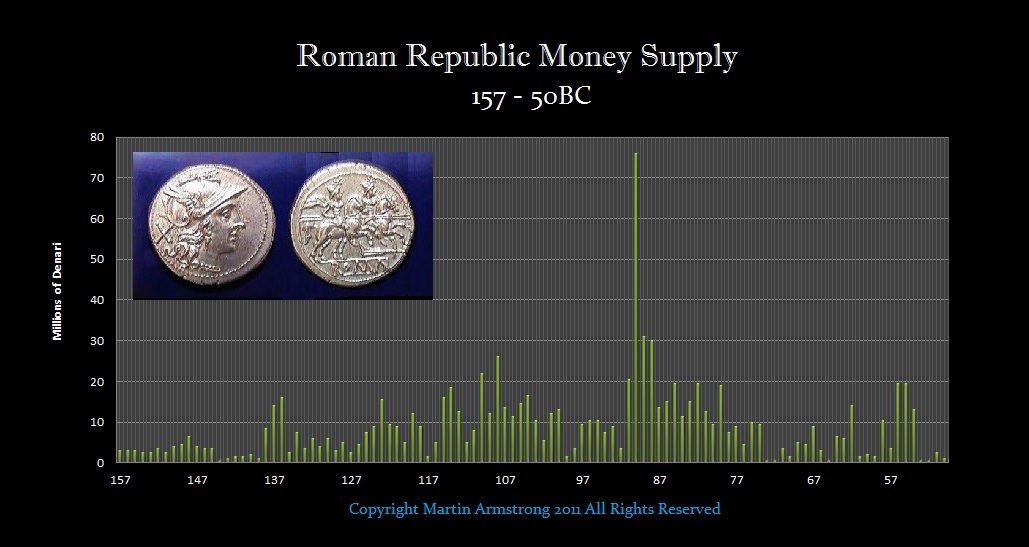
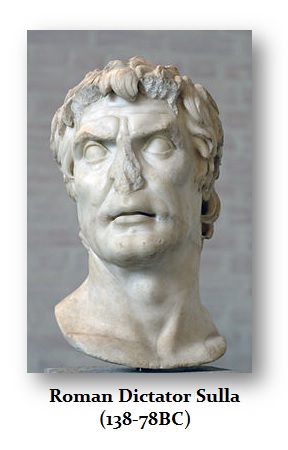
The Social War led to the complete state bankruptcy of the Roman State. We can see the dramatic rise in the money supply created during this time of war. This turmoil was then followed by the dictatorship of Sulla who then imposed an attempt to control the debt crisis capping interest rates at 12%. The previous legal rate was capped at 8.5%, but obviously, the market had exceeded that limit and Sulla had to confront that reality in 88BC. The debt crisis continued and then in 86BC, the government was compelled into default. This is when the Valerian Law came into play and this remitted 75% of all debts. The State debts were deflated on and reduced to 25%.
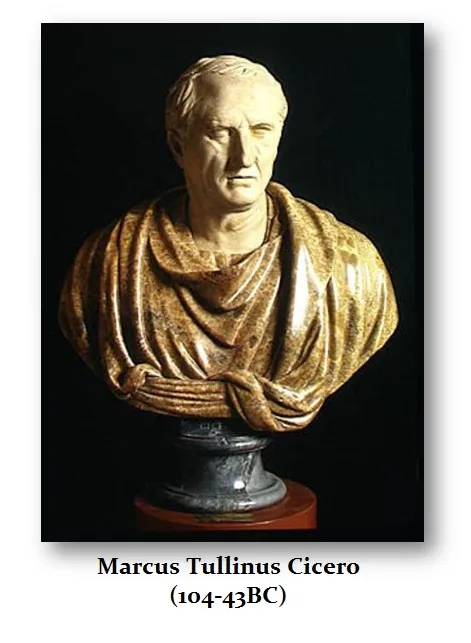
The Catalinian Conspiracy was thus an uprising of from the Debt Crisis. Political Corruption of the Republic Oligarchy was pervasive. The Catiline Conspiracy, that takes its name from Lucius Sergius Catiline (108-62 BC) who had unsuccessfully attempted to overthrow the Republic during which Marcus Tullius Cicero (106-43BC) was consul in 63 BC. Catiline served under Pompey’s father in the Social War of 89 BC and it is said he became such a zealot in Sulla’s proscriptions, he killed his own brother-in-law. He was a praetor in 68 BC, governor of Africa 67-66 BC, but could not run for election in 65 or 64 BC for consul when charges of extortion were pending which seemed to be intentionally designed to prevent him from running. Later, he was cleared of all charges.
Catiline was also against the oligarchy. Rumors were planted that he intended to kill the consuls and seize power in 65. However, there was never any evidence of this so-called First Catilinarian Conspiracy. It is significant, however, that there is even an allegation that predates the conflict. In 64 BC, Catiline stood for election against Cicero after all charges were dismissed, but lost. He stood for the elections again the following year, yet lost again.
Cicero was his opponent, and we must not forget that. Catiline was a popular man of the people and advocated for the cancellation of debt. He attracted the old victims of Sulla’s proscriptions who were dispossessed of their property. So we must understand that there was a brewing debt crisis in Rome and the oligarchy was determined to keep power at any cost. Cicero was counsel in 63 BC and he employed spies and informers making it very personal to attack Catiline. Whether Cicero even acted in an ethical manner is highly questionable when one resorts to spies and KGB informers tactics. Cicero on October 21st, 63 BC stood before the Senate and denounced Catiline charging him with treason and was granted what the Romans called the “ultimate decree” that was essentially a declaration of martial law – Dictatorship.
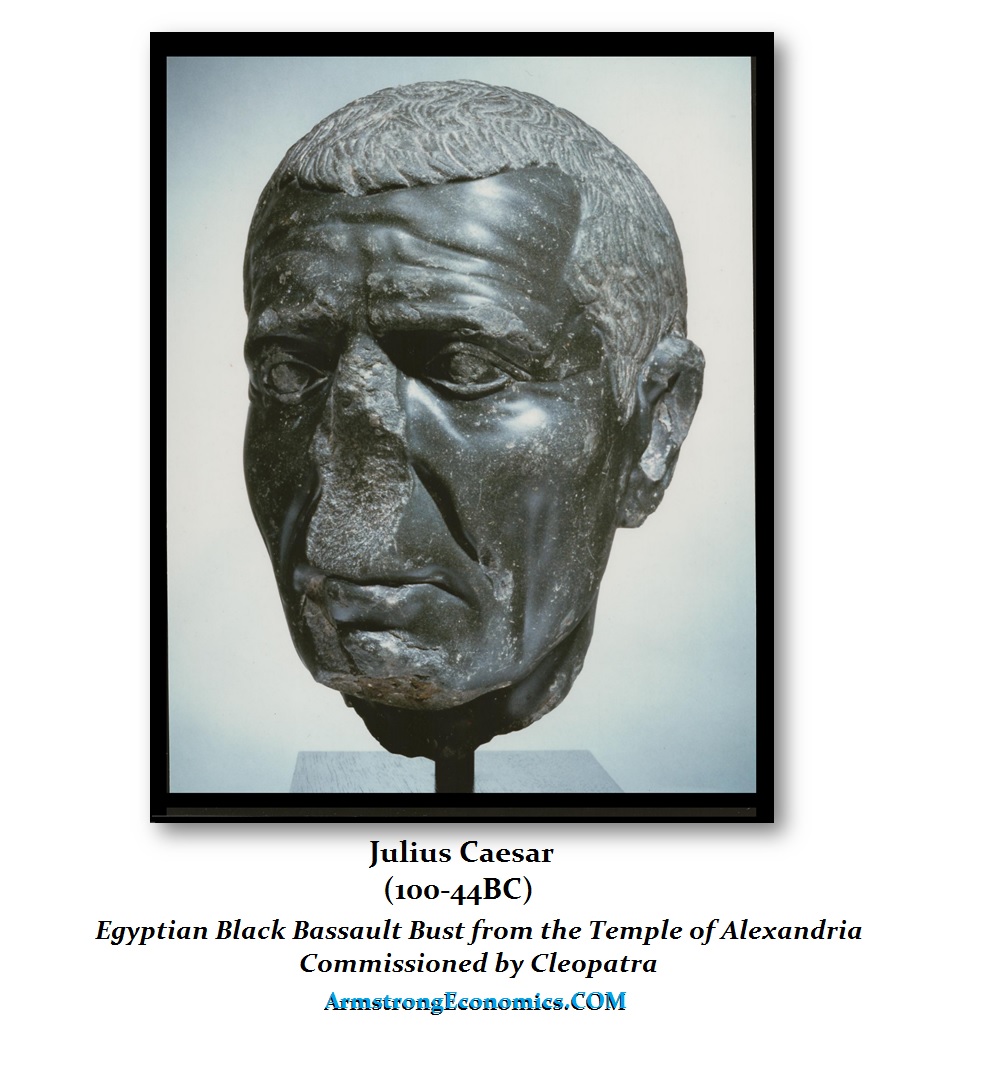
Catiline was quite popular. He had the support of Gaius Antonius and some of the tribunes were already following his line working for the cancellation of debts, as noted by historian Cassius Dio (Historia Romana 37,25,4). He was clearly sharing this idea with Crassus and Caesar and their view of the corruption within the oligarchy cannot be ignored. Cicero was the leader of a party known as the “Concord of the Orders” claiming to be the party of law and order. This was a life-long source of pride of Cicero. We must also understand that Catiline tried the constitutional approach and stood for elections against Cicero twice and lost. He clearly knew that the opposition included Pompey. Note keenly that the thrust was the cancellation of debts. The constitutional course of elections was always subject to bribery.
Catiline tried the constitutional approach. When Cicero accused him of being a threat to the Republic and guilty of treason, Catiline fled Rome on November 8th and joined a gathering of destitute veterans whom the oligarchy had never lived up to their promises of pensions. Despite the fact that the Senate handed the “ultimate decree” to Cicero, it does not appear from the contemporary accounts that the Senate fully believed in this Catiline
Conspiracy created by Cicero.
On December 3rd, Cicero’s informers and spies managed to get signed documents, or so they claimed, of others involved in the Catiline Conspiracy. Cicero won the Senate, arrested those, he alleged, signed the documents, and had them executed by December 5th and mobilized an army to attack Catiline. In January 62 BC, Catiline was attacked by Gaius Antonius Hybrida who commanded the Republican army and was killed in the battle at Pistoria. The victors portrayed those senators who sided with Catiline as the men who were facing bankruptcy. Cicero essentially eliminated any idea of revolution against corruption, and recast it as a bunch of losers who were bankrupts.

Sunday, October 21, 2018

The risk that the British pound will no longer exit arrives in 2029.

The End of Britain with 2nd Referendum on BREXIT?

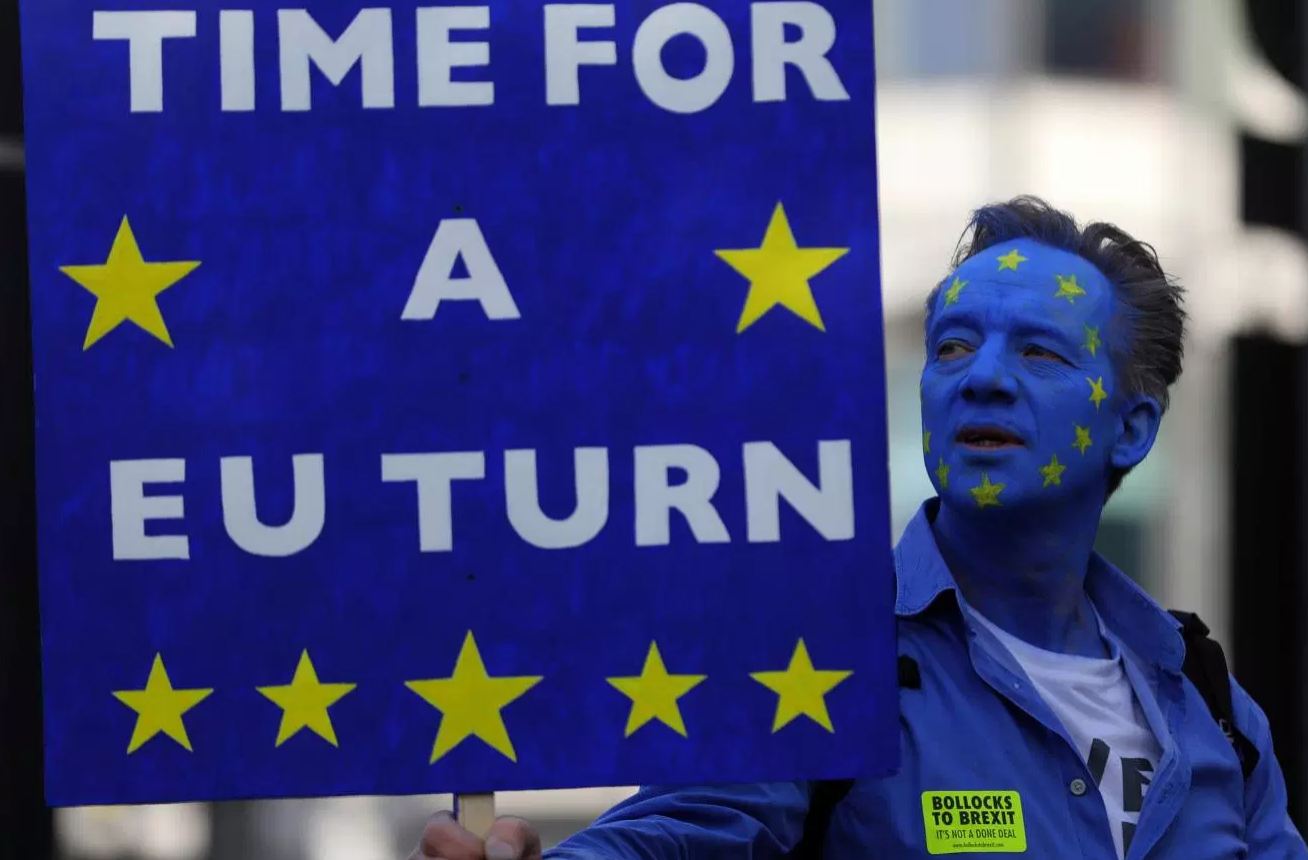
As many as 670,000 people protested in London to call for a second Brexit referendum. Our computer is showing that a second referendum will vote to remain but this is most likely because they will rig the vote. This is in conflict with our economic model which shows that BREXIT should still win. Keep in mind that we have crossed the Rubicon in politics here in 2018. The chances of any election actually being honest and fair is highly unlikely.


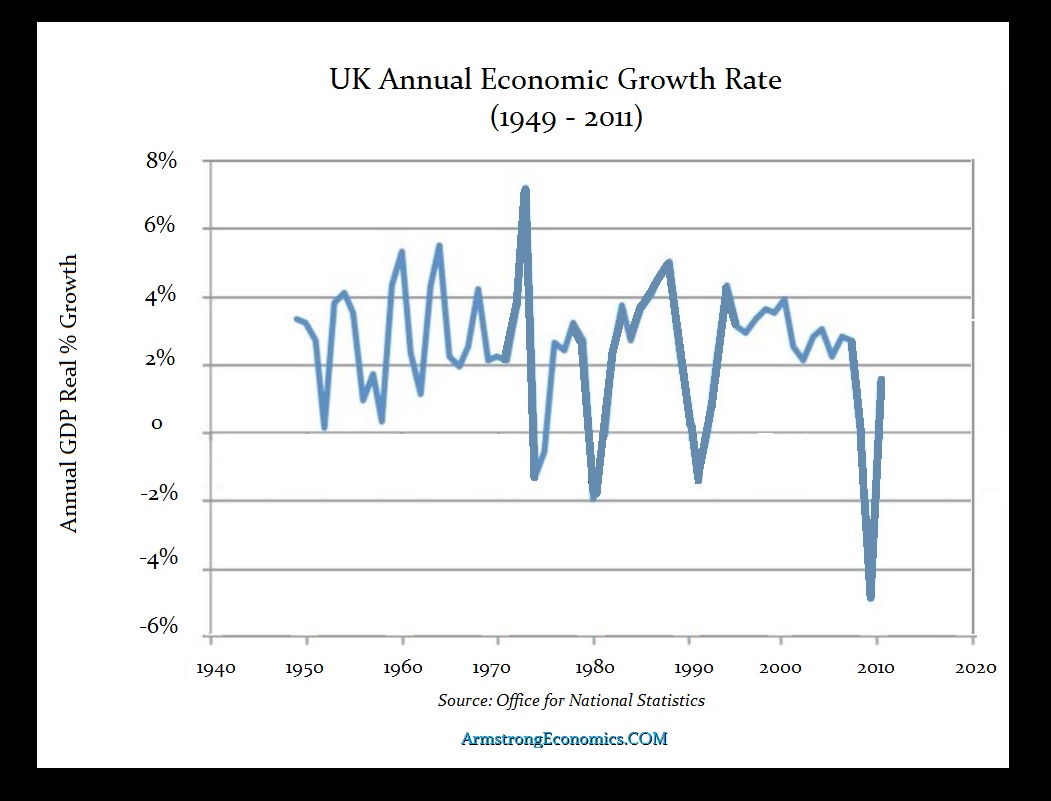
Of course, these people are just brainwashed. They are completely ignorant of the fact that remaining in the EU will be the death of Britain. They listen to the like of Tony Blair and are really too stupid to understand what they are protesting for. The economic growth of Britain has steadily declined ever since joining the EU. We have provided this chart to the British press and not a single person, even politicians, has made this chart public. But worse still, Britain is resented in the EU because without Britain Europe would have been lost both to Hitler as well as Napoleon.
All the history aside, any trade deal can only be subjected to a veto of 28 member states. Britain cannot reach a trade deal on its own terms with anyone for they can be stopped by the raising of just one hand. Britain will also see its financial market destroyed for Brussels was to be able to outlaw short-selling to protect the Euro by decree.
On top of that, Britain loses just about every court ruling by the European Court. And as for migrants, the number one name in Britain among newborns has been Mohamed.


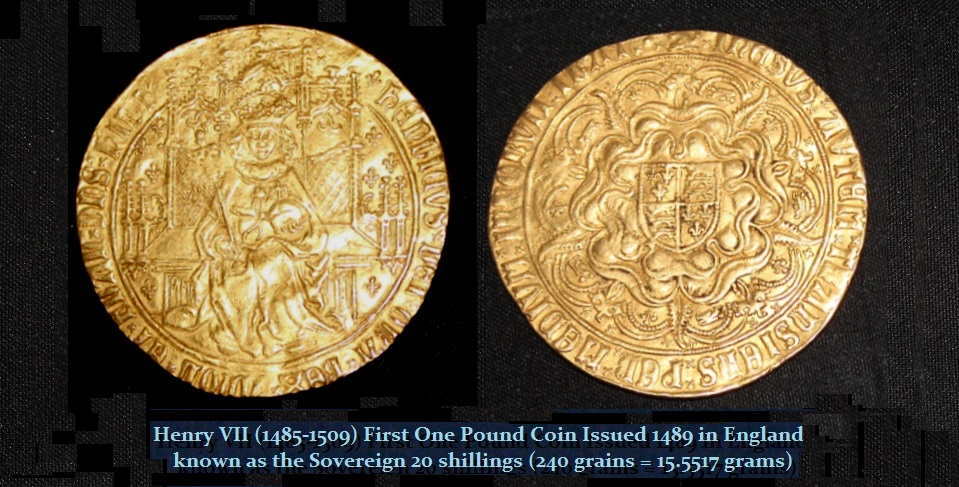
The British pound had really been just a unit-of-account prior to 1489. It was literally one pound of “sterling” silver .925 fine. The first one-pound coin appeared in gold and was issued in 1489 by Henry VII. The risk that the British pound will no longer exit arrives in 2029.

Friday, October 19, 2018

China & the Hidden Debt Crisis in the Provinces


The Sovereign Debt Crisis in China among the provisional governments is alive and well. The off-balance sheet government liabilities in the regions amounted to an estimated 40 trillion yuan which is almost $6 trillion. Some are calling this a “gigantic credit risk” which is a hidden liability. This represents 60% of  GDP which bypasses the debt-to-GDP ratio set by the central government on the provinces. They have created financial vehicles called LGFVs. Beijing has focused on shadow banks, regulatory loopholes, and hidden bad loans. They have curbed the shadow banking and brought the BitCoin outflow down. However, the Beijing government has only been able to reduce the credit risks associated with LGFVs marginally. The current view is that it will take China up to a decade or more to deal with the problem of LGFVs, as we enter this debt crisis cycle between 2019 and 2021, the pressure will build much sooner.
Nevertheless, we see that this debt crisis is what is holding back China short-term. Once this adjustment is addressed, we will still see China emerge as the Financial Capital of the World after 2032.

Monday, October 15, 2018

What is Wrong with Formal Education


QUESTION: I too am French and nobody in school ever connected the weather to the defeat of Napoleon even with so many deaths on his failed invasion of Russia. History is interesting, but it seems to be taught based upon some political agenda. What would you recommend for students to study since the formal education system is such a failure?
PG
ANSWER: Yes, when I was in Paris, I was asked if I would debate the top three economic students. I agreed. However, instead of a confrontation for TV viewers, it turned out to be a question session of how to fix the French economy conceding that what they were being taught was wrong.
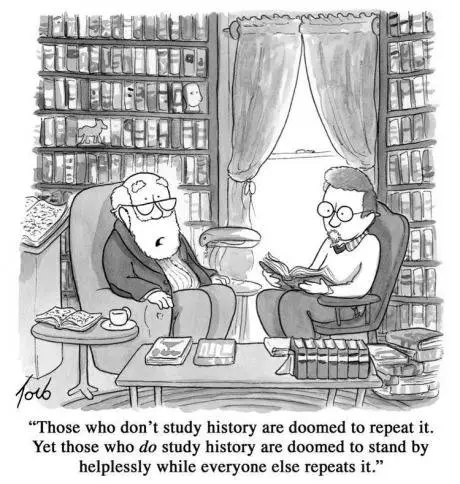
From a historical viewpoint, I always refer to contemporary writers. However, you must keep in mind that history is very often written only by the victor. We all learn quite a lot about history in school, but it is typically slanted. Nevertheless, it is also true that who don’t know history are doomed to repeat it. However, those of us who know history are also doomed to watch others repeat it. Ever since man has done anything, there has been someone nearby going “huh, maybe I should write this down.”
The way to understand the past REQUIRES a discipline that embraces all the fields of science. Back in the 1980s, I attended a lecture by a Scientist on the findings of the ice core samples from Greenland. When they disp[layed a graf of the energy output of the sun and documented from the ice core samples, I was stunned. I approached the presenter and informed them that their chart projected the rise and fall of empires which matched the Economic Confidence Model.
Back in the 1980s, I knew the model worked, but I could not explain why other than simply saying there were cycles. Suddenly, I saw history impacted by weather. I knew the 1906 San Francisco Earthquake set off the Panic of 1907 due to capital flows and that led to the creation of the Federal Reserves with all its branches that operated independently to manage the capital flows internally within the nation.
By keeping an open mind, I began to look at every field of science for explanations. By putting everything together, the picture became focused and suddenly the light went off. The key is being a diverse explorer. School is the opposite. I would go to Physics class and the professor would say nothing is random. Einstein said he did not believe God played dice with the universe. I then went to economics class and the professor said everything is random so don’t bother trying to forecast something. Because it’s random, that meant government could and should manipulate society to eliminate recessions. They have not succeeded in doing so even once