Showing posts with label Greeks. Show all posts

Tuesday, January 11, 2022

January 6th – Greece v Turkey


Another January 6th, 2022 important geopolitical event was the rising tension between Turkey and Greece. There has been an arms race between the two which escalated going into the end of 2021. Turkey intensified the arms race when it asked Biden to buy 40 F-16 fighter jets to upgrade its Air Force. The move coincides with the recent deal struck by Greece to acquire France Rafale jets and frigates. These two nations hate each other since when Xerces invaded Greece and was defeated and then Alexander the Great conquered Babylon. The tensions go back thousands of years but then Turkey became Muslim and now the clash remains also between Christianity and Islam.

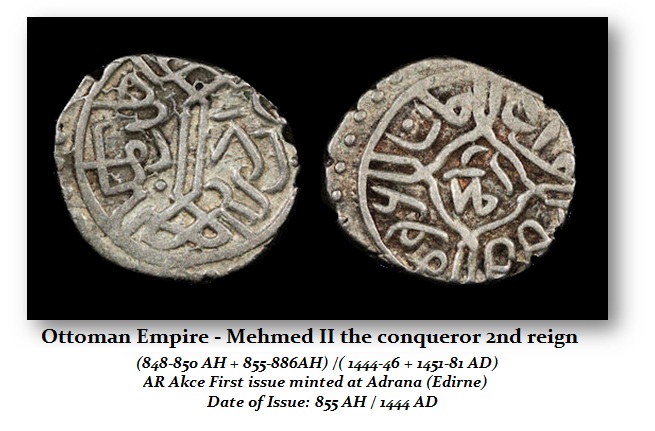
In 1453, the Ottoman Turks captured the Byzantine capital of Constantinople ending the Roman Empire for good. That completed their conquest of this once mighty empire and today we call what was Anatolia Turkey. That established the Ottoman Empire. For the next 400 years, Greece was ruled by the Turks, but Greece always resented their occupation given the history back to Xerxes and Alexander the Great. There were many failed uprisings against Turkish rule over the centuries.

In fact, it took just 28 years for the Greeks to stage their first revolt in 1481. The first uprising took place on the Mani peninsula in 1481, when Korkodeilos Kladas and the fierce Mani fighters rose up against the Ottomans. In 1711, the all-powerful Tsar of Russia, Peter the Great, issued a proclamation calling upon the Greek people to revolt. In truth, the Greeks took up arms against the Ottomans 123 separate times before 1821 and the great war.
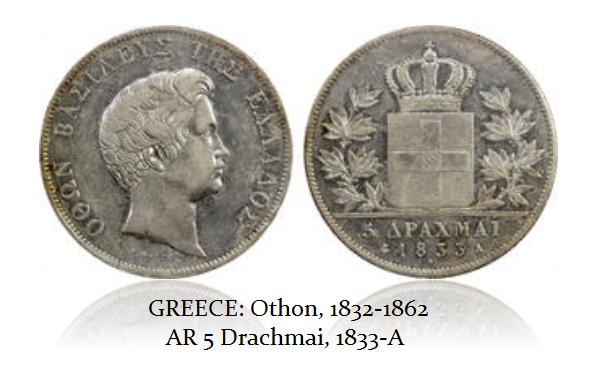
It was 1821 when the Greeks launched a rebellion that would develop into the Greek War of Independence. With the help of Britain, France, and Russia, the Greeks gained their independence from the Turks in 1832. However, the new Greek nation only included a relatively small part of European Greek lands. There remained a large Greek population in mainland Turkey, former Anatolia from ancient times. This fact led Greece to constantly seek to re-take more land from the Ottoman Turks. Multiple wars between Greece and Turkey unfolded, and local Greek rebellions with the support of the Greek government were becoming the norm.

Greek Epirus Revolt of 1854, in which Greek military officers aided the rebels in the Ottoman province of Epirus. This was also part of the larger Crimean War, and the Turks defeated these rebels. The Greek population of the large island of Crete launched many revolts against Turkish rule. There were the Greek Cretan Revolts of 1841, 1858, 1866-1868, 1875-1878, and 1889. All were defeated by the Turks.

A new revolt on Crete broke out in 1896 which led to the Second Greco-Turkish War which is also called the “Thirty Days’ War” of 1897. The Ottoman army re-organized with the help of German advisors. That enabled them to easily defeat the unprepared Greek military. Greece had to surrender some border areas in the peace treaty and were forced to pay heavy reparations to the Turks.

Nevertheless, there was the Cretan revolt, which continued until 1898. That at least forced the Turks to remove their military from the island and set up an autonomous Cretan State, which, while still under Ottoman rule, but was nominally self-governing.

Next came the First Balkan War (October, 1912-May 30, 1913), in which Greece, Serbia, Bulgaria, and Montenegro all combined forces to defeat the Turks. They almost conquered all of the Ottoman Empire’s remaining lands in Europe. This is when Crete became officially part of Greece ending the Third Greco-Turkish War.

This was followed by the Fourth Greco-Turkish War (1921-1922) which defeated the Ottoman Empire in World War One. Greek troops participated in the Allied occupation of large parts of Ottoman Turkey. This is when with the collapse of the Ottoman Empire, Greece launched a full invasion of Turkey. The goal was to re-establish all the former Greek-speaking lands into the modern Green nation.

51.6 years later, the tension rose again this time forming the Greek-Turkish Conflict Over Cyprus in 1974. This became a full-scale war between Greece and Turkey. In 1974, the island-nation of Cyprus was engulfed in conflict when a coup overthrew the government with the goal of joining Cyprus with its Greek majority population with Greece. Turkey invaded northern Cyprus and set up a separate Turkish Republic of Northern Cyprus, a “nation” that only Turkey recognizes.
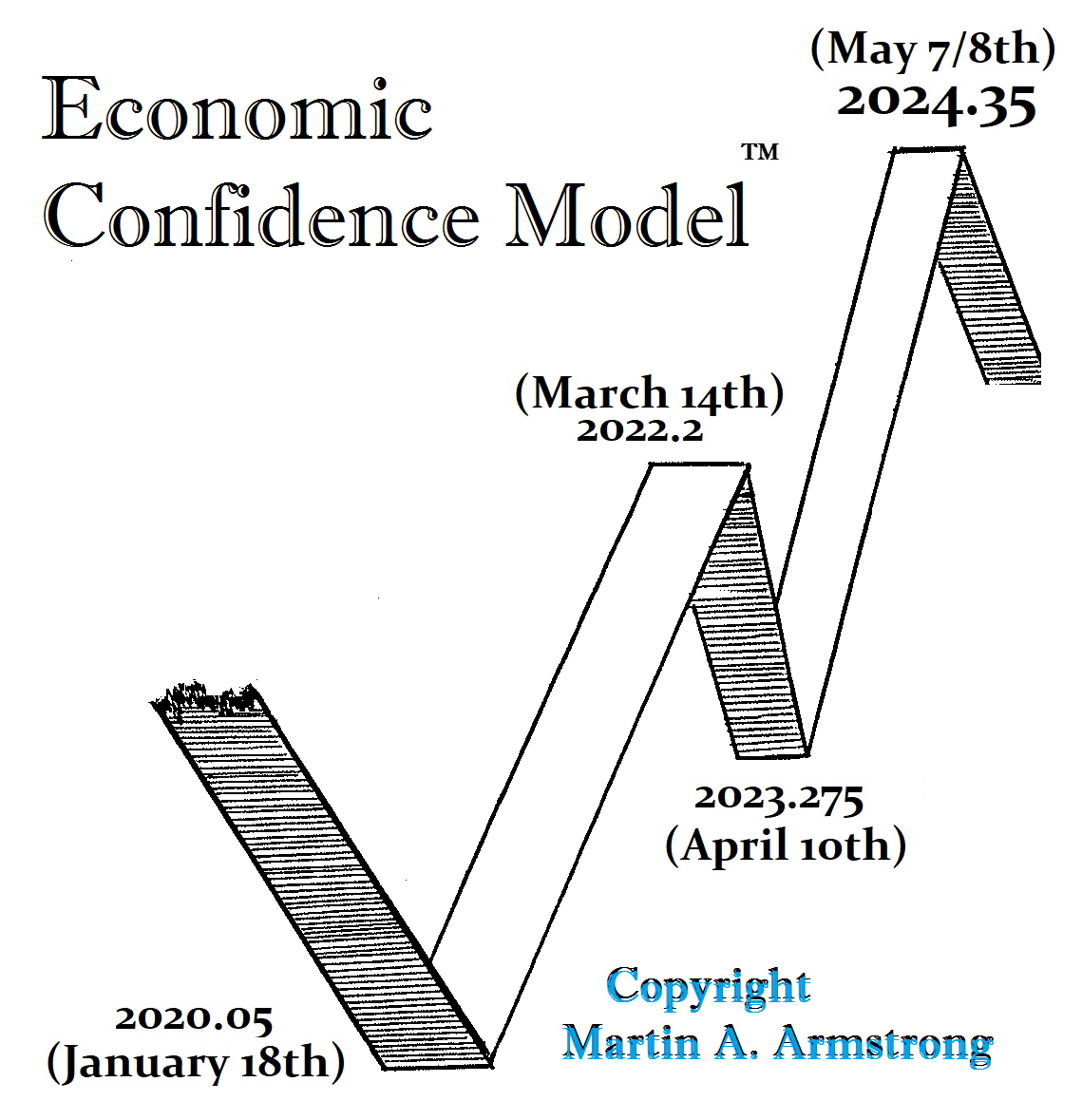
Tensions began to rise with the 2020.05 turning point on the Economic Confidence Model. These tensions are at their highest since 1974 and it looks like war is inevitable once again. Turkish President Erdogan’s re-conversion of the Hagia Sophia to a place of Muslim worship enraged many Greeks, which only exacerbated the economic competition for the oil and gas in the seabed near Cyprus. As the Greek and Turkish militaries face off at sea and in the air on a routine basis.

Here we also have a convergence of many cycles. The next 51.6-year cycle from 1974 events brings us directly to the period of rising risk of international war starting in 2025-2027 time period. This insane climate change policy that is deliberately driving up fuel prices around the world is crushing the third world and there people have far less risk in the face of war compared to the developed industrial nations.

The problem we have is as the economy turns down because of this absurd COVID nonsense that has wiped out tourism, a major income source for Greece and Turkey, hotels are closing and people are unemployed. This increases the tensions for war.

Tuesday, March 31, 2020

Praying to Saints & Gods during a Pandemic


A German cathedral has its collection of remains of St. Corona, the little-known Christian martyr who has been purported to be the patron saint of resisting epidemics. Her name in Latin merely means “crown,” which was an indication that the young saint had achieved the “crown of eternal life” because of the steadfastness of her faith. There is a connection with the coronaviruses, named because of their crown-like structure. So the virus is not named after her and there is not really any connection that can be verified that she is the patron saint of epidemics.

One of the excursions I have made in traveling around the world was to a tiny ancient city of Epidaurus in ancient Greece on the Argolid Peninsula at the Saronic Gulf. This is where people went to pray for their health. They prayed to Asclepius who was pictured with a staff with a serpent entwined which became our medical symbol still today. If you wanted to pray for the health of the community in times of a plague, you went to the temple next door for his daughter, Hygena, whose name is the origin of good hygiene.

Monday, March 16, 2020

Marx v Aristotle


QUESTION: Mr. Armstrong, you said that Marx was influenced by Aristotle. I have never heard that before. Would you care to explain?
HF
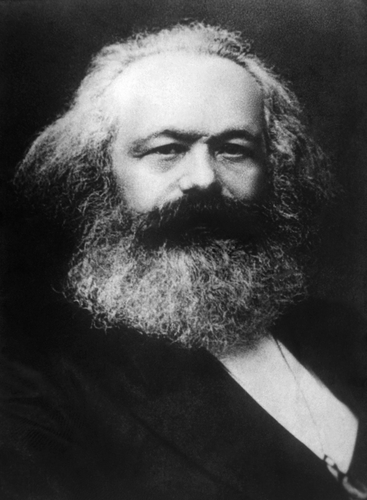
ANSWER: Aristotle recognized that the economy evolves, and to some degree, this also takes place with the generational shift in thinking. Aristotle’s writings actually influenced Karl Marx, for he was complaining about the evolution of Athens’ economy. Aristotle saw that Athens was emerging as the Financial Capital of the World. Athens was experiencing a Market Economy and this altered what I call the Villa Economy.
Traders emerged in Athens and were offering farmers to produce more crops than they needed so they could export them to other regions. This altered society by transforming it into a Market Economy compared to the self-sufficient Villa Economy. Aristotle called these people those who made money from money. Aristotle also wrote:
The life of money-making is one undertaken under compulsion, and wealth is evidently not the good we are seeking; for it is merely useful and for the sake of something else.
    • Book I, 1096.a5
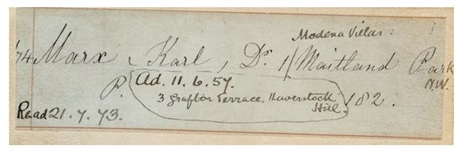
Marx was influenced by this observation which led to his eventual ideas of communism (Villa Economy) against capitalists (Market Economy). Marx was studying Aristotle’s works at the British Library in London.

Wednesday, January 16, 2019

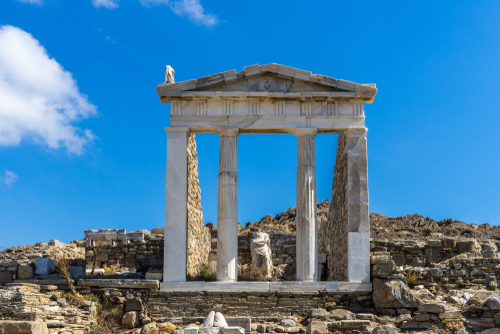
Temple of Delos in Greece.


 Central Banks v Clearing

Delos, First Central Bank
QUESTION: Dear Martin
Wonder if you have any insights as to the history of the bank clearing process.
Was the clearing process created mainly so banks could play games and earn interest with peoples’ money
with the reasoning that it was to prevent money laundering?
With technological advances today, one can accept an hour or two for automatic name and account number checks to happen
but 3-7 days seems ridiculous.
Any insights to the creation of the clearing process would be enlightening.
Thank you again
KW
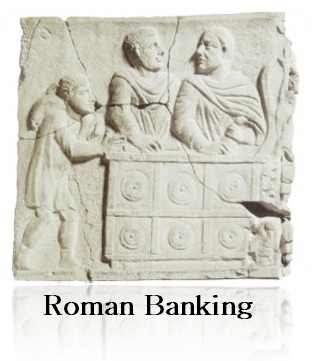
ANSWER: The function of bank clearing began with giro-banking, which originated in the Temple of Delos in Greece. The term refers to the circulation of money. It originated where you could write a check to one person and transfer the payment to their account at the same bank. Effectively, in ancient Greece, you would have an account at the Temple in Delos and instruct a transfer to their account in the Temple. The Romans adopted this concept and thus Roman banking was born.
A central bank emerged after the Dark Ages in the early modern history as a government or state-owned banks. The Dutch were pioneers and financial innovators who not only created this state banking concept, but they also invented insurance. The Wisselbank was the first such bank in Amsterdam which was founded in the Dutch Republic during 1609. The Wisselbank became the model of the central banking system and it spread throughout Europe; first in 1668 in Sweden known as the Sveriges Riksbank and then the Bank of England in 1694.
When smaller private banks began to pop up, the state-owned banks emerged as clearing banks where transfers between the accounts at the central bank took place the same as they did between accounts in ancient Delos.
The Wisselbank actually collapsed in 1790 after it was revealed that the deposits have been used secretly to fund the Dutch East India Company. The manipulation was that they represented themselves as just holding money for safe-keeping. They did not lend money out. So when the bank failed and they had been using the money to fund the Dutch East India Company, the city had to bail out the bank and stand behind the losses.
To eliminate cash, the ECB has a secret project to provide instantaneous transfers for each transaction. Therefore, the central bank was simply a state-owned bank whereas a clearing bank was one where all banks must clear transactions

Wednesday, September 20, 2017

After Rome fell, the financial capitol of the world moved to Constantinople in Turkey, Byzantine Empire then to India.

Cycle of Knowledge

QUESTION: Hello,
I am a French Astrophysicist and I end up watching with great interest a TV story about Martin Armstrong. As a scientist I am really curious and keen to build new connection between our way of describing the Universe and the bias introduced by our own vision and history. Hence I was wondering if the algorithm that Martin has developed was ever tested on human knowledge discovery or if this is something that could be interesting to do.
Kind Regards,
IA
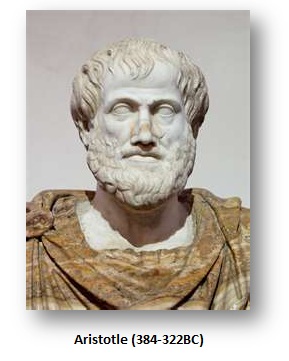
ANSWER: Absolutely. There is cycle to knowledge that I have also encountered and found fascinating. We reach period of knowledge and then we seem to lose it all and reboot. Society before the Dark Age knew the Earth was round and not flat.  For example, if we look at the ancient Greeks, the knew the Earth was round and not flat. They burned people like Giordano Bruno (1548–1600) alive at the stake for claiming the world was round and it revolved around the sun instead of the other way around. The Greek philosopher Aristotle (384-322 BC) argued in his writings that the Earth was spherical, because of the circular shadow it cast on the Moon, during a lunar eclipse. Another reason was that some stars visible from Egypt are not seen further north. Aristotle wrote:
 The evidence of the senses further corroborates this. How else would eclipses of the moon show segments shaped as we see them? As it is, the shapes which the moon itself each month shows are of every kind — straight, gibbous, and concave — but in eclipses the outline is always curved: and, since it is the interposition of the earth that makes the eclipse, the form of this line will be caused by the form of the earth’s surface, which is therefore spherical.
    Again, our observations of the stars make it evident, not only that the earth is circular, but that it is a circle of no great size. For quite a small change of position to south or north causes a manifest alteration of the horizon. There is much change, I mean, in the stars which are overhead, and the stars seen are different, as one moves northward or southward. Indeed there are some stars seen in Egypt and in the neighborhood of Cyprus which are not seen in the northerly regions; and stars, which in the north are never beyond range of observation, in those regions rise and set.
    All of which goes to show not only that the earth is circular in shape, but also that it is a sphere of no great size: for otherwise the effect of so slight a change of place would not be so quickly apparent. Hence one should not be too sure of the incredibility of the view of those who conceive that there is continuity between the parts about the pillars of Hercules and the parts about India, and that in this way the ocean is one.
(Aristotle, “On the Heavens,” Book II, Chapter 14, The Works of Aristotle, Oxford University Press; pp. 297-298.)
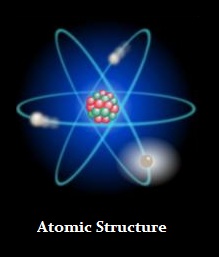
Aristotle, on the other hand, disagreed with the Atomic theory developed by Democritus (460—370 BC) in 465BC. He believed that instead of being matter being made of tiny particles (atoms) that they were all fundamentally air, fire, water, and earth. The Atomic theory was actually first proposed by Leucippus (c 5th cent. BC), and was then adopted by Democritus. The Atomic theory stated that “The universe is composed of two elements: the atoms and the void in which they exist and move.” According to Democritus atoms were miniscule quantities of matter, which he believed could not be destroyed, differ in size, shape and temperature. They were also in constant movement yet could not be seen with the naked eye. He believed that there are an infinite number of atoms.
Then there was the Alexandrian philosopher Eratosthenes (c. 276BC–195/194BC) who actually estimated how large the Earth was. Eratosthenes learned that on midsummer day (June 21) in the town of Syene in southern Egypt, the noontime Sun was reflected in a deep well for it was directly overhead on that one day. Eratosthenes in Alexandria which was about 5000 stadia north of Syene. In Alexandria the Sun on the corresponding date did not quite reach zenith (perfectly overhead), and vertical objects would cast a short shadow. Hence, Eratosthenes calculated that the direction of the noon Sun differed from the zenith by an angle that was 1/50 of the circle, that is, 7. 2 degrees. With this realization, ,Eratosthenes estimated the circumference of the Earth to be 250,000 stadia.
 I have stated before that after Rome fell, the financial capitol of the world moved to Constantinople in Turkey. After the Byzantine Empire fell, that financial capitol moved to India. It was because of the importance of India that Columbus set sail on a mission to India based upon a wrong calculation of the size of the earth. Columbus relied upon the calculations of the earth from Ptolemy. Ptolemy influenced Strabo who in turn reduced the 250,000 Stadia of Eratosthenes to 180,000, and then stated that half of that distance came to just 70,000 stadia, making India reachable by sailing West. So India has played a very important role for Europe bumped into the Americas by trying to sail to India.
This is only one example of how there has been a cycle to knowledge. It is by no means linear. Knowledge is built from experience. Thus, we have to go through the business cycle to advance. This was in part included in Schumpter’s explanation of the business cycle that there are waves of innovation. He did not see what I see studying history that there is also a peak and then a decline to the level of knowledge as well and it is not linear as Schumpter imagined from a small data set.

Wednesday, June 7, 2017

Cliamte change - drove the Greeks out of Greece to become the Sea People and invade the northern coast of Africa


Propaganda About Global Warming


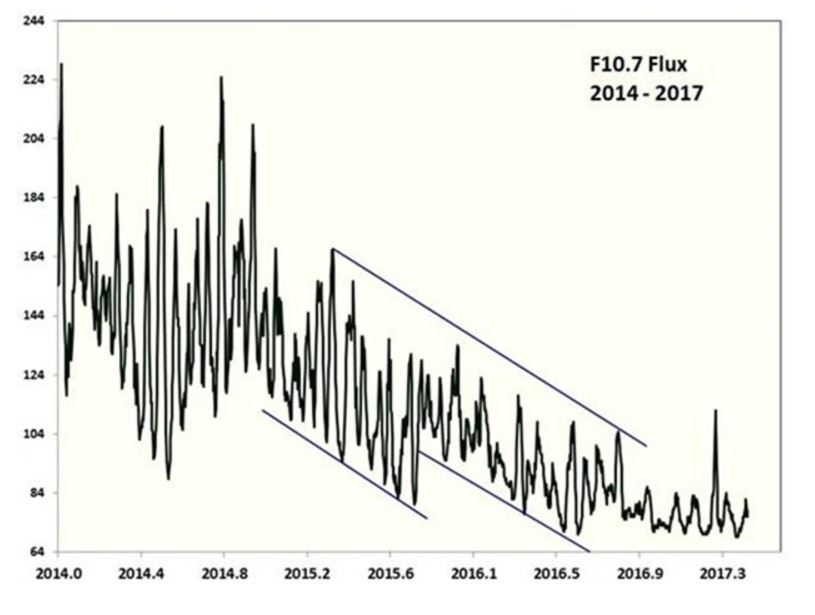
The energy output of the sun I have reported is crashing faster than anyone expected. Normally, when the cycle has changed from global warming to global cooling, it has tended to be more gradual. It appears the energy output of the sun may be now making 100 year lows. We have see food shortages in Europe and several very cold winters there. The North Pole has also shifted direction in 2000 and has been moving toward Europe at 55km annually, also a speed never seen before.
So while every is crying about Trump pulling out of the Paris accord, it should be noted that they would not allow anyone to speak there who disagreed with them. This is no longer about science. Global Warming seems to have crossed over into some sort of religion and nobody is will to even look at the data which shows them there is something much larger at stake going on here – the nature of cyclical activity. Dark Ages have taken place also in union with this type of crash in the energy output of the sun. It drove the Greeks out of Greece to become the Sea People and invade the northern coast of Africa.
The Biblical Philistines were not barbaric in the least and that seems to be the interpretation of the victor not the truth. New findings have most likely solved the mystery of the Philistines’ origins. They were among the famous Sea People who arrived in the Levant in the 12th century B.C. fleeing from Global Cooling, as recorded in Egyptian accounts. They settled between the Israelite tribes to the east and the Egyptian empire to the south. Excavations at several of these Philistine cities have revealed that their red-and-black ceramics pottery is striking similar to the styles of the Mycenaean Greeks.
They say that history is written by the victor. That is very true. Right now, the Global Warming crowd has convinced the world it is once again linear and flat denying the evidence of the cycles of the cycle of this planet.
This is another reason they want Trump’s head on a platter, but served cold not warm

Wednesday, January 4, 2017

Minoan collapse was instigated by one of the largest volcanic eruptions in history — Thera (Santorini)

Bonds & Climate Change

ubcbt-q-1-2-2017-gmw
QUESTION: Mr. Armstrong; Your Global Market Watch picked the high in bonds perfectly and called it a major high. I have to say, the system you have created monitoring everything is an incredible teaching tool. I can see what you are saying. There is a major global trend that politicians cannot alter and that is why communism fell and socialism is falling now. Do you believe we can advance this time around when it crashes and burns?
Thanks
BM
ANSWER: Believe it or not, I am an eternal optimist; foolish at times. I gave up trying to help behind the curtain because I came to witness how politics works. You can tell a politicians to do this or there will be a crash. They will not listen for a simple reason. No politician can run for office saying, “Vote for me, I saved your job.” You would ask, “How do I know I would have lost it?” Politics is about winning. It is far better to run for office by promising change but never delivering. The political situation is simple. They like the crisis for then they launch investigations to get the guy who caused it. They will never prevent it, for that does not have the same impact at the polls.
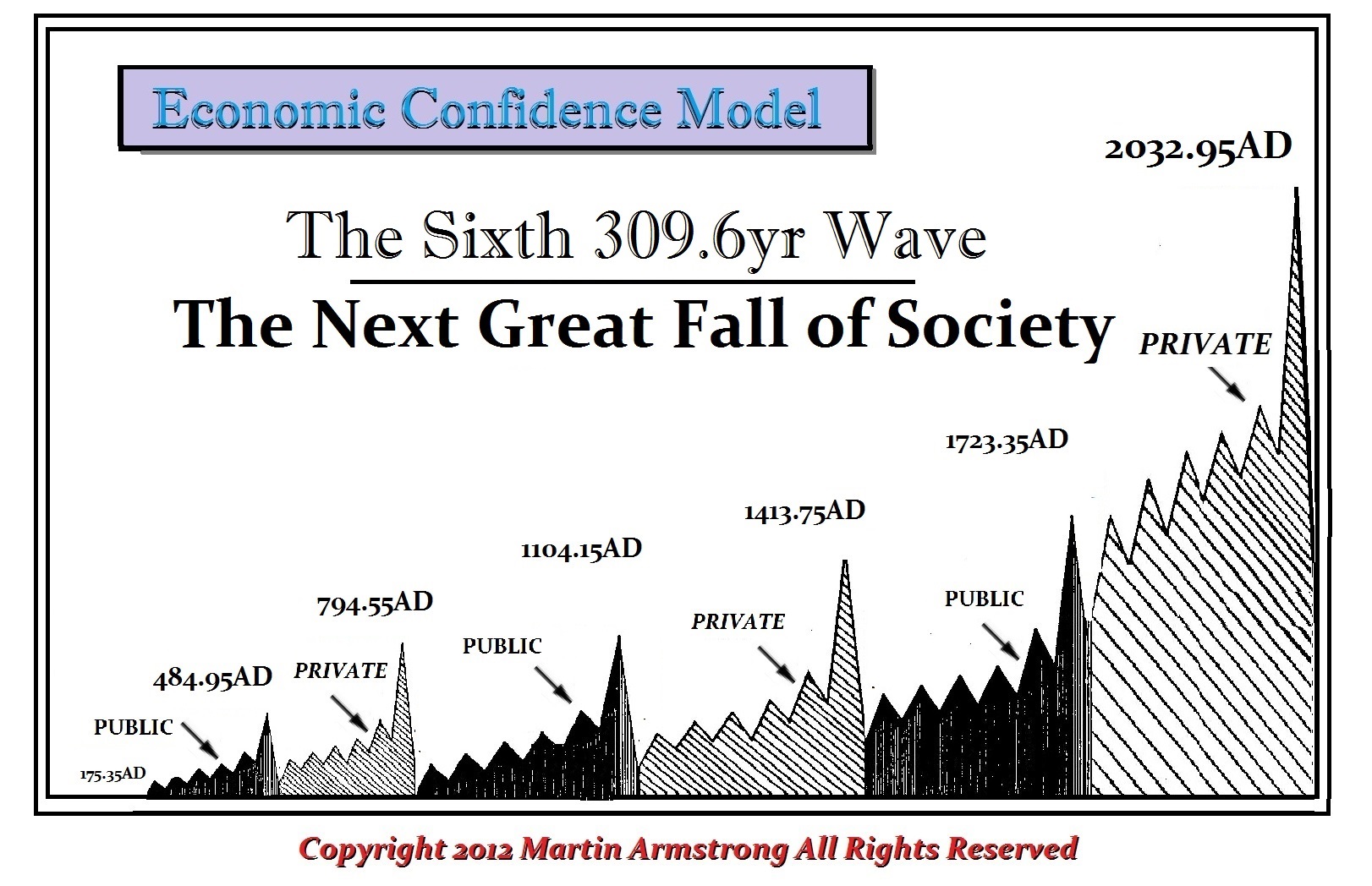
sixth-wave-ecm-2032
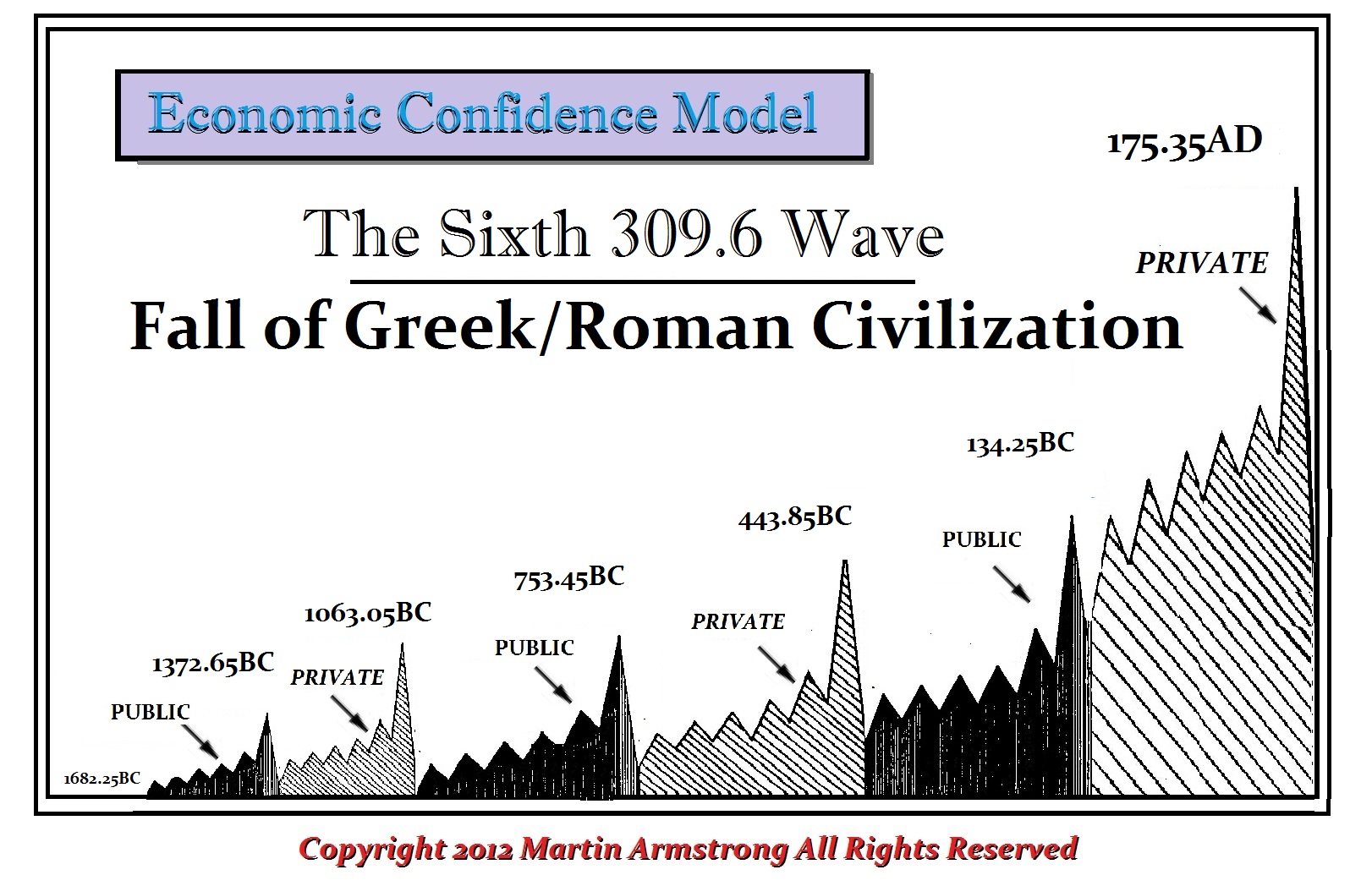
Society goes through these convulsions roughly every 309 years or so. They build in intensity and that is what we now face — the Sixth Wave. On the cyclical time line, we are at the point where the collapse of Rome came about with the Sixth Wave back then.
sixth-wave-ecm-greek-roman

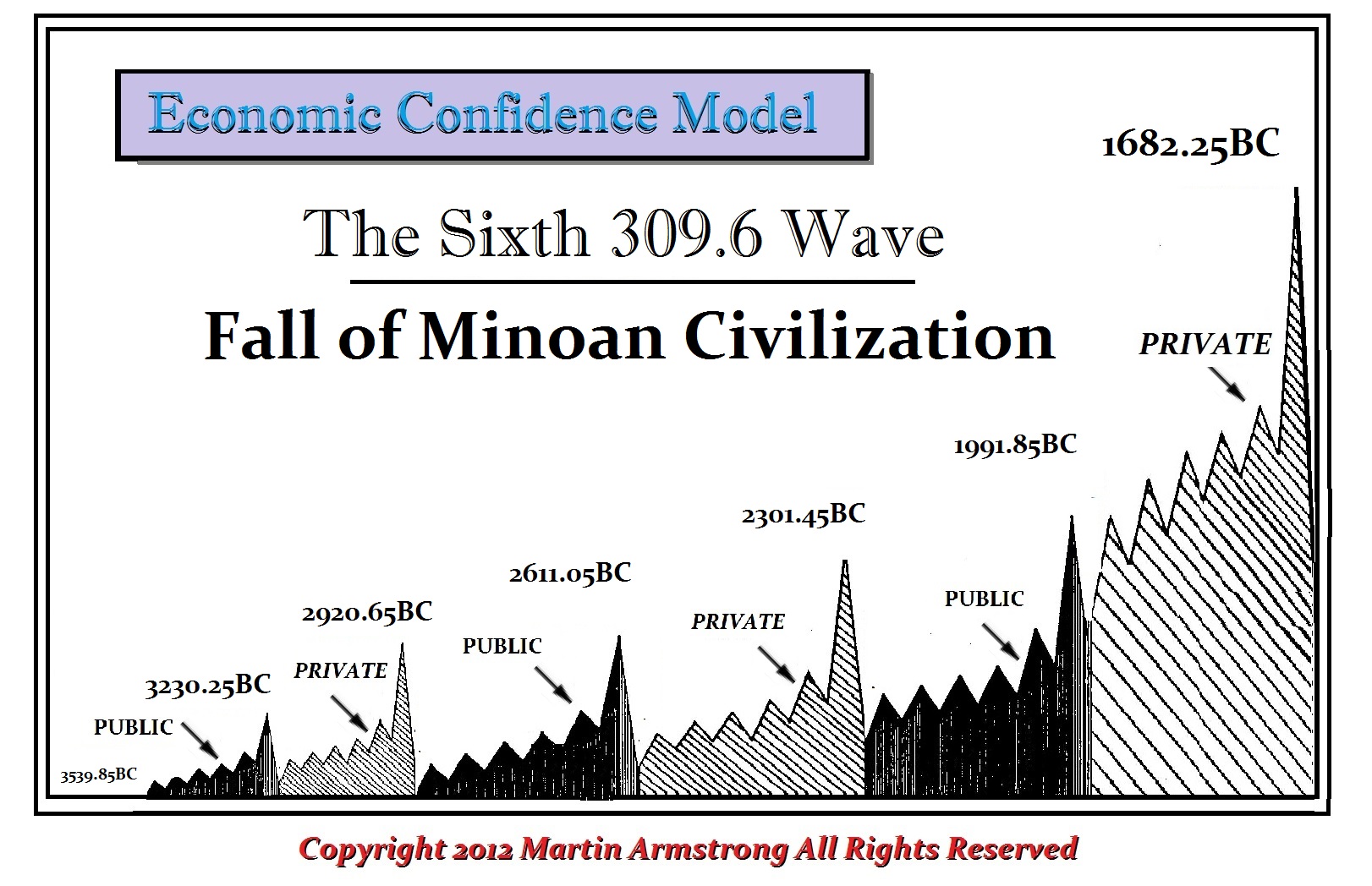
Before that, there was the Minoan Collapse.
sixth-wave-ecm-minoan
This is the third major wave. Either we go into a Dark Age, as took place after the last two groups, or we advance. I would like to think we can do this and reform the way things work. Maybe I am just wrong and we will fail. I realize the only way to take that one giant leap for humankind is if the PEOPLE understand why we never advance and say enough is enough.
So the more people we can move to understand the business cycle and DEMAND change, the better chance we have of taking a leap forward instead of backwards.
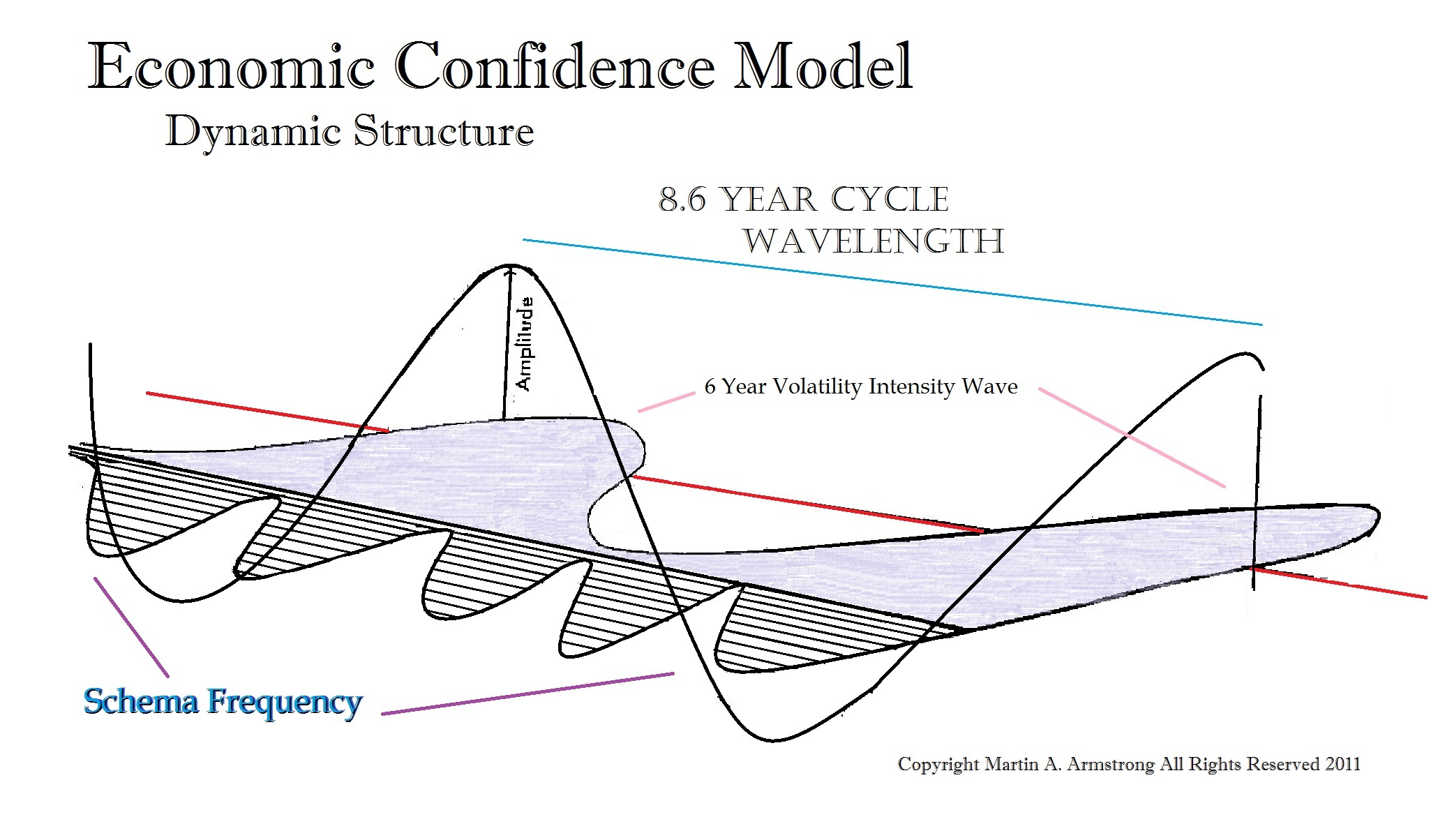
ECM-Dynamic
The ECM will still exist. We cannot alter that. The volatility (intensity) we can influence perhaps. Of course, the Minoan collapse was instigated by one of the largest volcanic eruptions in history — Thera (Santorini). The fall of Rome came with climate change when everything turned down much colder and resulted in the invasions of the barbarians who were migrating South.
global-warming-cyclical
These groups of Six Waves tend to coincide with the collapse in the energy output of the sun. The climate change we are heading into is by no means global warming, it is back down to record cold. That is not good in the least for civilization.